poetry, Uncategorized

Hemingway’s Distance

 When the great author of The Old Man and the Sea was in Michigan, he wrote about Paris. Likewise, when he was in Paris, he wrote of Michigan. In speaking with other poets and writers, I have found there to be a common link among creative types: The farther (in every sense of that word) we are from our dearest subjects, the stronger our writing about it becomes.

For instance, when I return to my family homestead many miles south of here, I am not automatically inspired to compose lines about it. The spirit of the place is too strong, too close. Also, the peace I experience there is too great for the fevered activity of poetry composition. The old place’s effect is soporific on my muse, but once I’ve left and I’m on the road or even back at my current suburban home, then the poetic flood begins to rise. Images, sensations, memories, and the whole of the family farm experience (past or present) sets itself heavily on my writing mind.

Time also serves as a literary “distance” filter: Consider Wordsworth’s famous lines above Tintern Abbey, written five years after the visit took place. By having hindsight, the truest and most poem-worthy elements of an experience can rise like sweet cream to the surface of our consciousness. The traumas and impressions of the present are intensified by having some chronological separation. Only the strongest details remain after delay. Sometimes this separation can be mere hours, other ideas may require years for processing. It all depends upon the severity and sincerity of the inspiration in question.

I am not advocating the idea that writers shouldn’t “strike while the iron is hot,” however. If one is overcome by the NEED to write at a moment, then by all means, don’t let that desire cool in apathy. The Beats would tell us that our first thoughts are our best thoughts, but the discerning voices before and after that generation would advise us to refine those first thoughts into something far more elegant.

The big picture is just this: If you want to create truly reflective writing, then some form of distance is necessary. It doesn’t always have to be as radical as Michigan to Paris, but stepping back from the subject is advisable for any creative endeavor. If you don’t believe me, just ask “Papa.”

poetry, Uncategorized

Integrity: When did it stop mattering?

 Recently, I’ve had more than one run-in with editors and publishers who say they’ll do one thing, and then they don’t. It’s disappointing, not only because my work hangs in the balance, but also because their behavior is indicative of a much larger cultural problem: the loss of character.

At one time, those who broke promises and failed to meet their obligations were castigated by the larger whole of society. People operated with the expectation that when someone said they would do something, it would indeed be done. Accountability was high, and our products and businesses reflected the ideals of quality and honesty. Contracts were a mere formality. But this post is no rant in favor of regression or even reminiscence. It’s a call to activation and engagement.

Today, integrity has become a buzzword for political campaigns and other self-enhancing promotions. We have handed over the mantle of consumer advocacy to organizations and  toothless watchdogs who, in turn, also serve themselves more than the concerned individual. Those who speak up and voice their frustrations are seen as rude or strange, and all the while competitors abroad are seizing on our loss of commercial moral fibre.

Here is my promise to you, readers: I  am awaiting word from at least three different literary magazines that have failed to make good on their publication promises. They have repeatedly missed deadlines, and their response to these infractions has been a sort of beligerent indifference laced with adolescent-sounding excuses. If these editors and publishers continue to fail in the fulfillment of their duties, I will happily publicize their lack of integrity, not only here in this little blog, but also through Duotrope, Submittable,  and other writing-submission-related sites. I do this not out of mean-spirited blackmail, but out of respect for other writers and creators who deserve to have their work treated with professionalism.

Again, I am disappointed that my encounters with these magazines has had to take such an ugly turn. A little bit of character and communication could have gone a long way, but instead, I’m left now with the job of staging a one-man rebellion. I would ask you to join me in this fight. No more laziness, no more dishonesty, no more apathy. It’s time to regain the sense of right that we once demanded. Today is the day to begin.

poetry, Uncategorized

Making “the Small Time”

Last night, I was privileged to attend Writer’s Harvest 2012, an event at University of South Florida. People paid $5 at the door, or brought three canned goods to help feed the hungry. In exchange, listeners and participants got to hear readings from the likes of Jeff Parker and poet Traci Brimhall. The hall where the event was being held was standing-room only. Of course, this was in Tampa, where the literary arts have a pretty loyal following.

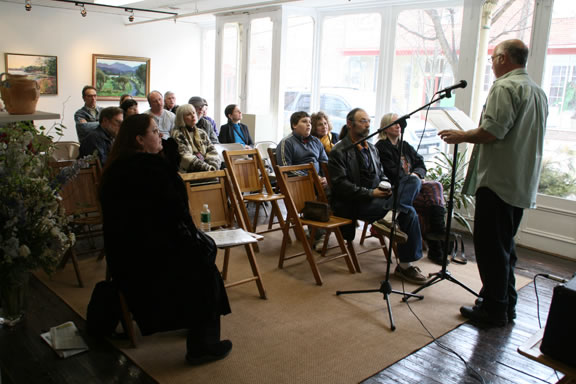
In smaller towns like mine, poetry readings are generally greeted by a handful of patrons who feel an “obligation” to support writing and culture in general. That being said, these “few but proud” gatherings have their own unique benefits. For one, small gatherings allow greater intimacy with the work presented. The poet can speak about the writing and be understood well, and usually, the readings are far more personal. Addressing a hall full of 500 people might be a rush, but it loses some of its closeness. Both the work and the artist are “drowned out” somewhat by the environment.

Comparing venues and styles of presentation caused me to think a little about the up-and-comers (like yours truly) who have to fight for their space in the limelight. Library and coffeehouse readings are great, and having a loyal little flock appreciate your work is nice. But at the end of the day, making the small time is exactly that — small. We poets are not unlike aspiring country crooners: Like them, we have to “pay our dues” in the dives and the honky-tonks of literature — the shabby cafes and tiny conference rooms where a handfull of people can begin to spread the word.

There are no backlit marquees or laser-printed fliers proclaiming the greatness of the small-town writer. This is why so many scribblers migrate to locales like New York City, where, with any luck, one’s work can be heard and experienced by larger crowds and potential game-changers for one’s writing career. However, throwing fate to a place populated by similar dreamers and doers has its own hazards. All of the old “fish bowl” cliches have some element of truth; one can be a big fish in a small pond or a smaller fish in a larger pond. It depends on your desires.

Personally, I would prefer not to be a fish at all. I write because I like to, I read because I love the music of language, and I appreciate people who appreciate my work. Whether that’s a crowd of 5 or 5,000, I’m simply happy to be the attended voice. Yes, I’d like one day to move beyond “the small time,” but for now, with my situation in life, I’ll take the sporadic applause of a few over the ovations of masses. There’s time for both yet.

poetry, Uncategorized

You win some, you lose some…

Some days you have to ask yourself, “Is it really worth it?”


Recently I received a letter in the mail informing me that I had (yet again) not been selected as the winner of a recent writing contest. Not a great surprise; I’m pretty used to getting bad news from publishers. This particular one, though, had my hopes really high — the contest judges were known for favoring my type of poetry, I had closely studied past winners and their work, and in general, I had prepared myself to take on this contest with the dead-level best of my abilities.

So much for that. In response to this letter, I took some of my own advice and revamped the manuscript, added in newer, even more high-quality works where they best fit, and spruced up the formatting a wee bit. I don’t anticipate that these changes will ensure my victory over 500 or 1,000 other entries, but at least I feel better about the whole situation. I am, by the way, submitting the manuscript to two other contests in response to this news also. Down, but assuredly not out.

I suppose the point of this post is, if you’re going to be a poet, you have to take the bad with the good. As my mentors would say, be persistent and don’t get discouraged. When you know your work is good, it’s bound to find a home somewhere. Pardon me while I go get this beautiful collection ready for its next journey. I’ve got work to do.