life, publishing, writers, writing

My Grandmother’s Upcoming Birthday: A Reflection

We always picked on my grandmother about her birthday falling on the day after Halloween. One year, she got a leftover witch cake from the Publix bakery to help her celebrate. Of course, she also claimed that All Saints Day was fitting and appropriate for her birthday — “I’m a saint, after all,” she would say, winking at whomever she was talking to.

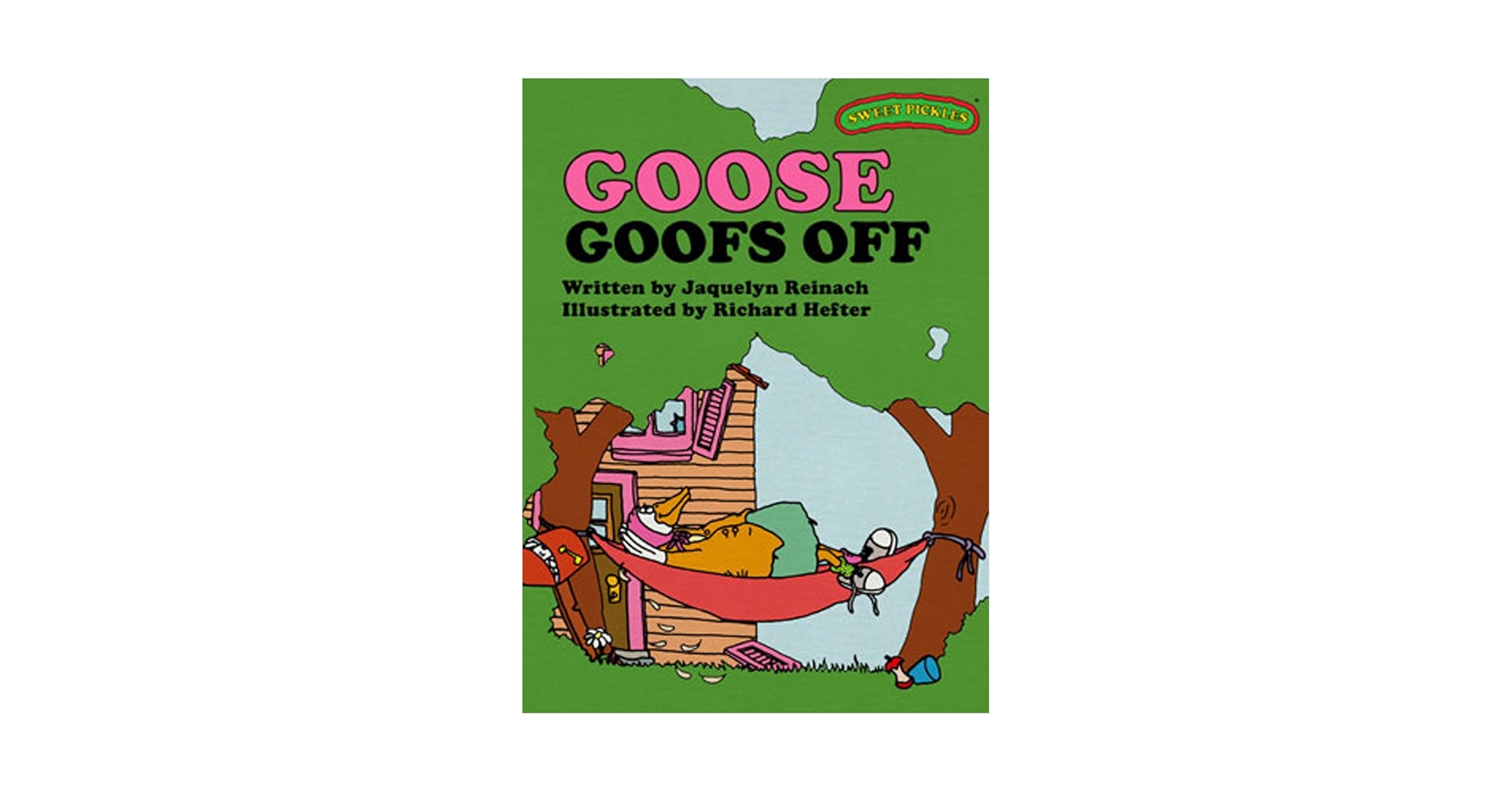
My grandmother was one of many family members who introduced me to books and a love of reading at an early age. Every day at my appointed toddler nap time, she would read me the same Sweet Pickles book: Goose Goofs Off. It was about a goose (shocking, right?) who decided to put off doing all her chores. The procrastinating protagonist’s classic line was: “I’m taking it easy today; I’ll do it tomorrow.” Her laziness creates havoc in the story, causing a mailman to slip on ice cream among other mishaps. But in the end, Goose’s neighbors are kind to her and allow her to join their party, despite her sloppy work ethic.

How my poor grandmother did not tire of this story I’ll never know. But the daily reading of it became ritual, like church on Sundays or bath-time before bedtime. And her reading was expressive, engaging, and funny — a happy preamble for midday sleep. Occasionally, she might read me other stories during parts of the day that were unoccupied by Play-Doh art, Bob Barker’s “The Price is Right” (which I called “the come-on-down show”), or playing outside. But Goose? She was a sacred landmark in our days at home.

In 2011, my grandmother passed away, but her legacy of loving literature lives on. This Saturday, the day after Halloween, on what would have been my grandmother’s 104th birthday, my middle-grades novel, Vidge Floyd and the Secret Frequencies, will be released for sale. I cannot think of a more fitting date for this book to come into the world. It will be available as a paperback, in hardcover, and as an ebook (a concept my grandmother would have mistrusted at first, loving traditional books as she did). In fact, you can preorder the Kindle version of the ebook here: Vidge Floyd and the Secret Frequencies. Honestly, though, I think my grandmother would like for you to wait on the “real” book — one that can go in your bookshelf or on your nightstand. And who knows? Maybe this fun fiction debut will wind up becoming a favorite of a young reader in your family. She’d like that, too.

life, poetry, publishing, writing

A Sneak Preview and a Bit of a Rant

Photo by Ray Bilcliff on Pexels.com — Beautiful native Florida as it should be.

My newest poetry collection is in the hands of many potential publishers: Small presses, contest judges, and university press editors are all considering it as we speak. I’m especially proud of this one. Its quality, organization, and message make it a strong book, and once it’s out in the world in its finished form, I feel certain that it will make a difference. One of its prevailing themes is land loss. The question many of the poems attempt to answer is this: What do we lose when native acreage in its natural state becomes housing developments, mining leases, or euphemistically named “solar farms?”

Here in Florida (and in the southeastern U.S. at large), more wild spaces are being pushed out in favor of generic, boxy homes with zero lot lines and oppressive HOAs. Subdivisions aren’t the only culprit, but they are the ugliest. And this isn’t a new occurrence, of course — Big developers and other commercial interests have been devouring woodlands for decades. But now more than ever, as country disappears, we are also losing its customs, practices, understandings, and the pioneer breed of people that once thrived amid an untainted Sunshine State. Historic greenspaces are being eradicated, and with them, the common sense one needs to live within an unbridled ecosystem, one replete with unique animals, plants, and bodies of water. In this way, Florida is a microcosm of our nation’s lower-right region, where woods are increasingly shoved aside so that more dull concrete monoliths can rise.

Readers who know me understand I do not consider myself an environmental crusader. I would call myself moderate when it comes to “green” causes. I believe in a healthy balance of business and conservation. But as my beloved state deforms into a hideous plain of beige construction and shiny black panels, I cannot stand idly by. We turn to poetry when significance demands it: funerals, weddings, commemorations, and similar occasions. Now, we need it to stand up and register an emphatic rejection of bulldozers and big money. Narrative is a powerful weapon, and the small poem-stories within my latest book comprise an arsenal. They commemorate and celebrate a place and people we are losing. They preserve the diligence and ingenuity of past generations while offering an objective look at our asphalt-smothered present. And they cherish a way of life that some may consider rustic, even quaint.

Nonetheless, these poems are needed for our times. What better way to pedestal a crisis than by expressing it in the one form closest to the sacred? Though some may say that poetry is a rarefied art enjoyed by a slim minority, it is also true that this genre is the one most sought after in our inherently human moments. As earth and knowledge perish in the name of “growth,” crafted language is one part of a much larger solution. My hope is that this book provides an emotional journey rather than a sermon. And when the reader finishes the final page, perhaps some inchoate desire for a purer land, one closer to our ancestors and our Creator, will take root.

Uncategorized

World Poetry Day, National Poetry Month, and New Opportunities

As World Poetry Day arrives (today!), and National Poetry Month waits just around the corner (April), I thought I’d offer a brief missive on literary matters both personal and universal:

Most people are poets to one degree or another, though some don’t like to admit it. When you walk outside and feel the temperature in the morning, your response to it is the beginning of poetry. The texture of the air on your skin, the combination of sunlight, birdsong, and environmental noise, and the state of the world around you (your seasonal lawn, the road nearby, the leaves that have fallen on your driveway)…these things are the earliest signals that your mind wishes to celebrate life by composing a poem. Most people immediately shut down this impulse with negative self-talk: “I’m not a poet,” or “That’s what somebody else would do,” or “That stuff’s too deep for me.” The truth is, we all want to record and respond to the world around us in artistic words; some folks just lean into that longing more than others.

There’s also that dreaded mental reservation called imposter syndrome. “I don’t know enough/haven’t done enough/can’t compete with experts” hinders so many earnest efforts. Nobody is the greatest at something the first time they try it, and there are plenty of metaphors and parables extolling the virtue of practice and patience. Being unwilling to try something because of initial frustration is ordinarily a child’s reaction, but in the adult world, too many creators quit before they’ve properly begun. Nowhere is this fact more evident than in poetry — the persistent thrive, even if they aren’t that great.

I won’t name names here, but walk into your mainstream bookstore and you’ll find the one shelf called a “poetry section” filled with poorly designed and badly written tomes by people whose greatest claim to fame is that they’ve penned trite cliches or radical malarkey for the last 25 years or more. And those “books” are placed alongside Dickinson, Shakespeare, and Frost. This literary injustice is a turnoff to those who may be considering writing well-crafted verses of their own, and it should be. But this sad fact should also be a motivator for producing better work for our current age. Make poetry great again!

So, how do we overcome a closed mindset regarding poem writing? The first step is to get inspired. Sometimes a little help can go a long way, and toward that end, I recently began a new mini-workshop by mail called “Metacreativity: The Process Behind the Poetry.” In this monthly letter, I offer one poem of mine, the backstory behind it, and the process it went through before becoming its final version. Sometimes seeing into someone else’s creative process inspires others to use their own, and this little communication allows readers to do exactly that. I also include a more traditional poetry prompt in every letter, and sometimes I add a QR code that links to an audio recording of the monthly poem. I also include news about my upcoming appearances, book signings, and other events when appropriate.

I’d love to add more subscribers to my growing roster for Metacreativity. Now more than ever, we need fresh voices putting more relevance into our world through poetry. And as celebrations of poetry begin in this first quarter of 2025, I hope you’ll join me in spreading good words. Whether it’s buying a fresh book of poetry or trying your hand at a sonnet, spring is a perfect time to appreciate beautiful language.

life, poetry, publishing, writers, writing

Radio Silence and Big News!

To my subscribers, friends, and fans: Sorry for the notable quiet over the last few months, but I’ve been hard at work on something new and fantastic which I’m sure you’ll enjoy. Read on…

My newest poetry book manuscript has at last come together, and I’m delighted with it. Featuring many poems that have been previously published in esteemed journals like The Common, Tupelo Quarterly, and elsewhere, this (currently) 70-page collection represents a return to themes that deserve further exploration: History, Work, Upbringing, Fatherhood, Maturity, Nature, and Faith all make appearances as they have in previous collections of mine, but this time, there are added bonuses. Without saying too much, I can promise you that there is something in this collection for everyone.

I am presently querying publishers and seeking the best fit for this newest book, and as soon as I’ve reached an agreement, I’ll be sure to post the good news here. For now, I’d like to wish everyone a happy National Poetry Month! Keep reading, and thank you for your support!

This year’s National Poetry Month poster from the Academy of American Poets
poetry

With Appreciation

Gratitude for people who read well…

In basic creative writing classes, instructors often begin by telling students to consider their purpose and audience. This is good advice, mostly, since lacking a “why” or a “who” is a surefire way to write something empty. But today I wanted to take a brief minute to examine the latter of these two fundamentals and express a quick word of thanks.

You see, a poet’s audience is a funny thing. We know that most modern people would rather not trouble their brains with meaningful imagery, earnest emotions, or contemplative thinking. We press on, though, continuing to write words that have inspiration embedded into every syllable, hoping that a select few will feel the richness and depth of revelations we record. We envision a reader who takes the time to truly decode every line, every stanza. We might even daydream about how this poem would be analyzed in an English class one day. And it is these aspirations that keep us doing what we do.

You, dear reader, are a part of that audience. You are among a handful of people for whom I write poetry. Even if you only scan poems for strong or relatable moments, even if you don’t closely inspect every page of my latest book for symbolism or graduate-level literary devices, and even if you only read poetry to fulfill an imaginary cultural expectation, I still write for you, the person who cares enough about language and literature to sit down with the challenge and delight of poems. You are rare and valued, and I care what you think.

So, to all of you who have bought my book, expressed some kind words in a review at Barnes and Noble or Amazon, or passed along word to friends or family, I thank you for being part of a small but vital audience. We need more like you.

poetry, Uncategorized, writing

How to Add More Poetry to the Holidays

Once in a while at this time of year, workshop participants and seminar attendees express a desire to integrate poetry reading into their holiday celebrations. There’s a fine tradition of reading verses at Christmas get-togethers, and it dates back centuries. As we get more high-tech and less connected to the old ways, events like reading “A Visit from St. Nicholas” can restore in our homes a generational bond, and a continuation or a renewal of tradition.

But we don’t have to limit poems to old standards; even newer poems and those with remote connections to Christmas can have value and add a fun, unconventional event to parties and family gatherings. For this post, let’s look at two poems that could give guests something meaningful and memorable:

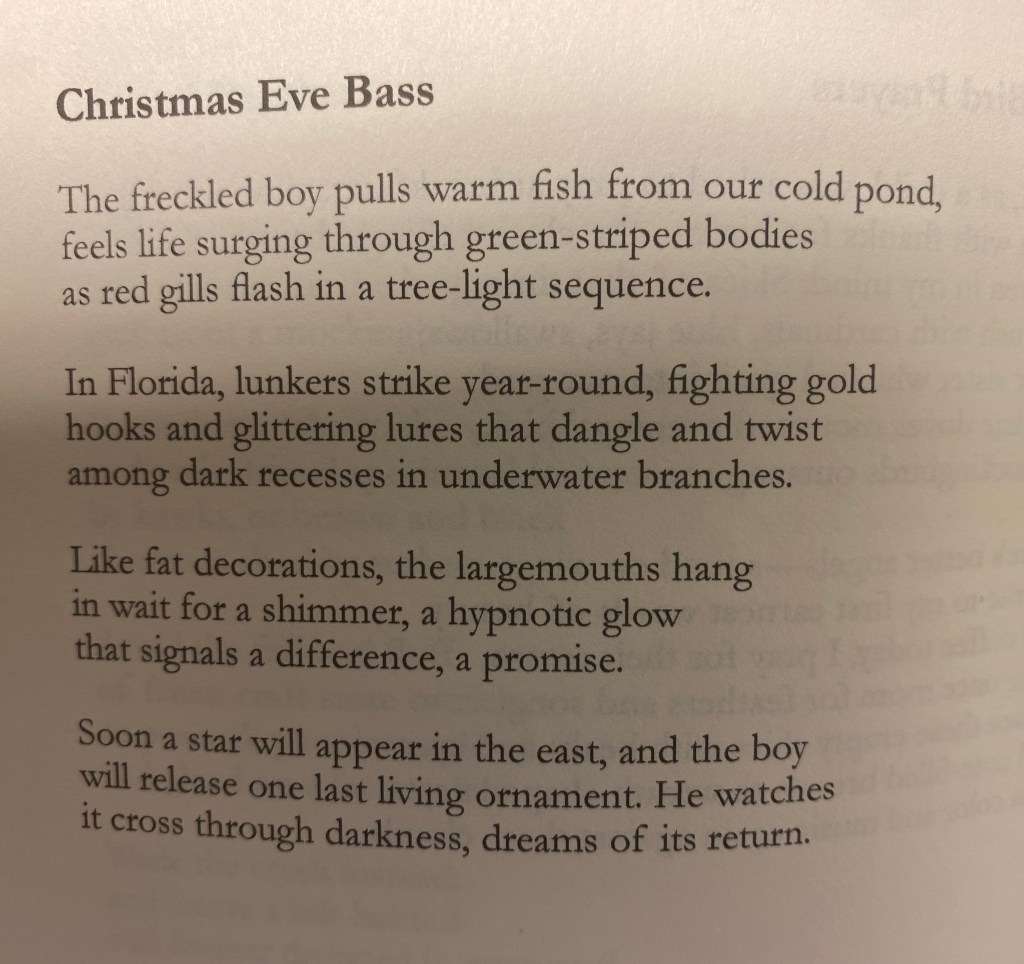
This poem appears in my latest collection, The Places That Hold. And while it isn’t a formulaic holiday poem, it uses lots of Christmas imagery and takes place on Christmas Eve. It’s a good one to read at occasions where anglers and outdoors-folk are present.
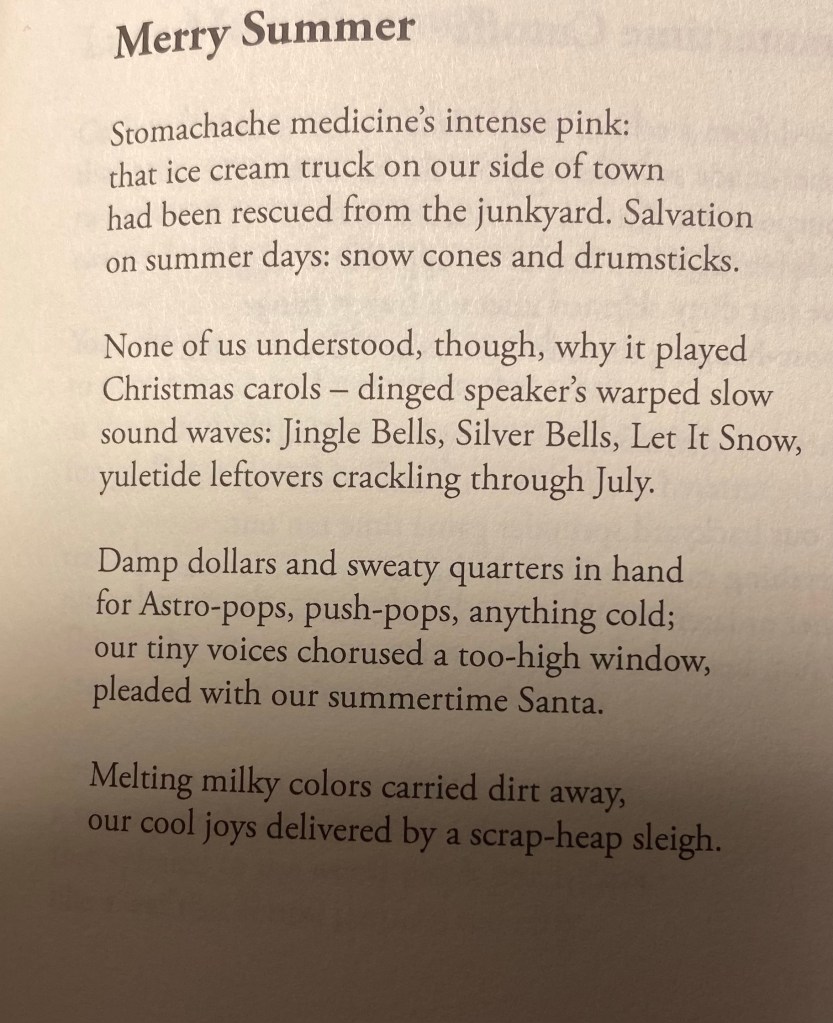
This poem, actually set during the hotter months of the year, uses Christmas carols, Santa, and strong nostalgia. It appears in my third collection, Middle Class American Proverb. It’s a good one for Florida Christmases that can occasionally be hotter than those elsewhere.

Now is also a good time to mention that books of poetry, usually slimmer and more travel-friendly than prose books, make great stocking stuffers. There’s always someone in our circles who is resolving to read more poetry in the new year, and the books linked to above will provide hours of truly engaging reading. Help make a poet’s Christmas brighter, and purchase copies for friends and loved ones! I am grateful to all of you, readers and followers, and I hope this season treats you well.

poetry, Uncategorized, writing

How to Add More Poetry to the Holidays

Once in a while at this time of year, workshop participants and seminar attendees express a desire to integrate poetry reading into their holiday celebrations. There’s a fine tradition of reading verses at Christmas get-togethers, and it dates back centuries. As we get more high-tech and less connected to the old ways, events like reading “A Visit from St. Nicholas” can restore in our homes a generational bond, and a continuation or a renewal of tradition.

But we don’t have to limit poems to old standards; even newer poems and those with remote connections to Christmas can have value and add a fun, unconventional event to parties and family gatherings. For this post, let’s look at two poems that could give guests something meaningful and memorable:

This poem appears in my latest collection, The Places That Hold. And while it isn’t a formulaic holiday poem, it uses lots of Christmas imagery and takes place on Christmas Eve. It’s a good one to read at occasions where anglers and outdoors-folk are present.
This poem, actually set during the hotter months of the year, uses Christmas carols, Santa, and strong nostalgia. It appears in my third collection, Middle Class American Proverb. It’s a good one for Florida Christmases that can occasionally be hotter than those elsewhere.

Now is also a good time to mention that books of poetry, usually slimmer and more travel-friendly than prose books, make great stocking stuffers. There’s always someone in our circles who is resolving to read more poetry in the new year, and the books linked to above will provide hours of truly engaging reading. Help make a poet’s Christmas brighter, and purchase copies for friends and loved ones! I am grateful to all of you, readers and followers, and I hope this season treats you well.

life, poetry, publishing, teaching, Uncategorized, writers, writing

Where Do You Get Your Ideas?

The title of this post is a question I often receive. Whether it’s in a writing workshop, a traditional classroom, or simply in casual conversation, people regularly inquire about the origin of creative ideas. Second only to this question is, “What do I write about if I’m not inspired?” Today’s post is an effort to answer both of these common quandaries with a single practice: Socratic Journaling.

Anyone who has spent a moment or two in school knows about the Socratic Method — that time-honored practice of invoking thought through questioning. First mastered by its namesake, Socrates, the method has served educators well over the years. And even today, we can use it to generate great ideas and to “get unstuck” in creative writing using a technique I pioneered over the course of 15 years.

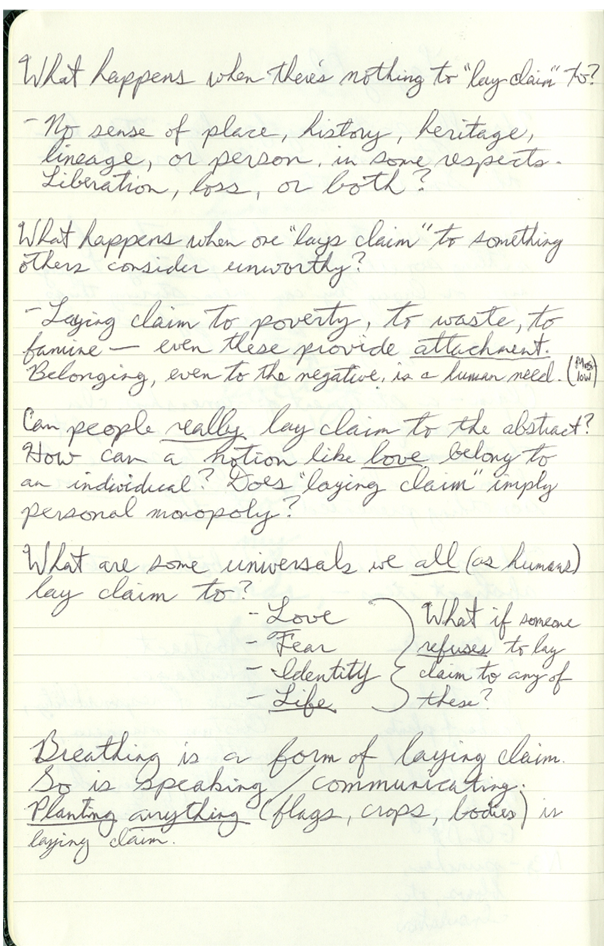
Socratic Journaling works like this: A writer begins with a “big” question (ideally, this should be one that is fairly philosophical or abstract) and answers it swiftly, almost without thinking. That fast answer then leads to another question, which leads to another answer that also then gets questioned. This process repeats until the writer finds within their questions and answers a subject to write about. See the example of Socratic Journaling below to get a better idea of what this process looks like:

A sample of my own Socratic Journaling that eventually led to a poem that was published.

In the sample above, I examined the nature of a simple phrase I heard growing up: “Laying Claim.” I thought the expression was odd, and so I gave it a thorough analysis through the wringer of Socratic Journaling. The result was a poem that integrated many of these initial wonderings and supplemented them with strong imagery. Occasionally, the act of asking and answering and asking repeatedly yields something different:

A response to a curiosity I had about sash weights in old farmhouse windows. This, too, became a longer poem later.

Drawings, scraps of curious artifacts, and other non-text items can often wind up in the pages of a good Socratic Journal. Historical notes, scientific questions, and even the logging of sensory impressions can serve as good kindling for the fire of creativity. By asking and answering sequentially, we break the often self-imposed limitations on our inspiration. This practice represents a kind of liberation, an unmooring from the safe harbor of pragmatism, and a break from mundane normalcy.

The great American poet Theodore Roethke once advised young poets to “…live in a state of constant astonishment.” Socratic Journaling aids in this quest for seeing wonder in everyday life. As the holidays arrive, what better gift could someone give than inspiration? I have collected and published some of the biggest “starter questions” for creatives of all sorts in the workbook pictured above. To give the thinker in your life a real present, spend $10 and watch their inspiration thrive as they encounter The Socratic Journal. Not only will you be providing the recipient hours of creative engagement, you’ll also be helping out a poet and educator who has some holiday bills of his own to pay.

Obviously, I’m a big believer in Socratic Journaling, not just because it has worked for me as a creative over the years, but because it has served so many of my students so well. When young writers especially feel mental drought, this practice stimulates them back into productivity. And if it works for the young, it can work for the…shall we say, mature? Give this a try. You won’t regret it. Thinking more deeply and more creatively is an incredibly rewarding experience, and The Socratic Journal can get you there. Click the link below to get your copy:

THE SOCRATIC JOURNAL by JOHN DAVIS JR.