poetry, Uncategorized

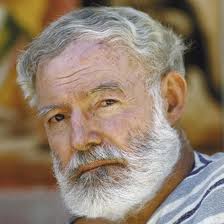
Hemingway’s Distance

 When the great author of The Old Man and the Sea was in Michigan, he wrote about Paris. Likewise, when he was in Paris, he wrote of Michigan. In speaking with other poets and writers, I have found there to be a common link among creative types: The farther (in every sense of that word) we are from our dearest subjects, the stronger our writing about it becomes.

For instance, when I return to my family homestead many miles south of here, I am not automatically inspired to compose lines about it. The spirit of the place is too strong, too close. Also, the peace I experience there is too great for the fevered activity of poetry composition. The old place’s effect is soporific on my muse, but once I’ve left and I’m on the road or even back at my current suburban home, then the poetic flood begins to rise. Images, sensations, memories, and the whole of the family farm experience (past or present) sets itself heavily on my writing mind.

Time also serves as a literary “distance” filter: Consider Wordsworth’s famous lines above Tintern Abbey, written five years after the visit took place. By having hindsight, the truest and most poem-worthy elements of an experience can rise like sweet cream to the surface of our consciousness. The traumas and impressions of the present are intensified by having some chronological separation. Only the strongest details remain after delay. Sometimes this separation can be mere hours, other ideas may require years for processing. It all depends upon the severity and sincerity of the inspiration in question.

I am not advocating the idea that writers shouldn’t “strike while the iron is hot,” however. If one is overcome by the NEED to write at a moment, then by all means, don’t let that desire cool in apathy. The Beats would tell us that our first thoughts are our best thoughts, but the discerning voices before and after that generation would advise us to refine those first thoughts into something far more elegant.

The big picture is just this: If you want to create truly reflective writing, then some form of distance is necessary. It doesn’t always have to be as radical as Michigan to Paris, but stepping back from the subject is advisable for any creative endeavor. If you don’t believe me, just ask “Papa.”

poetry, Uncategorized

Daniel Pink’s Theories and NaNoWriMo

I have never participated in National Novel Writing Month, and I do not plan to do so this year. I actually kind of object to the whole concept. I know: It works for a lot of people who ordinarily would not find the impetus to sit down and write 1,600 words per day (or whatever the “magic number” is). At the end  of one month, they find that they have created a lot of prose. Good for them.

Moreover, there are many success stories from writers about the manuscripts they created during this time of forced productivity. Several NaNoWriMo authors have found their books picked up by publishers, and some have even won awards. I congratulate them. But this post really isn’t about how NaNoWriMo works for other people. It’s about how it works for me, personally. Call it selfish if you will, but I think enough people share my quandary to warrant exploration of the topic.

When I was in my first round of grad school, I became an amateur philosopher for a while in the quest to make a John-Nash-like “new discovery,” only in the field of education rather than mathematics. I read works by Paolo Freire, John Dewey, Lev Vygotsky, Aristotle, and more modern names like Malcolm Gladwell and Daniel Pink. I related to Pink’s research because he consolidated and clearly stated exactly what I, and others like me, had known innately all along: We don’t do well what we aren’t motivated to do, and we aren’t motivated by a lot of things that corporate America has always used.

Pink identifies main “drivers” like autonomy, mastery, and purpose. Here is where my objections to NaNoWriMo come into play: Once I sense that something is “mandatory,” and I sense that it has been made that way by something or someone beyond myself, immediately I resist. I have had to overcome this instinct in the workplace and in graduate-level study — there are certain mundane tasks that others assign me that simply must be done, and so, my compliant “good soldier” self must supersede my most ingrained instincts to rebel against the compulsory. It is difficult, at best.

Why, then, if I know that I am “programmed” to shun the mandatory, would I choose to ruffle my own proverbial feathers? NaNoWriMo is a choice that quickly devolves into a chore. Engineered and engaged in by others, the purpose of NaNoWriMo is defeated by its “club-like” nature. When a self-improvement task begins to develop organizational properties, I then begin to hear its death knell. The only structure that truly succeeds is one decided upon by the individual, and in this case, the individual has given over that control to a group’s expectations instead. Failure for me as a writer would be inevitable. Some may call this assertion stark pessimism, but my own intrapersonal understandings tell me that it is valid. I have engaged in enough metacognition to know that my “rebel writer” within would sabotage any attempt by outside forces to control or “streamline” my creativity.

In addition, I could much more easily be devoting that time to endeavors I not only choose, but also design for myself. My fulfillment will be higher, my sense of accomplishment will be greater, and my enjoyment will make the tasks intrinsically rewarding. This reasoning is largely why I am a poet. My greatest contentment is found within the self-made structures, routines, and practices of an independent poetry writing life. I will probably never be a millionaire due to this simple satisfaction, but in the pursuit of my passions, I will be exponentially happier than I would be under the stressors and rigid constraints of affluence.

No, readers. I will not be participating in NaNoWriMo. When at last I sit down to begin “the great American novel,” it will be because the muse and my heart have impelled me to do so, not because I allowed a conjured-up contest to crow-bar its way into my creativity. Daniel Pink is right, and my right-brained life proves his correctness time and time again. I choose to succeed in my own way. How about you?


poetry, Uncategorized

Making “the Small Time”

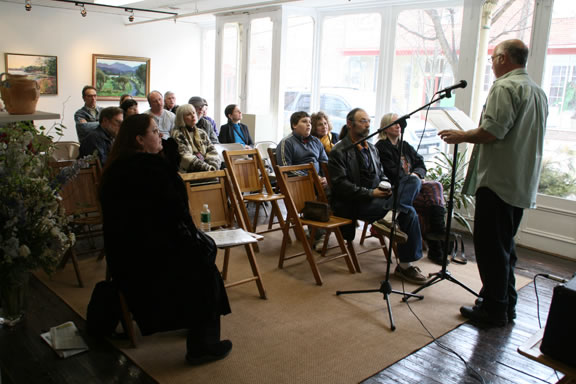
Last night, I was privileged to attend Writer’s Harvest 2012, an event at University of South Florida. People paid $5 at the door, or brought three canned goods to help feed the hungry. In exchange, listeners and participants got to hear readings from the likes of Jeff Parker and poet Traci Brimhall. The hall where the event was being held was standing-room only. Of course, this was in Tampa, where the literary arts have a pretty loyal following.

In smaller towns like mine, poetry readings are generally greeted by a handful of patrons who feel an “obligation” to support writing and culture in general. That being said, these “few but proud” gatherings have their own unique benefits. For one, small gatherings allow greater intimacy with the work presented. The poet can speak about the writing and be understood well, and usually, the readings are far more personal. Addressing a hall full of 500 people might be a rush, but it loses some of its closeness. Both the work and the artist are “drowned out” somewhat by the environment.

Comparing venues and styles of presentation caused me to think a little about the up-and-comers (like yours truly) who have to fight for their space in the limelight. Library and coffeehouse readings are great, and having a loyal little flock appreciate your work is nice. But at the end of the day, making the small time is exactly that — small. We poets are not unlike aspiring country crooners: Like them, we have to “pay our dues” in the dives and the honky-tonks of literature — the shabby cafes and tiny conference rooms where a handfull of people can begin to spread the word.

There are no backlit marquees or laser-printed fliers proclaiming the greatness of the small-town writer. This is why so many scribblers migrate to locales like New York City, where, with any luck, one’s work can be heard and experienced by larger crowds and potential game-changers for one’s writing career. However, throwing fate to a place populated by similar dreamers and doers has its own hazards. All of the old “fish bowl” cliches have some element of truth; one can be a big fish in a small pond or a smaller fish in a larger pond. It depends on your desires.

Personally, I would prefer not to be a fish at all. I write because I like to, I read because I love the music of language, and I appreciate people who appreciate my work. Whether that’s a crowd of 5 or 5,000, I’m simply happy to be the attended voice. Yes, I’d like one day to move beyond “the small time,” but for now, with my situation in life, I’ll take the sporadic applause of a few over the ovations of masses. There’s time for both yet.

poetry, Uncategorized

The “Not Knowing” and its Value

Sometimes, the question IS the answer.

After the recent success of my post about Arthur Flowers’s advice to writers, I felt obliged to write another quicker but equally applicable piece about something else that emerged during my last MFA residency: “The Not Knowing.”

It seemed this phrase was everywhere over the 10 June days I spent at University of Tampa. Fiction writers, especially, swore by it. They recounted tales of how their stories simply “took on lives of their own” after a truly boffo first line or a vague inkling concept drove pen to page. As a poet, I failed to see the relevance. After all, poets like me are in the business of crafting lines one by one, giving explicit attention to the sound, the sense, the structure, and even the symbolism of each individual word. “The Not Knowing” seemed to be something that prose writers did, and even then, with sketchy success at best.

Usually, I have a pretty good idea about where a piece is headed when I sit down to REALLY begin writing. My brainstorming methods are sort of standard: If there’s a central metaphor at work (as there usually is), I start with a two-column note chart. This is a T chart, for those in business. Using this visual organizer, I’m able to see similarities, differences, and relationships between two things, be they objects, ideas, or something else entirely. Then, as the prewriting begins to hum, I usually have a few real zinging lines come into my mind. I write these down. I’ll use them later. Once I have  a pretty good collection of these musical lines, then I’m ready to begin really putting pen to paper in the poetic endeavor. So, as you can see, I’m fairly methodical.

There are always a few surprises that creep into poems: pleasant wordplay or unforeseen ironies. But usually, the act of creating poetry goes pretty much according to plan. I know that sounds terribly boring, but it’s true. I have an idea, I explore the idea, I create a product from the idea. Then there’s the refining and the rewriting. I go through A LOT of drafts on legal pads, and usually 4 or 5 on the computer screen. In all this process, there isn’t much room for “not knowing,” as my prose-writing friends described it.

So when the great “not knowing” happened to me, I was pleasantly surprised, both with its advent and its outcome. I had a pretty decent first line written down on an index card: It was comprised of a single striking image that had a few different elements working within it. This line had occurred to me during one of those between-class lapses when the tardy bell has not yet rung, and students are idling about, yakking and poking at one another.

When I pulled the index card from my pocket later at home, I just started freewriting (something I virtually NEVER do) based solely upon that single first line that really sang to me. I’d like to tell you the piece that came from this inspiration won me a Pushcart and a Pulitzer simultaneously, and that Natasha Trethewey has written me envious hate-mail because of it. That didn’t happen. However, what did happen was this: I was now able to look at a “spontaneous” piece, one that was driven completely by the great “not knowing” I’d heard about, and I could relate. All I had to begin with was one line — one line that had beauty, had potential, and had heart. And that was enough.

I know, I know. You probably want to see the poem now, right? Here’s the letdown, reader: I’ve sent that poem out to several potential publishers with packets of other works I’ve generated, so, sorry about that. It’s going to have to remain “in the dark” for now. However, when it does find a home, please rest assured that you’ll see it here first. And in the meantime, please feel free to explore your own “not knowing”-driven work. I’d love to hear how that works out for people outside the literary realm. Who knows where the uncertain might lead us?

poetry, Uncategorized

The Necessity of Interruption

So, this post probably won’t win me many writer friends. Be warned.

I have found over the years I have written poetry and prose that I am different from my colleagues in one regard: I actually prefer to be interrupted from writing.

Now, before all you secluded-in-solitude writers go nuts, let me clarify: My writing room has no “doors” to speak of. My children can come in at any time and speak to me, get hugs, whatever. And in retrospect, those interruptions have actually made my writing stronger.

Here’s what I mean: My brain actually has to work harder to power through the static and the outside influences, and thereby comes up with things that my brain at total ease would never think. In fact, when I’ve tried to write in areas that are too quiet (the library, my local college study room, etc.), I find myself encountering greater difficulty. There has to be some background noise, and it can’t be something like music with lyrics or that artificial white noise garbage. The sounds in the environment have to be things I know are real: the drip of the rain beyond my window (like right now), the TV in the adjoining room mumbling about…I can’t tell what, the coffeemaker gently whirring forth a stream of fuel, my boys playing pirates in their bedroom down the hall. These noises actually help me to focus better. And while many of my poet friends would cringe at the thought of such “racket,” I’ve found that writing locales without these sensations rob me of something. Maybe it’s the familiarity, maybe it’s a degree of undiagnosed OCD — I’m not sure.

Whatever the cause of this scientific fact, the thing that matters most is its effect. I know how and where I write best, and life’s little interruptions are as necessary as pen and paper. Do I still fantasize about being that “lone wolf” author who has blackout blinds and acoustic paneling just to ensure that his thoughts aren’t “tainted?” I suppose. But given my druthers, I’ll take my boys’ imagination-chatter and the soft hum of life in the suburbs over celebrity sanctuary any day.

poetry, Uncategorized

The Poet as Father

OK, I admit it. I’d like to have a writing room. Ever since I heard novelist Michael Connelly talk about his during the last residency of my MFA in Creative Writing program at University of Tampa, I’ve been somewhat envious. It seems that Connelly has blackout blinds, soundproof walls, acoustic “dead zones” and other cool features in the room where he does all his writing. His family understands that when he goes into the special room, he is “at work,” and is not to be disturbed.

Even as I write this, my wife is asking me, “Honey, where did you put the boys’ gummies (those fruit-flavored gummy treat things)?” Granted, I wish I could focus on blogging in peace, but excluding myself from family life seems selfish, even irresponsible to a degree. “They’re in that narrow cabinet beside the stove,” I respond, and keep tappity-tap-tapping away at this keyboard.

In my house, we have a place called “The Quiet Room.” It serves as a library/study/creative workspace, and its view is fantastic. I’ll have to post a photo sometime. Through our large front window, I look out over our neighboring lake and beyond to the dotted houses, palm trees, and other charming features along the opposite shore’s landscape. The view changes based on wind, weather, season, and other factors, but its constancy is reassuring simultaneously. I guess you could say it has sort of a dynamic stability about it. Back in the seventies when this place was built, this room was considered the “formal living room,” that stuffy, pretentious room where you took guests that you considered high-class so you could impress them with your earth-tone hardwood furniture and extensive, gilt-edged encyclopedia sets. Today, that idea is outmoded (to say the least), and thus, the creation of a re-purposed space for reading, writing, and creative endeavors.

I know that The Quiet Room is the closest I’m going to come to a writing room anytime soon, and I’m good with that. It has no real doors to speak of, so my sons come and visit once in a while, usually just to see what I’m up to, and that’s okay with me. In the grand scheme of things, if I have to trade a Pulitzer Prize for attention given to my boys, I’ll gladly do so. My family, after all, is the greater priority. Flights of fancy and creative sparks come and go, but the value of these bonds forged in our home far surpasses any fleeting glory I may attain as a poet. The last thing I want is to be one of those authors who, when PBS makes their documentary, is described as a literary genius but a lousy dad. There are plenty of others out there who have made that mistake, and I’d prefer so stay out of their league. I’d love to write some more about this, but it’s playtime, readers. I have a plastic swordfight to go lose against two keen opponents. En garde!

Uncategorized

Thoughts on “Becoming a Name”

Within literary circles, there is constant talk about authors who are “names” — that is, they’ve done so much and accomplished things so notable that their names are immediately recognizable in print or elsewhere: Billy Collins, Rita Dove, C.K. Williams, and others could be considered “names” within the field of poetry, for example.
This observation, then, drives a question: How do amateur poets become “names” also? Certainly winning prizes and earning publication credits help, but without a big-name publisher, well-attended reading events, and a certain splash of eccentric personality, young or fledgling poets can seemingly forget about the idea of “becoming a name.”
Perhaps a deeper philosophical question is this: Should fame really be the end goal of poets, novice or experienced? Certainly recognition helps when making appearance arrangements and other accommodations, but if that sort of “brand awareness” becomes all we’re shooting for as writers, something’s wrong. We write, primarily, because we love to write, and feel deprived if we don’t. When that love becomes something other, some strong impetus for our faces to grace the cover of Poets and Writers perhaps, then it’s time to step back and re-examine.