poetry, Uncategorized, writers, writing

The Beauty of Lisbon, Portugal

lisbon rooftop

The rooftops of Lisbon are a sight to behold! This shot from the top of the Hotel de Chiado, where the opening reception for the Disquiet International Literary Program is taking place, says it all.

Lisbon peacock

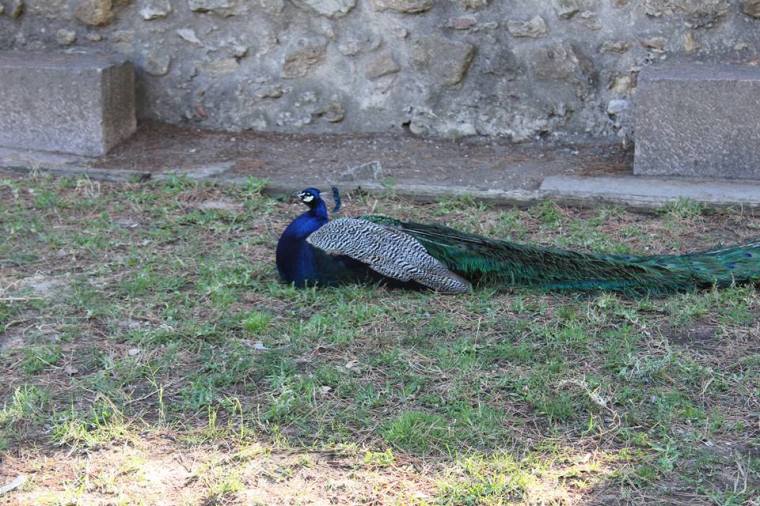
While walking the grounds of the Castela de St. Jorge in Sintra, this peacock stole the show. The castle is huge, and there will be more photos of it in future posts. Stay tuned!

Lisbon statue 1

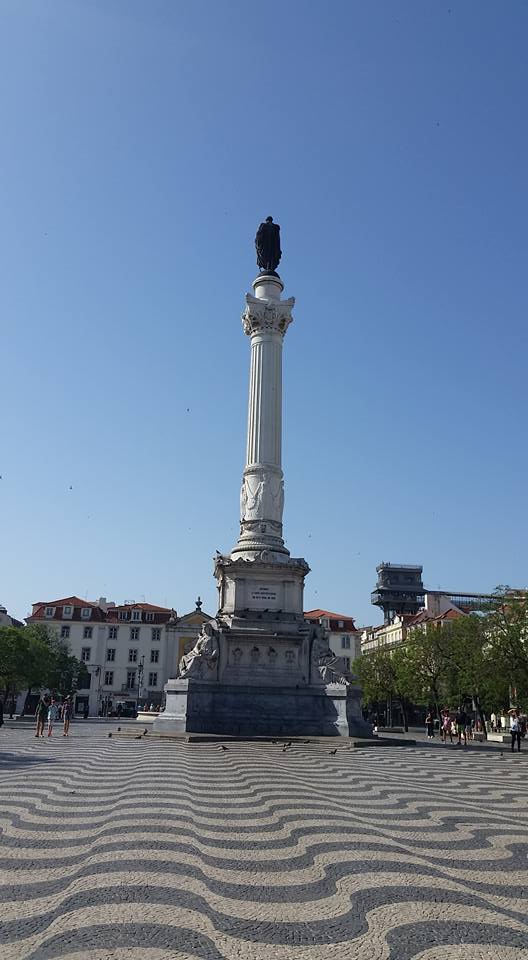
One of the many beautifully tiled plazas here in Lisbon. Statues of artists and writers are everywhere!

life, poetry, publishing, Uncategorized, writing

Coming Soon: Lisbon!

Flag_of_Lisbon Stay tuned here, readers. Beginning July 1, I’ll be attending the Disquiet International Literary Program in Lisbon, Portugal. I will be in workshops with Poets Prize winner Erica Dawson, and learning in seminars led by none other than Denis Johnson (author of Jesus’ Son) and Terri Witek, among others. Updates will follow. In the meantime, Bom viagem!

life, poetry, Uncategorized, writers, writing

More than Organisms

vitruvian-300-333Recently, I attended a lecture by a respected writer who posited that we should write about the obscene, the vulgar, the disgusting, and the revolting. He said that his logic for this encouragement depended not upon shock value, but rather, upon the notion that all such things were true. Specifically, he called writers in the seminar to write about their bodily functions, sexual encounters, hidden diseases, and sources of physical shame. This, he said, would lead to writing that was absolute truth, and would liberate writers from their self-consciousness. Likewise, such writing would reach an audience that has apparently been searching for such literature — in his mind, there exists a group of people who want to know that others do, in fact, excrete waste, cavort recklessly, and wrestle with modern-day plagues (and desire to read about it). Perhaps so.

My response to the notion that we should write ugliness, though, is this: We are more than organisms, and because we are, we should elevate ourselves and our art above the crass. This statement is not intended as condescension or old-school literary snobbishness, but, somewhat ironically, as a statement of truth. Stay with me here:

As the leaders of all other species, and as cognitive, reflective, intellectually astute creatures, we should use our creative and mental faculties in the most supreme way possible. Keats was not wrong when he equated truth with beauty, even though his definition may have been an oversimplification. Yes, there is more to truth than just beauty, but as highly developed beings, we should seek the best and finest truths rather than those which debase or denigrate. St. Augustine, Martin Luther, and countless others (including the Romantics) have reached this conclusion well before our time.

To write about subjects primitive, desperate, and scatological can sometimes be a fun and bawdy diversion, but devoting oneself to these lesser ideas renders literature into the equivalent of monkey-flung feces, to borrow an image from the aforementioned speaker. Some will call this assertion elitism, and maybe it is. But if we are to leave a legacy of thought, shouldn’t we aspire to greatness rather than the sewer? Shouldn’t we leave behind something more than our literal behind?

All this theoretical explication probably won’t change the downward spiral of gutter-dwelling “literature” that is being written. I get that. But if one person lifts clearer eyes to consider things less coarse, less brutal, and less detestable, then this small epistle hasn’t been in vain. As writers, we don’t have to be Pollyanna, falsely portraying a world that is all sunshine and daisies; in fact, we have an obligation not to. But likewise, we don’t have to decrease our own personal and cultural worth by slinging words that glorify the gross and reprehensible. We are more than organisms.We are wonderfully made, and that wonder should shine in all we write.

life, poetry, Uncategorized, writers, writing

Seeking the China Tree

cypress

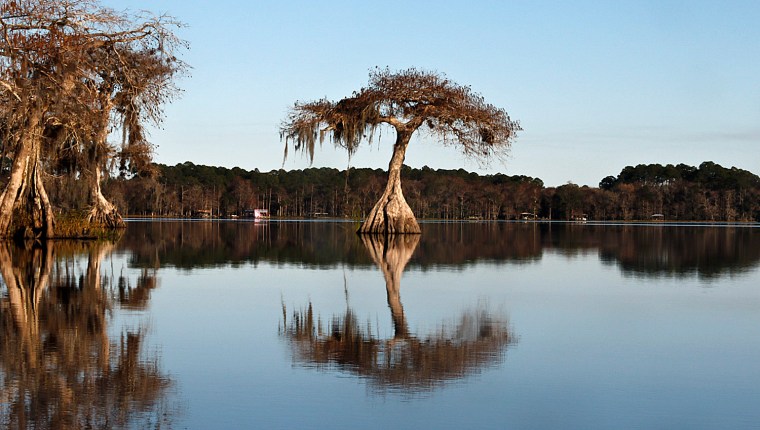
Only by climbing to the top of my grandparents’ magnolia could I see it: Far off in the west, craning above a humdrum horizon of pines and oaks, there was what I called “The China Tree.” In retrospect, it was probably just an oddly-shaped cypress, but its shadow pressed against sunsets made me think of Oriental landscapes and scenes from books and paintings I’d encountered as a boy.

While still a child, I vowed to seek the tree one day — I’d strike out on a hike to find its magnificent shape beyond the neighbors’ fields, and rest only once I’d stood at its proud, ancient trunk. The tree was a conquest-in-waiting, a thing of distinct beauty and history beckoning above and well beyond all that was common. And I told myself I would be its discoverer.

From my favorite thinking spot, the barn roof, I couldn’t see the tree’s paisley canopy; there were too many power lines and old chimneys blocking the view. But from the barn’s apex, I could ask myself: How will you know when you’ve found it? My answer as an adolescent was full of hubris — I’ll just know. Something that big, something that rare can’t be easily mistaken.

When I last returned to my grandparents’ farm, my boys and I climbed the old magnolia again, and I noticed that the China Tree was gone. Taken by hurricanes or hungry chainsaws sometime during my adult absence, its silhouette no longer marked the horizon. It saddened me, as I never pursued that quest I’d promised myself, and moreover, my sons would never know that landmark.

Maybe, though, in a more figurative way, I’ve been on the China Tree journey my whole life: I wanted to seek it for its beauty, its history, and its difference from everything around it. Is that not what the life of a poet is?

As one who has chosen the unconventional path toward a goal that many don’t understand, I believe that even today, I am seeking the China Tree. Yes, now it is more symbolic than literal, and maybe it’s a little harder to see — after all, the pines and oaks of grown-up obligations tower thick and high, and some days, it’s tough to discern my target.

Yet the ultimate objective remains the same: Find beauty, find history, find originality. With these missions in mind, I renew myself to the path ahead of me. The China Tree has not yet been fully discovered, and I will stop only once I can rest at its majestic foot. Time to press onward.

life, poetry, publishing, teaching, Uncategorized

On starting small

Earlier this year, brilliant mathematician and Nobel Prize winner John Nash and his wife Alicia were killed in a car wreck. Nash’s work and life were the subject of the film A Beautiful Mind, directed by Ron Howard in the early 2000s. Like many moviegoers, I too was touched and inspired by Nash’s biography (even if it was “adapted” for film). His humble West Virginia origins, his battle with personal demons, and his eventual rise to academic and economic prominence spoke to audiences everywhere.

A Beautiful Mind scene, courtesy of Universal Pictures
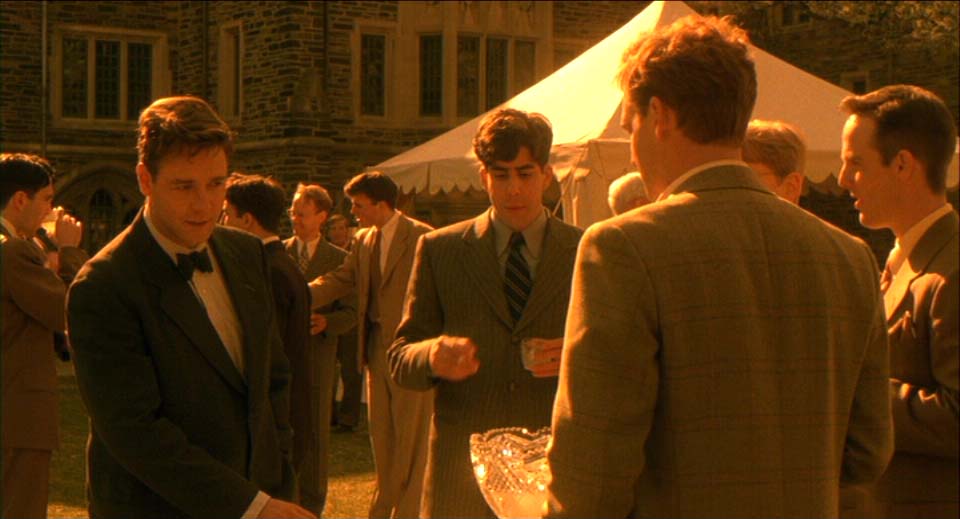
Martin Hansen, played by Josh Lucas in the foreground, engages in some party snobbery toward John Nash (Russell Crowe), at left.

Recently, one scene from Howard’s movie replayed in my head as I encountered a situation similar to one faced by Nash early on in the film: Upon his arrival at Princeton after receiving a substantial scholarship, Nash is confronted by Martin Hansen during a reception. Hansen indicates that he “simply assumed [Nash was] the waiter,” due to his appearance. This barbed condescension is a hallmark of the early Nash-Hansen competitive relationship as portrayed in the film.

People from small towns or rural upbringings often face this kind of slight, even today. I grew up in a town of 3,500 people. Everyone knew everyone else, and the main vocation was agriculture. So, when I eventually moved to a city of 35,000 people (and growing), I felt as though I’d made my home in a more metropolitan area. Even though the culture here is still one of welcoming and warmth (see prior posts), my city has many markers of being a larger, slightly more urban place than many of Florida’s smaller map dots.

While I was serving as a guest lecturer at an area university some months ago, a student I met had the audacity to insinuate that small to mid-sized cities are undeserving of artists in residence or poets laureate. His contention was that only large cities and crowded urban areas should pay attention to literary and arts-related matters, because, after all, creative gifts can only thrive in such a vast and populous setting. There was more “talent” to choose from, he indicated, and more educated people inhabiting the big cities.

So, let me set the record straight, if only to repudiate this student’s erroneous assumptions. Many highly educated and erudite individuals choose to be country-dwellers, suburbanites, and big city expatriates (I’d supply a list, but it would be far too long). Their decision is made not because they desire to be “bigger fish in smaller ponds,” but because they desire a truer sense of community, a safe and clean place to raise a family, or maybe because they hold dear the virtues that modestly populated areas often embrace. In the end, there are several reasons to eschew the hustle and bustle of the sky-scraped city, especially if one is an artist. Certainly, there are benefits to larger metropolises, just as there are drawbacks. And yes, arts and culture do thrive there in most cases.

However, assuming ignorance or lack of refinement exists solely in smaller towns or mid-sized cities is the height of arrogant urban imperialism. I believe that Annie Dillard, Mark Twain, and John Nash would agree, for starters. And for me, smaller places yield bigger ideas. It is not by accident that Richard Hugo encouraged poets to seek out “triggering towns” that seemed to be more tight-knit communities.

I’m not attempting to prescribe small-town living to those accustomed to bigger cities, nor am I advocating one particular mode of residency. But I do know that, for my creative purposes, small and medium places work. Those who denigrate them, somewhat ironically, need only a broader mind.

life, poetry, writers, writing

In Praise of Being “Mainstream”

The Cast of


As a kid growing up in the 80s, my television family was the Seavers, not the Cleavers. Every boy my age wanted to be Kirk Cameron (Mike Seaver of Growing Pains), or maybe Michael J. Fox, who played Alex P. Keaton in Family Ties. Shows like these made it seem cool to be like those families and their kids, for certain.

In today’s literary community, aspiring toward a more traditional type of success has been replaced by a phobia about being “too mainstream.” I was reading an article just the other day by a respected author who lamented that her life was “becoming too mainstream,” which she defined by tasks like going to the grocery store, washing dishes, and tending to the relationships beneath her roof.

Sadly, being responsible and attempting to live a reasonable, self-sufficient life are both ideas that have been denigrated by various media in recent years. The notions that we should work ethically, raise a family, seek advancement in a single field, and aspire toward something greater than self-satisfaction are frowned upon by a vocal minority. There are those, after all, who believe such ideas to be too old-fashioned, too whitebread, or too puritanical for the twenty-first century.

But this isn’t a political post. I’m here to defend the value of the mainstream in our literature, specifically. There is beauty in the common, after all, and while socio-cultural activists may be trying their hardest to redefine what constitutes “the norm,” Joe and Jane Average still know that their lives — complete with light bills, plumbing repairs, and runny noses — have wonder, merit, and poetry in their seemingly mundane routines. Eschewing the everyday limits the scope and reach of our literature.

What’s more, by omitting mainstream details, artists portray a fallacious picture of what our world is really like: Rather than giving readers honest visions of life, many are seeking shock value, or perhaps some abstract, inauthentic version of their environment. In the end, both of these motives generate lies — creative, occasionally beautiful lies, perhaps, but lies nonetheless. While I’m no Realist (artistically speaking), I also don’t believe that writers should fear the mainstream. Give us the sidewalk cracks, the wasps and overdue notices in the mailbox, the wiffle ball stuck in the backyard oak tree. There is poetry in all these things, and there is life.

Being mainstream, by the way, isn’t all that bad, you’ll find. Parenthood and the obligations of marriage, career, and family life remain sources of great inspiration, just as they did in prior generations. Maybe it’s not new, it’s not avant-garde, and it’s not the “artist thing to do.” But I’ll take it any day over the exotic or the crazy. To be clear, I’m not saying “mainstreaming” is for everyone. However, I am saying that in going about the business of writing, we as authors should not be scared of that which seems standard. For it is the run-of-the-mill that yields the exceptional, the original, and the special. And that, writers, is what we’re after — the diamond in the rough, the pearl inside the oyster, and the rainbow out of the gray. Without the ordinary, there can be no extraordinary.

poetry, publishing, writers, writing

On the Color of Names

Asian-sounding Pen Name Gets White Guy in Trouble

So, I read the story linked to above from the Washington Post. Here’s my two cents, for what it’s worth:

As a plainly named, semi-average white guy, I too have considered using a name that sounds “less Caucasian.” In today’s literary marketplace, it sometimes feels like people with humdrum, plain-Jane names get overshadowed by those without them, no matter what the ethnicity, gender, or background in question may be.

“Oh, to be a Li-Young Lee, a Marina Tsvetaeva, or a Yusef Komunyakaa!” say the Joe Smiths of the writing world. Of course, poets’ names are not their strength (although the aforementioned ones, especially, are impressive and beautiful sounding). It is the authors’ fine work that has earned them their spot in the literary marketplace. Their awards are many, and rightfully so. It is not a matter of name alliteration, length, or origin that has raised them to prominence; it is the quality of their writing, and a strong history of artistic contribution.

Statistics from a number of sources show us that writers from historically underrepresented communities still struggle to get their work in front of readers, and the good folks at Vida: Women in Literary Arts have demonstrated the imbalance between published male writers and their female counterparts. Nonetheless, when one opens a copy of Poets and Writers, AWP Chronicle, and other trade pubs that scribblers like me regularly receive, the most highly publicized writers can seem to be comprised of those with extraordinary and uniquely identifiable names, no matter what their color or creed.

Consider if you will the glossy back cover of the September 2015 issue of The Writer’s Chronicle: There, in a full-color ad for Grand Valley State University’s Poetry Night 2015, are Kwame Dawes and Aimee Nezhukumatathil. I wish I could be at the advertised event, not because I want an excuse to form such lovely names more often, but because these are exceptional writers. Inside the back cover, a full-page ad for the Sanibel Island Writers Conference (another event I wish I could attend this year) proclaims the presence of Edwidge Danticat, another brand-name poet whose work is as striking as her name, if not moreso. A quick flip through the magazine reveals Nikki Giovanni, Ravi Shankar, Minal Hajratwala, Luisa Igloria, and Natasha Trethewey, among other names like poems.

Admittedly, my name has sometimes raised an editor’s eyebrow or two because “John Davis Jr.” could belong to someone of any number of races. Sure, it’s a white guy’s name, but it could belong to someone of African-American descent, Native American descent, or any one of many other races, I’ve found. A quick run of my name through Google reveals a rainbow of people from all walks of life. Some are realtors, some are doctors, and one even ran for president in 2012. I’ve had editors presume I was African-American because my name reminded them of another famous “Davis Jr.” — Sammy Davis Jr. No joke. I didn’t mind the confusion, nor did I take offense. But then, I’m a member of this country’s majority. My people are not disenfranchised, nor have they faced excessive hurdles in society. And maybe that’s why Michael Derrick Hudson’s decision irks me.

It irks me for the same reasons that dialect-discrimination irks me, actually. I’ve had plenty of people assume over the years (based upon my size, appearance, and Floridian accent) that I am ignorant. “Dumb Southerner” is the label some have attached without knowing my full story. They hear my use of the colloquial “y’all” and jump to their conclusions, which are, ultimately, dead wrong. Yes, my family has farmed for three generations (at least). But we’ve also been educators, doctors, lawyers, professors, and Air Force pilots, just to name a few other roles. I don’t appreciate others assuming we’re hillbillies any more than writers of Asian descent appreciate “Yi-Fen Chou.”

So what’ll it be, Mr. Hudson? You think your name sounds too Anglo-Saxon? Oh, gosh. Better fix that right up. You’ll never get published now. It’s not like Billy Collins, Ted Kooser, C.K. Williams, or — let’s go back a ways — Edgar Allan Poe, Robert Frost, or W.B. Yeats have had any luck. I can see your quandary, what with all the illogical repression of white male names and voices, It’s clearly a wonder that your work has managed to see the light of day.

But I get it. I really do. All those delicious-sounding syllables from diverse cultures are out there, just waiting to be exhaled. And they’re tempting. I know they are. That, however, doesn’t make them yours to appropriate. Might I be so bold as to suggest Mr. Hudson read an excellent essay by Henry Louis Gates Jr. entitled “What’s In a Name?” I assign it to my students regularly. When you read it, consider yourself Mr. Wilson, Michael. For in essence, you have called Asian and Asian-American writers everywhere “George.” And that’s not okay.

poetry, publishing, teaching, writing

Television Appearance

So here was a first: My interview with local literati member Jane Waters-Thomas: Writers Den

Lessons learned:

  1. When doing an author interview, never resign oneself to a chair that tilts backward, making you push every ounce of your neck flesh out from under your face. The camera already adds 15 pounds; don’t make it worse with posture.
  2. Avoid using verbal fillers like “if you will” and random catch-all adjectives.
  3. Know when to SHUT UP. There’s a fine line between adding details and bloviating.
  4. Keep your eyes on the host, or on one of a few select spots around the set. Too much eye-shifting seems disingenuous.
  5. Read the text that’s in your book, even if you’ve changed it in a later, better draft. Avoid creating cognitive dissonance.

There you have it. If I had it to do over again, I’d probably lose the tie, also. But we all live and learn, I suppose. Hopefully I get another shot at TV sometime — I liked the format, and I truly appreciated the opportunity to get the word out about my writing and teaching. And now that I know what NOT to do, I’d love another shot at speaking to an audience through broadcast. Great conversations are always welcome!

poetry, publishing, writers, writing

When should you blacklist a publisher?

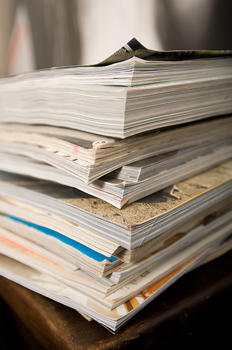
magazinesI’m not usually one to post one negative thing after another, but recently, circumstances in my literary life have been causing me to offer a few “no-nos” to the general public. In today’s edition: How to know when you should never submit to a magazine/journal/publisher again.

Without naming names, I’ll tell you that I’ve recently scrawled a list of literary venues that I will never offer my work to again, and posted them to my bulletin board as a reminder. As a younger writer, I did this after a single rejection (or even two or three), which was hot-headed and foolish on my part. However, the places that I’ve listed and “sworn off” recently have committed editorial faux pas that I consider frankly unforgivable in the 21st century. And so, without further adieu (punny, yes?), here’s why I said goodbye and good riddance to a few literary outlets lately:

1. No response unless accepted. One journal is on my list because the editors cling to a policy that states, “We will communicate with you only in case of acceptance.” Hogwash. There is absolutely no reason that a magazine of any size should refuse sending a simple “no” to a waiting and hopeful writer. Their exclusive practice is rude, and rudeness doesn’t fly, even today.

2. Hostile, condescending, or insulting rejections. Another place is on my list because the editor could have sent a simple form rejection letter or a polite “This doesn’t fit our current needs,” but decided instead to engage in blatant snobbery and offer a few ad hominem cutting remarks. Where “no thanks” will suffice, subtle or obvious condescension has no place. Farewell, editorial ugliness. You have no home here.

3. Rampant inefficiency or gross incompetence. My third blacklisted venue accepted my work more than two years ago, and published it about a week ago. No, I haven’t mentioned them by name here or on social media. I thought the place had gone belly-up, honestly, as my attempts at communication were never returned, and I had already submitted the pieces they accepted to other venues. This could have created a major legal snafu, among other issues. Also, my author’s bio was grossly outdated in this publication due to lax oversight and poor management. Never again, (name withheld) Review. Yes, I know publishing is tough and time-consuming, but not to the extent that it should cause literary malpractice.

4. Emotional/personal affairs affecting editorial discernment. The final place to which I will no longer submit is operated by a novice publisher who sees every “no thank you” as a personal attack, or as an affront to the integrity of her/his operation. This same publisher overshares his/her personal problems when deadlines are missed or when quality is questionable. When the boss has problems, everybody has problems, much like the old adage “When momma ain’t happy, ain’t nobody happy.” I’ll steer clear, thanks.

So there you have them: my reasons for “blacklisting” certain publishers. Some of these may seem hasty or even unfair, but in every case, my personal experience has been such that I felt compelled to write them off. I would be interested to know why you, the reader, have stopped submitting to various places, as well. Feel free to posit your experiences in the comments section (please keep it clean and non-libelous). We’ve all been there. Keep writing!

poetry, Uncategorized

Of Robert, Emily, and Thoughts of Legacy

Emily1
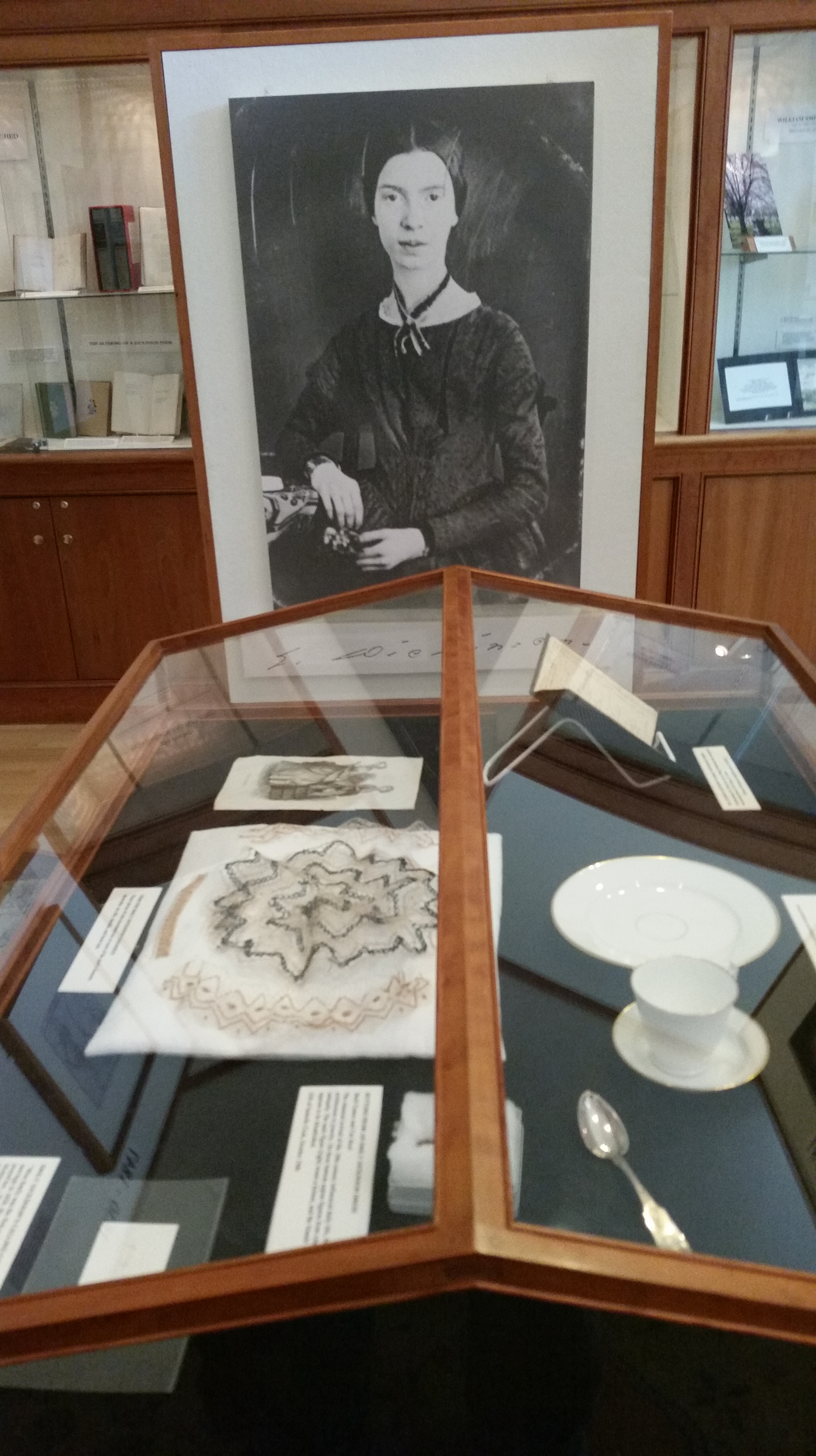
Emily Dickinson’s portrait in the Dickinson/Frost collection of Jones Library, Amherst, Mass.

Recently, I attended the Juniper Writing Institute at University of Massachusetts in Amherst. For the unaware, Amherst is the hometown of one of the canon’s most memorable and memorized poets, Emily Dickinson. Also nearby, one can find the farm of another great American poet, Robert Frost, considered by many to be the landmark poet of the 20th century. Both of these poets have meant a great deal to me as a writer throughout my career, and being in their part of the world was an unforgettable experience.

But my own independent studies of both Frost and Dickinson raised a new question for me — one that awoke me at 3:30 a.m. the first night of the conference. So distracted was I from this recurring question that I arose from my semi-peaceful travel slumber to write by hand in my journal. Here, in its unedited version, is the transcript of my late-night, early-morning writing:


6/21/15, 3:30 a.m.

I am awake because Emily Dickinson will not leave my mind. Having visited her house yesterday, I keep seeing her small corner bedroom over and over: its little sleigh bed, its dresser, its white-knobbed doors.

The Dickinson House in downtown Amherst.

Most of all, though, I think of all its windows. The tour guide kept using phrases like “extraordinary fenestration,” and she did not exaggerate. The natural light in Emily’s room was almost church-like. White and spiritual, it seemed to give life to the broad, thick beams of hardwood flooring there. As old as everything was, the light carried no dust. The air in her quarters was as pristine as the white housecoat she sewed for herself. On that air was the scent of history, a rare mixture of old wood, natural fibers, and unstirred earth.

I glimpsed the Amherst world from her window. Her tiny desk was positioned before it, and for a second, I could visualize her sitting, penning lines of legacy. Some of these lines also awoke me today, mostly her first lines:

Hope is the thing with feathers

I dwell in possibility

My teacher-mind sets to work on these, and I envision exercises for my students:

(Abstraction) is the thing with (concrete object)

What idea or notion do you “dwell in,” and why?

EmilyCollection
A collection of Emily’s things at the Jones Library in Amherst.

 The second of these questions applies to me as well, for once again I find myself too fixated on the idea of leaving my mark as an artist. I dream of a time when others tour my family’s farm or my smaller lake-view house in the city to see where and why and how I worked. Even at this mature age, my boyish whims of literary celebrity return, thanks in part to Emily Dickinson. My pragmatism intervenes, though, and tells me I need to sleep before daylight arrives. [End Journal Entry]

So, I was at my most honest in the middle of the night. But my thoughts of leaving a literary trail for others to follow would not stop with Emily. No, not when the home and writing space of one of my all-time literary heroes was nearby.

Upon my visit to the Frost Farm in Derry, New Hampshire, I was privileged to see his barn, his house (both floors!) and the land surrounding. I stood where the great man stood, walked where he walked, and even trod the staircase his wife descended, prompting the poem “Home Burial.” All these experiences once again raised the concern of posthumous impact.

Would people want to similarly experience the spaces where I have created? Will my own work ever merit that kind of attention, before or after my death? The literary marketplace is full of Frost-wannabes and Dickinson-aspirants, and who am I to even ponder such weighty matters? How does proving oneself a “fanboy” of literature make one any more likely to succeed at literary and scholarly endeavors? And thusly, I tortured myself further.

I visited the Robert Frost Library. I spent hours perusing the Frost-Dickinson collection in the Jones Library of Amherst. I allowed my imagination to run wild with scenarios concocted only from the notion of greatnesses recognized. And once again, I found myself twisting my brain into the same enigma that it has puzzled over like a Rubik’s Cube countless times before: Will I matter? Will my work matter? How do I ensure both? What steps must I next take to be certain that I’m not forgotten, like so many writers of the past?

EmilySign
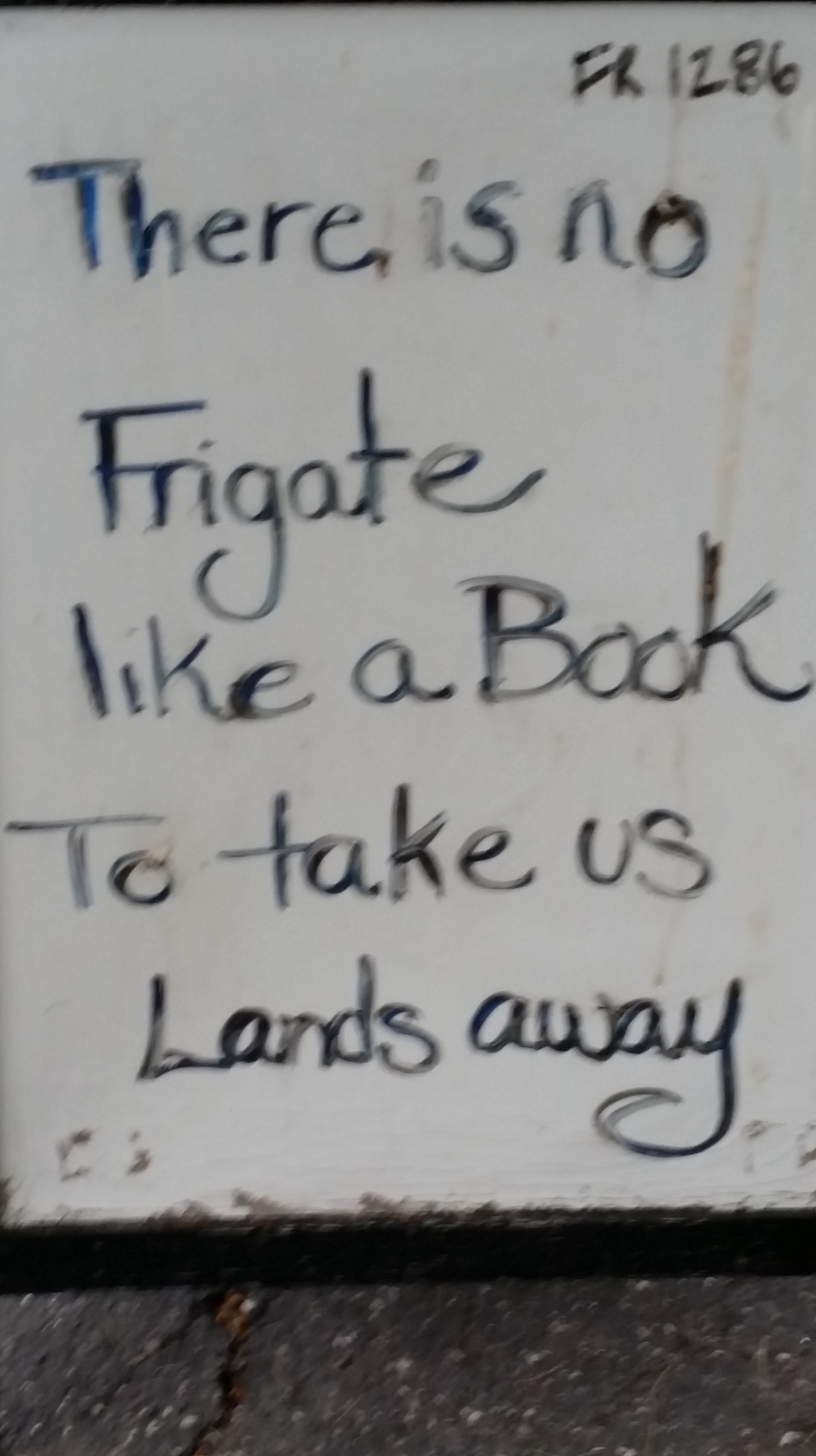
A sign on the grounds of the Dickinson House in Amherst. This passage is directly from Emily’s poetry.
FrostBust
A bust of the great man himself inside the Dickinson/Frost collection at Jones Library.

I had hoped by now, at my nearly 40 years of age, that such concerns would really be a thing of the past. After all, I continue to write, and I’m sure that one day I’ll see some wider recognition than my meager efforts have so far produced. Like all writers, I’d like a Pulitzer and maybe some other big awards (see prior posts), but honestly, at the end of the day, what I’m really aiming to do is preserve people, times, and places that have mattered to me the most. If my poetry results in just a few people gaining a broader appreciation of the heritage, values, and experiences I’ve received in this life, then I’ve won. And I don’t mean that all of my poems are totally autobiographical — certainly many are not. But all of them lend themselves toward ideas, visions, and perspectives that, however universal, have arisen somehow from the life I’ve lived.

Will people care about that life? Why should they? Will students sit through laborious documentaries about the different periods in my writing timeline? Will my work be anthologized in textbooks of the future? Such inquiries can drive one mad, if left unchecked. Spending countless hours in the homes of the greats might not make me a better writer, but it did accomplish one thing — it allowed me to see a shared humanity, a common thread of inspiration, motivation, and dedication.

Persistence, diligence, and  enormous creativity are shared traits among those we celebrate today, so long after their earthly departures. And perhaps it is these traits that we should take away from memorials and museums commemorating their contributions. More than the vanity of asking, “How can I attain their level of distinction?”, perhaps we (I) should be asking, “What can I do continuously and creatively well to positively affect my world?” Such a question surpasses the superficial desire for remembrance, and enters us into a more philosophical, even theological, realm. May our answers lead us not to fame, not to fortune, and not to solipsism. Rather, may they lead us to be better human beings, produce finer work, and seize the opportunities of the everyday.

Frost's Desk
Robert Frost’s writing space at Frost Farm in Derry, N.H.
FrostStatue
A statue of Frost just outside the Robert Frost Library at Amherst College.