poetry, Uncategorized

Integrity: When did it stop mattering?

 Recently, I’ve had more than one run-in with editors and publishers who say they’ll do one thing, and then they don’t. It’s disappointing, not only because my work hangs in the balance, but also because their behavior is indicative of a much larger cultural problem: the loss of character.

At one time, those who broke promises and failed to meet their obligations were castigated by the larger whole of society. People operated with the expectation that when someone said they would do something, it would indeed be done. Accountability was high, and our products and businesses reflected the ideals of quality and honesty. Contracts were a mere formality. But this post is no rant in favor of regression or even reminiscence. It’s a call to activation and engagement.

Today, integrity has become a buzzword for political campaigns and other self-enhancing promotions. We have handed over the mantle of consumer advocacy to organizations and  toothless watchdogs who, in turn, also serve themselves more than the concerned individual. Those who speak up and voice their frustrations are seen as rude or strange, and all the while competitors abroad are seizing on our loss of commercial moral fibre.

Here is my promise to you, readers: I  am awaiting word from at least three different literary magazines that have failed to make good on their publication promises. They have repeatedly missed deadlines, and their response to these infractions has been a sort of beligerent indifference laced with adolescent-sounding excuses. If these editors and publishers continue to fail in the fulfillment of their duties, I will happily publicize their lack of integrity, not only here in this little blog, but also through Duotrope, Submittable,  and other writing-submission-related sites. I do this not out of mean-spirited blackmail, but out of respect for other writers and creators who deserve to have their work treated with professionalism.

Again, I am disappointed that my encounters with these magazines has had to take such an ugly turn. A little bit of character and communication could have gone a long way, but instead, I’m left now with the job of staging a one-man rebellion. I would ask you to join me in this fight. No more laziness, no more dishonesty, no more apathy. It’s time to regain the sense of right that we once demanded. Today is the day to begin.

poetry, Uncategorized

Politics and Poetry

 Today is Election Day. In a vast departure from my usual blog fare, I am writing today about my political leanings. Prepare to be offended. You may stop reading here if you believe this post will make you angry.

As a group, poets have always been pretty politically active. Usually, that activism has been of the Berkeley-inspired sort, with Allen Ginsberg appearing naked or George Saunders writing tongue-in-cheek about being Ayn Rand’s lover (see the latest New Yorker).

Artists and poets have historically professed to being open-minded and accepting of all. And yet, watch what happens in writing groups or seminars when a conservative voice enters the picture. Suddenly that open-mindedness is nowhere to be found, and ugliness quickly enters the scene. All the anti-bullying rhetoric that these same “compassionate” people spout daily somehow gets forgotten in the barrage of name-calling and slur-shouting. Hypocrisy at its finest. It’s as though people who vote Republican or even conservatively Independent aren’t welcome in the “literary clubhouse.” The children already inside have posted a poorly lettered sign that reads, “No Patriots Allowed.” After all, patriotism is a notion that shows some kind of loyalty or devotion; strictly verboten ideas to the hedonists, nihilists, atheists, and radicals who nailed together the clubhouse in the first place.

This statement takes me back to a few years ago when a friend of mine was banned from a coffeehouse for reading a poem that the business owner considered “too right-wing.” What happened to freedom of speech there? Does it only apply to my liberal friends? Why is burning a flag okay, but expressing legitimate concern over our national debt suddenly taboo? The questions could go on and on.

Certainly conservatives are not exempt from the hand of this accusation, either. “The Ol’ Boy Club” has been around for generations, and there is good reason why the artists and creatives of our society felt the need to become a clique of outsiders in the first place. Now the outsiders, however, are those within the arts who cherish ideas like religious liberty, traditional family values, a strong military, the right to life, the freedom to defend one’s home and family, or giving just and swift punishment to those who commit heinous acts against innocent others. These are the very tenets that our ancestors fought and died for, writer and reader friends.

For a moment, however, let’s leave behind any issue that is not directly related to writing and the arts. Let’s assume that today when you go to the polls, you want to vote for the candidate who has done the most to support these two ideas. One candidate leveraged the arts into prominence, supporting music and creativity-based programs in schools while supporting business and individual liberties. The other candidate slashed 13 percent of funding from the National Endowment for the Humanities AND from the National Endowment for the Arts. You do the math.

The polls will open in about half an hour here. I plan to make my vote count. I hope that you plan to do the same, friend. And I hope that my assertive utilization of the First Amendment has not in any way negatively impacted your view of me as a writer. At the end of the day, what really counts is my performance, not my politics.

poetry, Uncategorized

Daniel Pink’s Theories and NaNoWriMo

I have never participated in National Novel Writing Month, and I do not plan to do so this year. I actually kind of object to the whole concept. I know: It works for a lot of people who ordinarily would not find the impetus to sit down and write 1,600 words per day (or whatever the “magic number” is). At the end  of one month, they find that they have created a lot of prose. Good for them.

Moreover, there are many success stories from writers about the manuscripts they created during this time of forced productivity. Several NaNoWriMo authors have found their books picked up by publishers, and some have even won awards. I congratulate them. But this post really isn’t about how NaNoWriMo works for other people. It’s about how it works for me, personally. Call it selfish if you will, but I think enough people share my quandary to warrant exploration of the topic.

When I was in my first round of grad school, I became an amateur philosopher for a while in the quest to make a John-Nash-like “new discovery,” only in the field of education rather than mathematics. I read works by Paolo Freire, John Dewey, Lev Vygotsky, Aristotle, and more modern names like Malcolm Gladwell and Daniel Pink. I related to Pink’s research because he consolidated and clearly stated exactly what I, and others like me, had known innately all along: We don’t do well what we aren’t motivated to do, and we aren’t motivated by a lot of things that corporate America has always used.

Pink identifies main “drivers” like autonomy, mastery, and purpose. Here is where my objections to NaNoWriMo come into play: Once I sense that something is “mandatory,” and I sense that it has been made that way by something or someone beyond myself, immediately I resist. I have had to overcome this instinct in the workplace and in graduate-level study — there are certain mundane tasks that others assign me that simply must be done, and so, my compliant “good soldier” self must supersede my most ingrained instincts to rebel against the compulsory. It is difficult, at best.

Why, then, if I know that I am “programmed” to shun the mandatory, would I choose to ruffle my own proverbial feathers? NaNoWriMo is a choice that quickly devolves into a chore. Engineered and engaged in by others, the purpose of NaNoWriMo is defeated by its “club-like” nature. When a self-improvement task begins to develop organizational properties, I then begin to hear its death knell. The only structure that truly succeeds is one decided upon by the individual, and in this case, the individual has given over that control to a group’s expectations instead. Failure for me as a writer would be inevitable. Some may call this assertion stark pessimism, but my own intrapersonal understandings tell me that it is valid. I have engaged in enough metacognition to know that my “rebel writer” within would sabotage any attempt by outside forces to control or “streamline” my creativity.

In addition, I could much more easily be devoting that time to endeavors I not only choose, but also design for myself. My fulfillment will be higher, my sense of accomplishment will be greater, and my enjoyment will make the tasks intrinsically rewarding. This reasoning is largely why I am a poet. My greatest contentment is found within the self-made structures, routines, and practices of an independent poetry writing life. I will probably never be a millionaire due to this simple satisfaction, but in the pursuit of my passions, I will be exponentially happier than I would be under the stressors and rigid constraints of affluence.

No, readers. I will not be participating in NaNoWriMo. When at last I sit down to begin “the great American novel,” it will be because the muse and my heart have impelled me to do so, not because I allowed a conjured-up contest to crow-bar its way into my creativity. Daniel Pink is right, and my right-brained life proves his correctness time and time again. I choose to succeed in my own way. How about you?


poetry, Uncategorized

A Poem for Halloween

I don’t usually publish my work on this blog unless it’s been accepted somewhere else, but for this particular holiday, I felt inspired to post the following for all the parents of trick-or-treaters out there like me:


Spirit Encounter


I could have worried that cold Hallows Eve
when we made it home from trick-or-treating
and there was that owl: unafraid, peering
from my dark study’s square window ledge.
I didn’t though. He was small, not at all

like those somber-faced great horned harbingers
of storybook lore – all death and wisdom –
more like a clay pot waiting for flowers,
an earthen vessel sheltered and shrouded
by warm bricks, mortar holding frosted glass.

Crouching like pranksters, slow-creeping as frightened field mice, we inched toward him.
Whispering, pointing, my two sons –
zombie and doctor – wanted him to fly.
He didn’t though. His nocturnal eyes turned

toward us, pleading, it seemed, to remain
in that safe alcove on the cusp between
thoughts and a threatening night.
We headed inside with our pumpkins full
of treasure from our neighborhood.

His silhouette stayed, backlit in yellow
shining streetlamp shades – a happy shadow
sighing, cooing: soothing us into
deepest contented-dream slumber where we
could not worry until All Saints’ morning.

poetry, Uncategorized

The MFA — “Legitimizing” writers

I’ve always been a writer. Even when I was very young, I would write fantastic stories about spies and detectives, and as I matured, so did my writing tastes and styles.

At this point, I proudly call myself a poet. I’ve had work published pretty regularly, I have a book of my own out there, and while poetry doesn’t keep the lights on and the kids fed, it does contribute something to my existence (see prior posts). With that being said, I always felt that it was pretty important to have something that proved my “writerness” more than just bylines and a strong publication history. Hence, my enrollment in the University of Tampa’s Master of Fine Arts in Creative Writing program.

Yes, I know many of my writer friends out there will quickly jump to the assertion that you don’t “need” a piece of paper proclaiming that you are indeed a writer. With that said, however, the benefits of the MFA program have so far been many and great: I’ve been able to meet and speak with renowned writers, I’ve gotten an inside view of the publishing industry, and my own abilities have become refined as a result of my enrollment.

For some writers, the MFA works. Others believe that a good writing critique group can yield the same outcomes. I disagree. Your writers’ group probably will not  get you introduced to the likes of Philip Levine or Lucille Clifton. If it does, I’d love to know what group you’re attending.

Likewise, it seems that an awful lot of very well-intended people who have been told they have “talent” wind up in writing clubs or groups that are community-based. They bring in their latest piece about granny’s quilt or pappy’s old dawg and expect it to be given the same level of thought as work by Chaucer, all because their ailing mother gave them high praise for rhyming the words “bone” and “home.” Perhaps I’m being a bit snarky here, but I’ve seen this happen.

You get what you pay for, folks. The MFA is an investment in a writing career. If you desire for your writing to be a serious part of your life and not just a hobby, then a degree is the path to that reality. If you’re satisfied being a local celebrity and the “big fish in the small pond,” then maybe a writers’ group is best. As for me, I plan to keep plugging away at the ole sheepskin. One year down, one to go!

poetry, Uncategorized

Making “the Small Time”

Last night, I was privileged to attend Writer’s Harvest 2012, an event at University of South Florida. People paid $5 at the door, or brought three canned goods to help feed the hungry. In exchange, listeners and participants got to hear readings from the likes of Jeff Parker and poet Traci Brimhall. The hall where the event was being held was standing-room only. Of course, this was in Tampa, where the literary arts have a pretty loyal following.

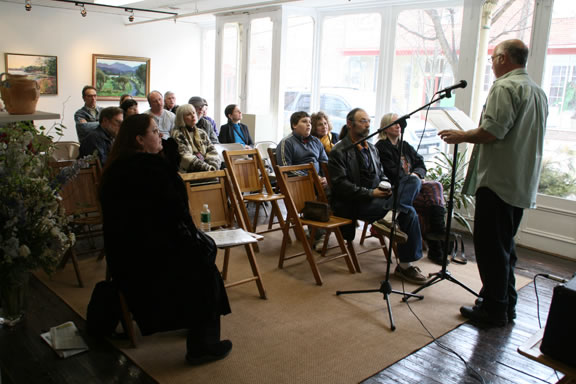
In smaller towns like mine, poetry readings are generally greeted by a handful of patrons who feel an “obligation” to support writing and culture in general. That being said, these “few but proud” gatherings have their own unique benefits. For one, small gatherings allow greater intimacy with the work presented. The poet can speak about the writing and be understood well, and usually, the readings are far more personal. Addressing a hall full of 500 people might be a rush, but it loses some of its closeness. Both the work and the artist are “drowned out” somewhat by the environment.

Comparing venues and styles of presentation caused me to think a little about the up-and-comers (like yours truly) who have to fight for their space in the limelight. Library and coffeehouse readings are great, and having a loyal little flock appreciate your work is nice. But at the end of the day, making the small time is exactly that — small. We poets are not unlike aspiring country crooners: Like them, we have to “pay our dues” in the dives and the honky-tonks of literature — the shabby cafes and tiny conference rooms where a handfull of people can begin to spread the word.

There are no backlit marquees or laser-printed fliers proclaiming the greatness of the small-town writer. This is why so many scribblers migrate to locales like New York City, where, with any luck, one’s work can be heard and experienced by larger crowds and potential game-changers for one’s writing career. However, throwing fate to a place populated by similar dreamers and doers has its own hazards. All of the old “fish bowl” cliches have some element of truth; one can be a big fish in a small pond or a smaller fish in a larger pond. It depends on your desires.

Personally, I would prefer not to be a fish at all. I write because I like to, I read because I love the music of language, and I appreciate people who appreciate my work. Whether that’s a crowd of 5 or 5,000, I’m simply happy to be the attended voice. Yes, I’d like one day to move beyond “the small time,” but for now, with my situation in life, I’ll take the sporadic applause of a few over the ovations of masses. There’s time for both yet.

poetry, Uncategorized

Faith, Cognition, and Creativity

It’s always dangerous to start blogging about potentially divisive issues like religion, especially on Sunday. But this post really isn’t about religion; it’s about faith and its role in the creative process. It’s also about how others within the creative and academic community perceive writers of faith. This post will probably cost me some readers, and I’m okay with that. I respect your views, and I’d like for you to respect mine as well. If you don’t, so be it. This is America, after all.

I have a lot of friends within the writing and arts realm who generally frown upon Christianity. They’ve had bad experiences with churches, pastors, congregation members, or other entities (choir directors, for instance). They’ve been fatigued by petty squabbles over methodology or order of worship. Their doors have been knocked on by cult members who say the path to prosperity and eternity is “my way or the hell-way.” It’s too bad, really.

In workshops and in seminars, there always seems to be a faction of holy-haters, and inevitably, they flock together to build the fire of their ire with the fuel of others’ guile. I happen to be a Christian, and I’m saddened by their disdain. Now before anyone gets the wrong idea, let me clarify: I am not what certain popular media portray as “Christian:” Quran-burning, hate-filled, condemnation spewers who bomb abortion clinics and wave “God Hates F*gs” posters. My Jesus wouldn’t do that.

My position is just this: In order to be “whole” people, individuals must engage not only their minds, but also the other aspects of their humanity– the physical, the emotional, and yes, the spiritual. My soul happened to be spoken to at an early age. I felt a sincere and innate desire to choose Jesus Christ as my Lord and Savior, and since that time, my Faith has given me “life more abundantly:” My highs have been the highest, my lows have been the lowest, but in every circumstance, my God has seen me through in a way that secular logic never could. Whether it’s been near-death experiences (I’ve been on life support twice), experimental brain surgery in my early thirties, or the thousands of smaller instances along the way, I feel certain that my life would have been much worse and less significant without Christ.

My personal faith isn’t the way some choose to engage their soul, and I get that. For some of my writer friends, Yoga is their spiritual exercise of choice. For others, they lean toward a different set of traditions. These same friends have sent me their “happy thoughts” or their “positive vibrations” when they’ve been doing their religious practices. I am not offended. We agree to disagree, and they acknowledge my prayers and practices just as I acknowledge theirs. Call it the spiritual equivalent of the “two-finger wave” off the steering wheels of our separate supernatural vehicles.

But herein lies the key to this matter: Faith, you see, is exactly that — metaphysical belief. It’s not a scientific theory to be diagnosed and dissected by the mind, and that element of mystery disturbs some of my colleagues. You cannot solve a spiritual question with a cognitive answer any more than you can use your heart as your brain. The two (in both cases) carry specific demands and capabilities that cannot be met or found in other ways.

Likewise, having a science-based argument about religion is like trying to apply duct tape to a rainbow. It ain’t-a gonna happen, friend. I know that my writing is stronger and my life is better when both most closely reflect and exhibit the tenets of my beliefs. When I’ve tried to “be someone else”  or write like someone I’m not, the product was passionless, synthetic, and ugly. I cannot “write like a Buddhist” any more than Richard Gere can act like he’s me (trust me, he can’t).

My faith has given me inspiration many times over the years. Granted, my poems have not become evangelical daggers that stab scripture into people; that wouldn’t help anyone, and it’s not my style. However, chances are good that if you’ve had a strong emotional (even spiritual) response or connection while reading my work, that’s probably not accidental, either. I’ll let the reader decide that little detail.

The purpose of this post, I hope, has been clearly conveyed. My intent here is not alienation or division, but explication and perhaps some provision of understanding. The closer we can come to being real with each other about all the diverse facets of our lives as writers, artists, and whole human beings, the better our world will be. If this transparency offends you, reader, I apologize. I would offer my warmest regards and highest hopes for all of us in the week ahead. And if you’d like, I’ll say a little prayer for you, too.

poetry, Uncategorized

The “Not Knowing” and its Value

Sometimes, the question IS the answer.

After the recent success of my post about Arthur Flowers’s advice to writers, I felt obliged to write another quicker but equally applicable piece about something else that emerged during my last MFA residency: “The Not Knowing.”

It seemed this phrase was everywhere over the 10 June days I spent at University of Tampa. Fiction writers, especially, swore by it. They recounted tales of how their stories simply “took on lives of their own” after a truly boffo first line or a vague inkling concept drove pen to page. As a poet, I failed to see the relevance. After all, poets like me are in the business of crafting lines one by one, giving explicit attention to the sound, the sense, the structure, and even the symbolism of each individual word. “The Not Knowing” seemed to be something that prose writers did, and even then, with sketchy success at best.

Usually, I have a pretty good idea about where a piece is headed when I sit down to REALLY begin writing. My brainstorming methods are sort of standard: If there’s a central metaphor at work (as there usually is), I start with a two-column note chart. This is a T chart, for those in business. Using this visual organizer, I’m able to see similarities, differences, and relationships between two things, be they objects, ideas, or something else entirely. Then, as the prewriting begins to hum, I usually have a few real zinging lines come into my mind. I write these down. I’ll use them later. Once I have  a pretty good collection of these musical lines, then I’m ready to begin really putting pen to paper in the poetic endeavor. So, as you can see, I’m fairly methodical.

There are always a few surprises that creep into poems: pleasant wordplay or unforeseen ironies. But usually, the act of creating poetry goes pretty much according to plan. I know that sounds terribly boring, but it’s true. I have an idea, I explore the idea, I create a product from the idea. Then there’s the refining and the rewriting. I go through A LOT of drafts on legal pads, and usually 4 or 5 on the computer screen. In all this process, there isn’t much room for “not knowing,” as my prose-writing friends described it.

So when the great “not knowing” happened to me, I was pleasantly surprised, both with its advent and its outcome. I had a pretty decent first line written down on an index card: It was comprised of a single striking image that had a few different elements working within it. This line had occurred to me during one of those between-class lapses when the tardy bell has not yet rung, and students are idling about, yakking and poking at one another.

When I pulled the index card from my pocket later at home, I just started freewriting (something I virtually NEVER do) based solely upon that single first line that really sang to me. I’d like to tell you the piece that came from this inspiration won me a Pushcart and a Pulitzer simultaneously, and that Natasha Trethewey has written me envious hate-mail because of it. That didn’t happen. However, what did happen was this: I was now able to look at a “spontaneous” piece, one that was driven completely by the great “not knowing” I’d heard about, and I could relate. All I had to begin with was one line — one line that had beauty, had potential, and had heart. And that was enough.

I know, I know. You probably want to see the poem now, right? Here’s the letdown, reader: I’ve sent that poem out to several potential publishers with packets of other works I’ve generated, so, sorry about that. It’s going to have to remain “in the dark” for now. However, when it does find a home, please rest assured that you’ll see it here first. And in the meantime, please feel free to explore your own “not knowing”-driven work. I’d love to hear how that works out for people outside the literary realm. Who knows where the uncertain might lead us?

poetry, Uncategorized

The Poet as Peddler

I’ve never considered myself much of a salesman. As a kid, I sold a few candy bars and other fundraisers for school, but other than that, I’ve never had much of a knack for getting people to part with their money. Truthfully, it feels kind of dirty. Even when I’m selling a product that I firmly believe in (like my own writing), I find it difficult to persuade others to buy.

This past weekend, I had the benefit of participating in the Polk Authors and Illustrators Festival, a downtown marketplace-style gathering of writers and artists in Lakeland. There I was, hawking my wares to Joe Public, having the grandest of conversations about poetry, Florida, and a thousand other topics. I fell into sort of a groove at one point where people were buying books left and right, not because I was pushing my product on them, but because I engaged their natural desire to talk about themselves.

As they spilled their guts about their childhood or their daughter-in-law, I found some kind of remotely related tie-in to my work. I opened the book up, showed them a verse or two that had to do with our conversation, and by George, they bought the book. I’m sure that those of you in sales have a name for this kind of approach, but far be it from me to know such things — I remain a poet and schoolteacher at heart.

The lesson, I guess, was just this: If you show up to a place all worried about how many books you’re going to sell (or not), then you reap the results of your anxiety. If you just take it easy, talk to the people like a normal human being, and do your best to be a good listener, the sales take care of themselves. Events like the Authors and Illustrators Festival help me to remember my place in this world; I’m not a pitch-man or a carpetbagger, thank goodness. I do, however, know good-sounding words when I come across them, and I’m a pretty fair peddler of free knowledge. I might do the festival again next year, but for tonight, there’s writing to be done. Time to close up shop.

poetry, Uncategorized

Writing in “Real Life”

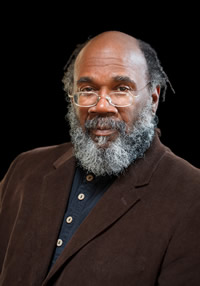
Before my cohort and my other fellow MFA candidates left from our last residency in June, we were given a final warning by the inimitable Arthur Flowers (see photo, left): “So, what are you going to do? You’re about to go back out into real life, where there’s bills to pay and mouths to feed. … People are going to tell you that you’re chasing a fantasy. People are going to say to you, ‘Just do like the rest of us.’ Don’t you do it. Follow that dream you’ve begun here. Never let anybody tell you that you’re not a writer.”

The truth is, I’ve had to replay this little lecture to myself on more than one occasion. As my teaching gigs and the mundane suburban duties of yardwork and such pile up, I sometimes tend to forget that I am also a poet. After all, the labels of father, husband, and professor seem to hold so many more responsibilities. What’s more, the immediacy of providing for my family tends to obscure the more long-term goal of poetic success.

It is indeed a dog-eat-dog world out there, and poets, like everyone else, are scrambling in a fight to the top: networking, assuming new titles, taking on the challenges of work-home balance, and ensuring that all the parts of life are functioning smoothly. In the midst of all this, it becomes pretty easy to allow writing and those related goals to take a back seat. I even found myself telling my wife recently, “Writing’s not as important as (insert bigger priority here).” And while that may be true, I must remind myself not to throw out the proverbial baby with the bathwater. Just because life demands greater attention to things of necessity doesn’t mean that I should completely cast aside any and all writing endeavors. And neither should you, reader.

“We do what we have to do so we can do what we want to do,” the old saying goes. But occasionally there’s a blurry line between those two ideas. Where the needs meet the wants, in that blurry gray space, is poetry. Yes, I could live without writing. But it would definitely be a sad and colorless existence, devoid of any creative sparks or intrinsic cognitive satisfaction. It is unimaginable and unimaginative. I have no plans to cut out my essence, just as I have no plans to desert my family or my career. Join me, readers, in this persistent striving toward the bigger, toward the better, toward tomorrow. Let us be pilgrims on this journey together. May our walk be filled with abundance, and may our pens never run dry.