poetry, publishing, writers, writing

On the Color of Names

Asian-sounding Pen Name Gets White Guy in Trouble

So, I read the story linked to above from the Washington Post. Here’s my two cents, for what it’s worth:

As a plainly named, semi-average white guy, I too have considered using a name that sounds “less Caucasian.” In today’s literary marketplace, it sometimes feels like people with humdrum, plain-Jane names get overshadowed by those without them, no matter what the ethnicity, gender, or background in question may be.

“Oh, to be a Li-Young Lee, a Marina Tsvetaeva, or a Yusef Komunyakaa!” say the Joe Smiths of the writing world. Of course, poets’ names are not their strength (although the aforementioned ones, especially, are impressive and beautiful sounding). It is the authors’ fine work that has earned them their spot in the literary marketplace. Their awards are many, and rightfully so. It is not a matter of name alliteration, length, or origin that has raised them to prominence; it is the quality of their writing, and a strong history of artistic contribution.

Statistics from a number of sources show us that writers from historically underrepresented communities still struggle to get their work in front of readers, and the good folks at Vida: Women in Literary Arts have demonstrated the imbalance between published male writers and their female counterparts. Nonetheless, when one opens a copy of Poets and Writers, AWP Chronicle, and other trade pubs that scribblers like me regularly receive, the most highly publicized writers can seem to be comprised of those with extraordinary and uniquely identifiable names, no matter what their color or creed.

Consider if you will the glossy back cover of the September 2015 issue of The Writer’s Chronicle: There, in a full-color ad for Grand Valley State University’s Poetry Night 2015, are Kwame Dawes and Aimee Nezhukumatathil. I wish I could be at the advertised event, not because I want an excuse to form such lovely names more often, but because these are exceptional writers. Inside the back cover, a full-page ad for the Sanibel Island Writers Conference (another event I wish I could attend this year) proclaims the presence of Edwidge Danticat, another brand-name poet whose work is as striking as her name, if not moreso. A quick flip through the magazine reveals Nikki Giovanni, Ravi Shankar, Minal Hajratwala, Luisa Igloria, and Natasha Trethewey, among other names like poems.

Admittedly, my name has sometimes raised an editor’s eyebrow or two because “John Davis Jr.” could belong to someone of any number of races. Sure, it’s a white guy’s name, but it could belong to someone of African-American descent, Native American descent, or any one of many other races, I’ve found. A quick run of my name through Google reveals a rainbow of people from all walks of life. Some are realtors, some are doctors, and one even ran for president in 2012. I’ve had editors presume I was African-American because my name reminded them of another famous “Davis Jr.” — Sammy Davis Jr. No joke. I didn’t mind the confusion, nor did I take offense. But then, I’m a member of this country’s majority. My people are not disenfranchised, nor have they faced excessive hurdles in society. And maybe that’s why Michael Derrick Hudson’s decision irks me.

It irks me for the same reasons that dialect-discrimination irks me, actually. I’ve had plenty of people assume over the years (based upon my size, appearance, and Floridian accent) that I am ignorant. “Dumb Southerner” is the label some have attached without knowing my full story. They hear my use of the colloquial “y’all” and jump to their conclusions, which are, ultimately, dead wrong. Yes, my family has farmed for three generations (at least). But we’ve also been educators, doctors, lawyers, professors, and Air Force pilots, just to name a few other roles. I don’t appreciate others assuming we’re hillbillies any more than writers of Asian descent appreciate “Yi-Fen Chou.”

So what’ll it be, Mr. Hudson? You think your name sounds too Anglo-Saxon? Oh, gosh. Better fix that right up. You’ll never get published now. It’s not like Billy Collins, Ted Kooser, C.K. Williams, or — let’s go back a ways — Edgar Allan Poe, Robert Frost, or W.B. Yeats have had any luck. I can see your quandary, what with all the illogical repression of white male names and voices, It’s clearly a wonder that your work has managed to see the light of day.

But I get it. I really do. All those delicious-sounding syllables from diverse cultures are out there, just waiting to be exhaled. And they’re tempting. I know they are. That, however, doesn’t make them yours to appropriate. Might I be so bold as to suggest Mr. Hudson read an excellent essay by Henry Louis Gates Jr. entitled “What’s In a Name?” I assign it to my students regularly. When you read it, consider yourself Mr. Wilson, Michael. For in essence, you have called Asian and Asian-American writers everywhere “George.” And that’s not okay.

poetry

Against Obviation of the Abstract

colorful-abstract-face-chris-bradleyIn just a few short weeks, I’ll be speaking to the graduating class of my alma mater’s MFA program. I’m supposed to be addressing “Life after the MFA,” a subject that I’ve become intimately familiar with over the last year and a half. In preparation for this talk, I’ve been looking over some of the notes I once took in MFA workshops, seminars, and synthesis sessions, and I’ve found that, while apart from the academic structure of the program, I’ve developed a discerning sensibility about some of the issues presented by professors in grad school.

One subject is that of using the abstract vs. using the concrete. Not one, not two, but three different professors in the MFA program at different times encouraged students to eschew abstraction in favor of concrete images. This is a good idea for beginning writers like the ones I teach, as their poetry is often littered with pathos in the form of notions like love, jealousy, rage, and abandonment.

But to lay down as a rule the idea that anything abstract or intangible must be omitted is incorrect, or at the very least, in need of refinement. The truth that I’ve found is this — using the abstract in poetry is much like using anything else in art: too much, and the work will become imbalanced; too little, and the work will lack relatability. This is especially true in the use of one of my favorite literary devices, the zeugma. For the unfamiliar, a zeugma is a combination of something concrete with something abstract in a line of poetry (or literature): “She spoiled her honor and her Sunday dress,” for example. Using too many zeugmas cheapens a poem and casts the image that the author must prevail upon parlor tricks to wow the audience rather than solid content.

But the right zeugma in the right place can make a piece sing. Just like similes, metaphors, oxymorons, and the whole array of other literary devices, the zeugma too carries its weight. And without abstraction, the zeugma is relegated to the status of a single image, a single item. Abstraction is necessary for this device and so many others to work.

“Everything in moderation,” the old saying goes, and in poetry as in life, this cliche actually holds true. Plenty of concrete imagery mixed with the right amount of abstract language can produce beauty, truth. Will I, like my former professors, prescribe my advice to near-graduates?  Probably not. I’ll probably discuss the pragmatics of literary life — the necessity of staying in touch with fellow writers and readers, the merits of continuing to submit work, and possibly the necessity of overcoming rejections.

As for using the abstract, my students and I will continue to ply the often-holistic, qualitative language in our everyday writings. Rather than removing a tool from the writer’s toolbox, we will use it as a carpenter uses a plane — the write tool for the right job at the right time.

poetry

On Poet Laureateship

I’ve written before about awards and prizes in the literary realm — some good, some bad. But today I’d like to talk about a very special kind of award; one that recognizes not only quality or quantity of work, but devotion to one’s community. Having recently been named poet laureate of Winter Haven, Florida, I feel a need to examine what such a title means, and what it means to others.

I first heard of poets laureate when I was in college; about that time, two Roberts, Robert Hass and then Robert Pinsky, were poets laureate of our country. And even though I wasn’t an English major, I knew that the title was something significant. I had dabbled in poetry myself even though I was pursuing a misguided career in journalism, and thought that anyone who received such a title must have an exceptional affinity for the written word. The office intrigued me.

The next poet laureate I knew, this time more personally, was Peter Meinke. As a student of Peter’s both in workshops and in my MFA program, I was privileged to see and learn what it took to become the poet laureate of a city. In Peter’s case, his city is St. Petersburg, and all one has to do is pay a visit there to see how St. Pete appreciates him and his work. While the “man on the street” might be unfamiliar with Meinke’s decades-long canon of literature, those who read widely and have been around the Tampa Bay area for a while know that, when it comes to poetry, Peter is king in Florida. In fact, he is currently under consideration to become the poet laureate of our state, a position that I hope he occupies soon. Peter knows what it means to love an area and portray its beauty, its scars, and its people in poetry.

After Billy Collins served the US as poet laureate in the early 2000s, bringing with him the Poetry 180 program to American high schools, I was equally excited when Natasha Trethewey, Southern poet extraordinaire, was named to the office. Her work, while examining issues like civil rights and racial hardships, drips with the resonance and the harmony of America’s southland. She can render an oxymoron so skillfully that it can rip your heart out, and in the next line she’ll have you laughing hysterically. Certainly our national poets laureate give up-and-comers something to aim for as a goal.

Meanwhile, here in Winter Haven, I am humbled by the title of local poet laureate. As my city’s first, I also hope to set the bar for those who may come after me. Whether it’s celebrating a groundbreaking, honoring fallen heroes, or inspiring the bright young minds of tomorrow, my poems are intended to be a positive addition to our city’s growing understanding of and emphasis upon the arts. I love this city that has served as my home for the last 14 years — a time span that has allowed me to evolve from a young photojournalist into an educator, a writer, a husband, a father, and now, a poet laureate. During my time in Winter Haven, I’ve earned two graduate level degrees, taught at two colleges and spoken at many others, and I’ve been allowed the freedom to pursue my craft in a natural setting comparable to none. May my words serve this community well and with the greatest of gratitude.

Here, for my readers, is the short piece I read to the city commission at their meeting Monday night after the poet laureate pronouncement was made:

End Weekend

Our lake is silver
on the cusp of evening
as it is waiting

for sunset, nightfall,
a thousand blind mosquitoes
making black blacker.

Here we are, a lone
boat trolling toward our dock
where God’s finger trails

and our wake both stop.
The surface cools to midnight
blue – that good-bye hue

preceding the stars
that navigate our earthbound
vessels to Monday.

This poem was first published in Saw Palm magazine (USF); included in my latest book Middle Class American Proverb (published by Negative Capability Press).

poetry, Uncategorized

Launching the Chapbook

davis cover 1This Tuesday, I will launch my chapbook of poems entitled “The Boys of Men.” This volume, a collection of poems dealing with the topics of fatherhood and mentorship, is near and dear to me, as it was originally developed as a gift for my two sons. As the poems developed, though, I began to understand how this little assembly of verses might be useful to others beyond my family. The messages, after all, cross the boundaries of bloodlines.
Ideals of trust, loyalty, persistence, and courage are universal, after all, and these poems speak of all those and more. As a bigger book of poems waits for its release just around the corner, I want to take the time to celebrate this smaller milestone; this little get-together of poems that future generations can look to for fond reflection, family connection, and perhaps even a moment or two of guidance. My purpose in publishing this book was never to get rich — rather, I wanted those close to me to have a keepsake, something intimate and direct. In this volume, I feel that’s accomplished.

For those wishing to buy a copy, here’s the Amazon address: http://www.amazon.com/Boys-Men-John-Davis-Jr/dp/0692276874/ref=sr_1_1?s=books&ie=UTF8&qid=1411822481&sr=1-1&keywords=The+Boys+of+Men+by+John+Davis+Jr.

I hope that you gain as much from reading this as I gained from writing it. Your purchase is appreciated, and your attention to my work is always, always valued. Thank you.


poetry, Uncategorized

FREE poetry this weekend!

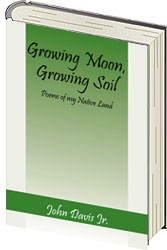
coverBlog followers and fans, THANK YOU. Because of your loyal support and great word-of-mouth promoting poetjohndavisjr.com, I am proud to announce that this weekend, my 2005 collection, Growing Moon, Growing Soil, will be available FREE on Kindle to those who would like a copy. The promotion begins on Friday and ends on Sunday, so grab a copy while you can! The site, at last count, has 257 followers, well above my initial hopes of 200. With your continued support and avid readership, my hope is to make this site into something that every artist, writer, and creative can enjoy. Plans for the future include video clips of readings, audio files of certain pieces, poetry prompts, and lots more.  Thank you again for your confidence; please see below for a link to the Kindle version of my book for your complimentary use:

Also, if any technical issues arise with the promotion, please provide feedback here. Happy reading!

poetry, Uncategorized

Gone Digital

coverHello, loyal readers. This is just a quick post to let you all know that my book, Growing Moon, Growing Soil: Poems of my Native Land, is now available as a Kindle edition. The digital version is far less expensive than the original paperback, but it maintains the character and artistry of the printed page. Please see the link below, and purchase your copy today! All proceeds will go toward advancing the literary arts in central Florida. Thank you as always for your support!

My book, in Kindle edition