life, poetry, publishing, teaching, Uncategorized, writing

A Farewell Book Launch

cover-for-adIn one week, I will be launching my latest collection, Hard Inheritance, at one of our city’s nicest art galleries. It is bittersweet, as this will be both the first and last book launch I hold here. I’ve loved my current city for 17 years, but this summer, my family and I will be moving to the west coast of Florida. My newest university teaching gig is a 70-mile drive from my present home, and making a 140-mile round trip daily is simply infeasible. By spring break, we plan to put our house on the market, and hopefully by summer, we will be in a new house in the Tampa Bay area. Timing, the market, and other factors will determine how quickly all this occurs, of course.

In the meantime, I’m excited to offer this new book, much of which has been inspired by our city, to the people of Winter Haven. My cover artist, a Winter Haven native herself, will be on hand to sign copies of the book with me, and invitees include people who have been supportive of my craft over the years that I’ve resided here. In many ways, this book launch is a fond goodbye to a place that has been kind to me and my family. The time I’ve spent here hasn’t been perfect — the same is true anywhere called home — but it has been inspirational.

Winter Haven’s people, its lakes, its nature, and its history have all woven themselves into my poems at different points along my artistic journey. I’ll miss all that over on the west coast, but there will be fertile material for writing there, as well. I’ve enjoyed seeing the vast salt water every day as I cross the Courtney Campbell Causeway or the Howard Frankland Bridge, and I feel certain that soon enough, my writing will take on a flavor that is more beach-driven. My hope is not to become one of those poets who creates trite rhymes about the sea, but rather, one who allows the environment to speak in its own way. Certainly that has happened here among the lakes of Winter Haven.

My wife’s family lives in Winter Haven, and doubtless we will be returning to visit often, especially during the summers. And yes, it will be a while yet before we’re out of the area. But this book launch allows me to reflect upon and salute a place that has been meaningful. The future is uncertain but hopeful, and it wouldn’t be possible without history. So, Winter Haven, a place of history, beauty, and opportunity, this book launch is for you. Best wishes.

life, poetry, publishing, teaching, writing

An Empathetic Farewell to Unpopular 2016

last-day-imageSo many of my friends have been cheering on the parting of 2016, thankful that it is about to fade into oblivion. As these last few hours tick by, I can’t believe I’m actually feeling sorry for a year in history. But 2016 has elicited that response from me, strangely enough. I feel that 2016 has been like that unpopular kid in class that everybody liked to pick on: easy prey because of difference. I, for one, kind of enjoyed 2016 — not necessarily for political or cultural reasons, but for its more personal milestones:

My fourth book (and by far my best to date), Hard Inheritance, received publication on December 5, and I have been honored by its critical reception. It was good to see a new book of poetry out there, and as 2017 waits just a few hours away, I fully anticipate that it will be a great year for my latest collection.

I received an incredible new full-time position teaching English and Literature at the university level, a long-time goal of mine. The job itself is both rewarding and intellectually stimulating, and I’m the happiest (professionally) I’ve been in a long time. My students make teaching a joy and privilege. That’s a sentiment I thought I’d lost, and now it’s back, thanks to the events of 2016.

Both of my sons have done well in different areas this year. My oldest son discovered a love for basketball, while my younger son has continued to develop himself academically and artistically in the new Montessori school both boys attend. My wife has continued to enjoy her work in the medical field, and my family life has been good, to say the least. My fortieth birthday meant a big trip to Lisbon for all of us, a time that none of us will soon forget for its meaningful experiences.

Maybe your candidate didn’t get elected. Maybe your favorite celebrity died. Maybe unnatural disasters befell your part of the world. But from my little corner of the planet, 2016 was more than okay. It was memorable, it was unique, and it was unpredictable. All three of these traits, while they can be negative, also give us things of beauty. And despite its occasional difficulty and ugliness, 2016 also had plenty of the positive. All we have to do is look for it.

life, poetry, publishing, Uncategorized, writing

How 5 became my life’s official number

handfiveAllow me to begin by saying I’m no numerologist. I do believe, however, that one day, we will all understand why the numbers in our lives intermingle and coordinate the way they do. I also believe that this overlap of figures is more than just mathematical. There is a purpose to the numbers, and it’s not just coincidental.

Here’s a good example: I was born on July 5. As a kid, I lived on Fifth Street. My stepdad was born March 5. My oldest son was born January 5. My best friend growing up had a birthday 25 days later than mine. Many of my other family members have birthdays, anniversaries, and other important dates that are influenced by the number five — maybe they’re multiples or maybe the dates add up to something five-related. Perhaps that last bit is stretching the significance a little, but you get the picture.

So I suppose it shouldn’t have surprised me when, the other day, my publisher emailed to tell me that my latest book, Hard Inheritance, had been published on the date of my grandfather’s death 12 years prior — December 5th.

To really grasp the importance of this chronological lineup, you have to know the kind of influence my grandfather had in my life. As a young child, I grew up on his citrus farm in Hardee County, a very rural community in southern central Florida. My grandfather loved me more deeply than almost any other person in my life, save my mother. He invested his time, his resources, and his wisdom in preparing me to become a hard working, honest, and thinking man.

He had flown 51 missions in World War II, and his American devotion carried well beyond his military service. He served his church as a deacon (a model I would later follow myself). He faithfully worked for the Coca-Cola Foods Division as a groves manager for decades before retiring to volunteer with my scout troop. I became an Eagle Scout because he taught me the value of persistence and perseverance; seeing a thing through to its successful end.

It only made sense to me when Hard Inheritance came out on the fifth. Of course it would, I thought, following the five-laden trail of bread crumbs throughout my life. It’s both fitting and bittersweet that this book, my best and most earnest to date, would become available to the public on a day with such meaning.

My hope now is that this volume would please him, were he still here. It celebrates the beautiful and the natural, but it also shows the events in life that leave our scars and calluses, both of which he was intensely familiar with. It celebrates Our Florida — that place that he, six generations of our ancestors, and now my children call home.

I think he’d like the history, the honesty, and the geography of this book. He’d probably laugh at the pieces he’s featured in, having forgotten an episode that seemed relatively unimportant to him, but one in which I find deeper relevance. He, too, was a “five” man, after all — born in the month of May, living to the age of 83 (subtract the two digits), and being great-grandfather to five children (3 girls by my sister, 2 boys that are mine).

Being connected to one particular number in such a vital way can sometimes be a Hard Inheritance  of its own. Rarely a day goes by when some important connection to the number 5 doesn’t crop up in my day-to-day life. Were I one to play the lottery, I sometimes think I’d buy one of those “Pick 5” tickets and just play all fives to see what happens. My statistician friends would discourage this, of course, knowing the wild improbability of winning from such a choice.

But if it’s one thing that my life has taught me, it’s that all the cold, sterile math in the world can’t explain the way that numbers work. There is no algebra, no geometry, no trigonometry or physics formula to rationalize how the figures align. And in that same logically inexplicable space, poetry lives.

Tomorrow will mark five days since my book was published. I will celebrate by watching my oldest son, number 35 on his basketball team, play his final game of the season. I will think of how proud my grandfather would be — both of my writing and my boys’ achievements. I will hope for more fives in the future. And I know that I will surely receive them.


life, poetry, publishing, Uncategorized, writers, writing

The Big Announcement

After years of writing and months of preparation, Hard Inheritance is now available! Just in time for the holiday season, this new volume contains works first published by such literary powerhouses as Nashville Review and similar respected journals.

Perhaps more importantly, though, it is a testament to life lived in rural Florida. Following in the footsteps of its older brother, Middle Class American Proverb, Hard Inheritance offers readers a glimpse into the trials, joys, and landmark events of time spent in places that barely get their own map-dot. Moreover, it presents a portrait of such places’ people — the hard, the charitable, the native.

Notable southern poet Andrew Hudgins says this about Hard Inheritance:

“The poems in Hard Inheritance are set firmly in the poet’s ‘ancestral terrain’ of small-town Florida. The landscape is lovingly but unsentimentally brought to the page, and it is peopled by the poet’s family, friends, and fellow parishioners. … These truly are ‘songs sculpted by home’s hard structures.'”

And award-winning poet Sandra Beasley adds:

“What is architecture, without its inhabitants? ‘In our heart pine handmade farm house, / my grandparents were window weights: // cast iron bars tethered in country wood, / plumb and place-holding pendulums.’ What is a field, without the hands that tend it? In HARD INHERITANCE, John Davis, Jr. recognizes the potent ecosystems of everyday life, as in “What the Grove Knows”: “Stirred soil lifts its secrets to the sky. / Revealed and overturned crickets / invite snowy egrets who eat them.” Readers will enjoy taking a joy ride on an untethered dock, hunting down poisonous white frogs, harvesting worms before a father and son’s angling expedition, and hand-nestling one newspaper section into another before the morning’s delivery. Yet these poems resist mere nostalgia; the author’s voice is attentive, conversational, and wise to how class shapes the landscape at hand. Given graceful and balanced stanzas, consonance of word choice, and the unexpected glimmer of a pantoum, I admire both Davis’s rigors of craft and vitality of spirit.”

I’m incredibly excited by this new release, and I hope you’ll pick up a copy to fill a stocking or to surprise that word-lover on your list. Get one for yourself, while you’re at it. Here’s wishing everyone the warmest of holiday seasons! Happy Reading!

BUY HARD INHERITANCE HERE: Link to purchase the book


poetry, publishing, Uncategorized, writing

Cover Revealed!

hardinheritance

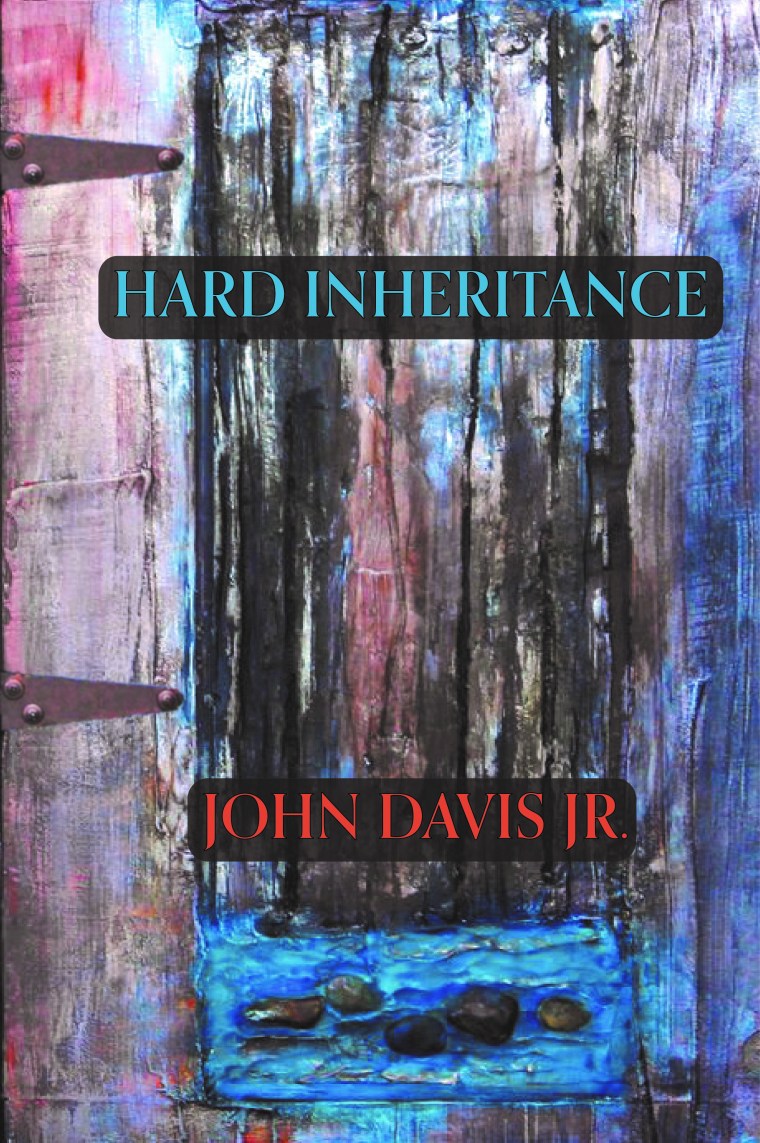
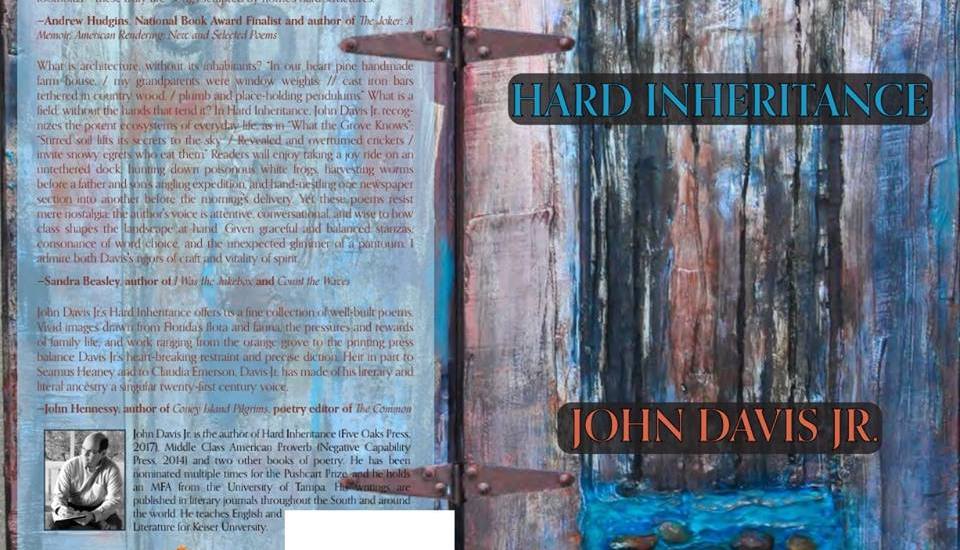
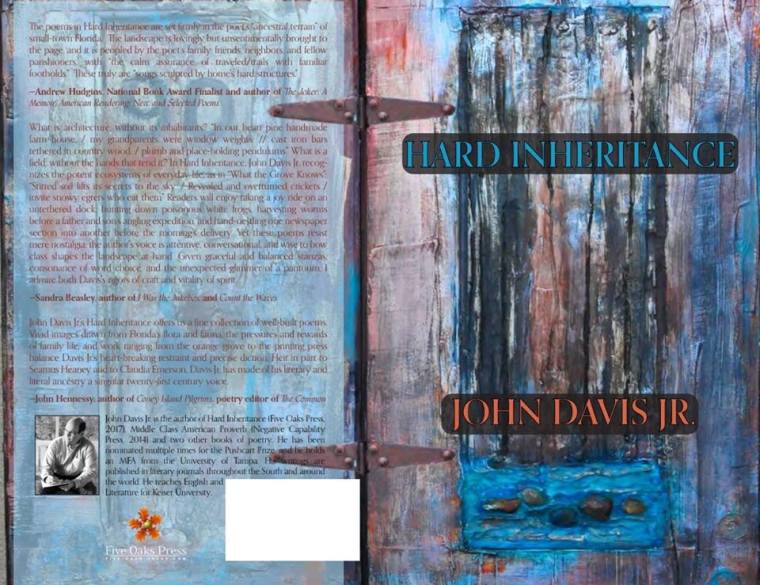
Thanksgiving is always a great time for my family, but today was made even greater by some unexpected news: The cover for my latest collection is now completed! The wonderful people at Five Oaks Press emailed me to let me know that the cover, complete with art from the inimitable Tinia Polk Clark, was ready. So here it is for your enjoyment. If you think this cover is great, however, just wait until you read the book!

My greatest pleasure is that my book was honored by blurbs from the likes of Andrew Hudgins, Sandra Beasley, and John Hennessy — all highly esteemed voices in the literary community. Their vote of confidence means a great deal to me, and I’m hopeful that their words, seen here on the back (left) cover, might give you, reader, some idea about the book itself.

Soon it will be time for book launch arrangements, readings, signings, and the like. Stay tuned here for all the details. In the meantime, Happy Thanksgiving, and thanks for following!

poetry, publishing, teaching, writers, writing

Catching up with a Great Mentor

peter meinkeRecently I had the privilege of driving our state’s poet laureate to and from my employer school for a special reading and appearance. Peter Meinke, author of multiple volumes of poetry and prose, professor emeritus for Eckerd College, and long-time St. Petersburg resident, was one of my mentors in University of Tampa’s MFA program, and before that, he edited my work and instructed me at other workshops around Florida. If you take a look at my book, Middle Class American Proverb, you’ll see that one of the blurbs on the back is from Peter, as well. His advice helped form my personal aesthetic, and his appreciation of forms helped give me a bigger poet’s toolbox.

Conversations with Peter are always interesting because he’s been in the literary game long enough to have stories aplenty about the teaching and writing life. He’s worked with some of the biggest and most recognizable names in the poetry community, and he’s won a plethora of awards, although he’d never brag. In many ways, Peter is what I would consider “the poet’s poet.” So to be driving this gentleman to and from his home was a real treat for an emerging writer.

I had the opportunity to talk with Peter about some of my recent endeavors, poetic and academic alike. I mentioned that I’d applied for a few different things (programs and such), and he replied, “You know, sometimes you get struck by lightning. Something just comes to you out of the blue when you least expect it. Somebody calls you up, and you can hardly believe it.” He talked about a few of his own such experiences, and then finished up with, “…but you have to put yourself out there.”

We chatted a while about some of the folks we both knew — where they were, how they were doing, who had vacated or filled positions here or there. It was richly rewarding to converse with someone who shared a common vocabulary and a common set of interests.

As usual, Peter’s appearance was met with applause and appreciation. Students and community members lined up for his book signing afterward, and he took pictures with several of my awe-struck pupils. The night was memorable, successful, and enjoyable for us all.

On my way back to my own home after dropping Peter off, I was filled with the hope that one day, I too could provide the gift of experience to some up-and-comer. As great as poetry is, passing its “fever” on to others is even greater. And therein lies the quiet strength of our state’s poet laureate: his legacy of learning and love of language. Might we all aspire to leave similar tracks for others to follow.

life, poetry, writers, writing

In Praise of Being “Mainstream”

The Cast of


As a kid growing up in the 80s, my television family was the Seavers, not the Cleavers. Every boy my age wanted to be Kirk Cameron (Mike Seaver of Growing Pains), or maybe Michael J. Fox, who played Alex P. Keaton in Family Ties. Shows like these made it seem cool to be like those families and their kids, for certain.

In today’s literary community, aspiring toward a more traditional type of success has been replaced by a phobia about being “too mainstream.” I was reading an article just the other day by a respected author who lamented that her life was “becoming too mainstream,” which she defined by tasks like going to the grocery store, washing dishes, and tending to the relationships beneath her roof.

Sadly, being responsible and attempting to live a reasonable, self-sufficient life are both ideas that have been denigrated by various media in recent years. The notions that we should work ethically, raise a family, seek advancement in a single field, and aspire toward something greater than self-satisfaction are frowned upon by a vocal minority. There are those, after all, who believe such ideas to be too old-fashioned, too whitebread, or too puritanical for the twenty-first century.

But this isn’t a political post. I’m here to defend the value of the mainstream in our literature, specifically. There is beauty in the common, after all, and while socio-cultural activists may be trying their hardest to redefine what constitutes “the norm,” Joe and Jane Average still know that their lives — complete with light bills, plumbing repairs, and runny noses — have wonder, merit, and poetry in their seemingly mundane routines. Eschewing the everyday limits the scope and reach of our literature.

What’s more, by omitting mainstream details, artists portray a fallacious picture of what our world is really like: Rather than giving readers honest visions of life, many are seeking shock value, or perhaps some abstract, inauthentic version of their environment. In the end, both of these motives generate lies — creative, occasionally beautiful lies, perhaps, but lies nonetheless. While I’m no Realist (artistically speaking), I also don’t believe that writers should fear the mainstream. Give us the sidewalk cracks, the wasps and overdue notices in the mailbox, the wiffle ball stuck in the backyard oak tree. There is poetry in all these things, and there is life.

Being mainstream, by the way, isn’t all that bad, you’ll find. Parenthood and the obligations of marriage, career, and family life remain sources of great inspiration, just as they did in prior generations. Maybe it’s not new, it’s not avant-garde, and it’s not the “artist thing to do.” But I’ll take it any day over the exotic or the crazy. To be clear, I’m not saying “mainstreaming” is for everyone. However, I am saying that in going about the business of writing, we as authors should not be scared of that which seems standard. For it is the run-of-the-mill that yields the exceptional, the original, and the special. And that, writers, is what we’re after — the diamond in the rough, the pearl inside the oyster, and the rainbow out of the gray. Without the ordinary, there can be no extraordinary.

poetry, publishing, writers, writing

On the Color of Names

Asian-sounding Pen Name Gets White Guy in Trouble

So, I read the story linked to above from the Washington Post. Here’s my two cents, for what it’s worth:

As a plainly named, semi-average white guy, I too have considered using a name that sounds “less Caucasian.” In today’s literary marketplace, it sometimes feels like people with humdrum, plain-Jane names get overshadowed by those without them, no matter what the ethnicity, gender, or background in question may be.

“Oh, to be a Li-Young Lee, a Marina Tsvetaeva, or a Yusef Komunyakaa!” say the Joe Smiths of the writing world. Of course, poets’ names are not their strength (although the aforementioned ones, especially, are impressive and beautiful sounding). It is the authors’ fine work that has earned them their spot in the literary marketplace. Their awards are many, and rightfully so. It is not a matter of name alliteration, length, or origin that has raised them to prominence; it is the quality of their writing, and a strong history of artistic contribution.

Statistics from a number of sources show us that writers from historically underrepresented communities still struggle to get their work in front of readers, and the good folks at Vida: Women in Literary Arts have demonstrated the imbalance between published male writers and their female counterparts. Nonetheless, when one opens a copy of Poets and Writers, AWP Chronicle, and other trade pubs that scribblers like me regularly receive, the most highly publicized writers can seem to be comprised of those with extraordinary and uniquely identifiable names, no matter what their color or creed.

Consider if you will the glossy back cover of the September 2015 issue of The Writer’s Chronicle: There, in a full-color ad for Grand Valley State University’s Poetry Night 2015, are Kwame Dawes and Aimee Nezhukumatathil. I wish I could be at the advertised event, not because I want an excuse to form such lovely names more often, but because these are exceptional writers. Inside the back cover, a full-page ad for the Sanibel Island Writers Conference (another event I wish I could attend this year) proclaims the presence of Edwidge Danticat, another brand-name poet whose work is as striking as her name, if not moreso. A quick flip through the magazine reveals Nikki Giovanni, Ravi Shankar, Minal Hajratwala, Luisa Igloria, and Natasha Trethewey, among other names like poems.

Admittedly, my name has sometimes raised an editor’s eyebrow or two because “John Davis Jr.” could belong to someone of any number of races. Sure, it’s a white guy’s name, but it could belong to someone of African-American descent, Native American descent, or any one of many other races, I’ve found. A quick run of my name through Google reveals a rainbow of people from all walks of life. Some are realtors, some are doctors, and one even ran for president in 2012. I’ve had editors presume I was African-American because my name reminded them of another famous “Davis Jr.” — Sammy Davis Jr. No joke. I didn’t mind the confusion, nor did I take offense. But then, I’m a member of this country’s majority. My people are not disenfranchised, nor have they faced excessive hurdles in society. And maybe that’s why Michael Derrick Hudson’s decision irks me.

It irks me for the same reasons that dialect-discrimination irks me, actually. I’ve had plenty of people assume over the years (based upon my size, appearance, and Floridian accent) that I am ignorant. “Dumb Southerner” is the label some have attached without knowing my full story. They hear my use of the colloquial “y’all” and jump to their conclusions, which are, ultimately, dead wrong. Yes, my family has farmed for three generations (at least). But we’ve also been educators, doctors, lawyers, professors, and Air Force pilots, just to name a few other roles. I don’t appreciate others assuming we’re hillbillies any more than writers of Asian descent appreciate “Yi-Fen Chou.”

So what’ll it be, Mr. Hudson? You think your name sounds too Anglo-Saxon? Oh, gosh. Better fix that right up. You’ll never get published now. It’s not like Billy Collins, Ted Kooser, C.K. Williams, or — let’s go back a ways — Edgar Allan Poe, Robert Frost, or W.B. Yeats have had any luck. I can see your quandary, what with all the illogical repression of white male names and voices, It’s clearly a wonder that your work has managed to see the light of day.

But I get it. I really do. All those delicious-sounding syllables from diverse cultures are out there, just waiting to be exhaled. And they’re tempting. I know they are. That, however, doesn’t make them yours to appropriate. Might I be so bold as to suggest Mr. Hudson read an excellent essay by Henry Louis Gates Jr. entitled “What’s In a Name?” I assign it to my students regularly. When you read it, consider yourself Mr. Wilson, Michael. For in essence, you have called Asian and Asian-American writers everywhere “George.” And that’s not okay.

poetry, Uncategorized

Of Robert, Emily, and Thoughts of Legacy

Emily1
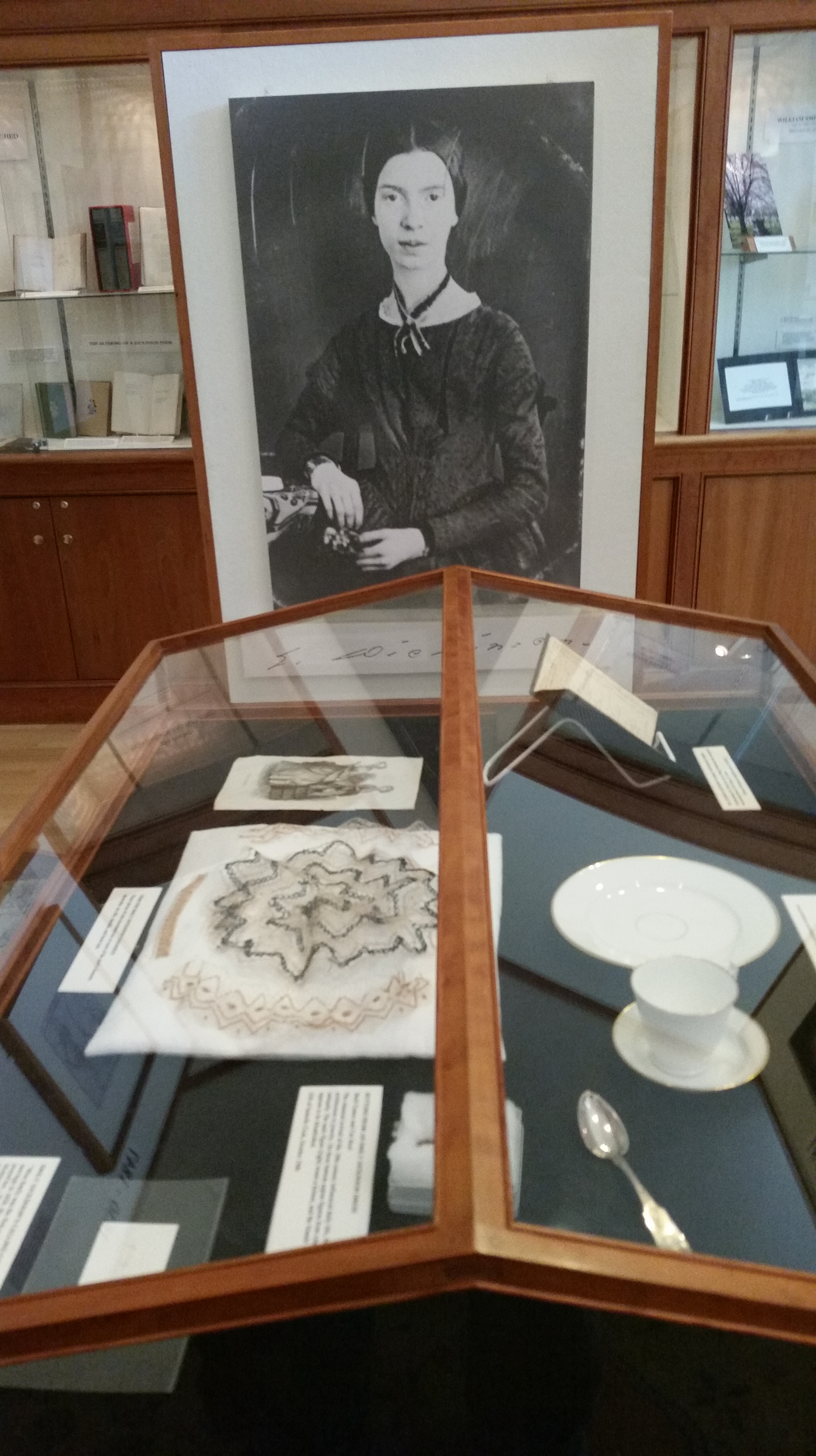
Emily Dickinson’s portrait in the Dickinson/Frost collection of Jones Library, Amherst, Mass.

Recently, I attended the Juniper Writing Institute at University of Massachusetts in Amherst. For the unaware, Amherst is the hometown of one of the canon’s most memorable and memorized poets, Emily Dickinson. Also nearby, one can find the farm of another great American poet, Robert Frost, considered by many to be the landmark poet of the 20th century. Both of these poets have meant a great deal to me as a writer throughout my career, and being in their part of the world was an unforgettable experience.

But my own independent studies of both Frost and Dickinson raised a new question for me — one that awoke me at 3:30 a.m. the first night of the conference. So distracted was I from this recurring question that I arose from my semi-peaceful travel slumber to write by hand in my journal. Here, in its unedited version, is the transcript of my late-night, early-morning writing:


6/21/15, 3:30 a.m.

I am awake because Emily Dickinson will not leave my mind. Having visited her house yesterday, I keep seeing her small corner bedroom over and over: its little sleigh bed, its dresser, its white-knobbed doors.

The Dickinson House in downtown Amherst.

Most of all, though, I think of all its windows. The tour guide kept using phrases like “extraordinary fenestration,” and she did not exaggerate. The natural light in Emily’s room was almost church-like. White and spiritual, it seemed to give life to the broad, thick beams of hardwood flooring there. As old as everything was, the light carried no dust. The air in her quarters was as pristine as the white housecoat she sewed for herself. On that air was the scent of history, a rare mixture of old wood, natural fibers, and unstirred earth.

I glimpsed the Amherst world from her window. Her tiny desk was positioned before it, and for a second, I could visualize her sitting, penning lines of legacy. Some of these lines also awoke me today, mostly her first lines:

Hope is the thing with feathers

I dwell in possibility

My teacher-mind sets to work on these, and I envision exercises for my students:

(Abstraction) is the thing with (concrete object)

What idea or notion do you “dwell in,” and why?

EmilyCollection
A collection of Emily’s things at the Jones Library in Amherst.

 The second of these questions applies to me as well, for once again I find myself too fixated on the idea of leaving my mark as an artist. I dream of a time when others tour my family’s farm or my smaller lake-view house in the city to see where and why and how I worked. Even at this mature age, my boyish whims of literary celebrity return, thanks in part to Emily Dickinson. My pragmatism intervenes, though, and tells me I need to sleep before daylight arrives. [End Journal Entry]

So, I was at my most honest in the middle of the night. But my thoughts of leaving a literary trail for others to follow would not stop with Emily. No, not when the home and writing space of one of my all-time literary heroes was nearby.

Upon my visit to the Frost Farm in Derry, New Hampshire, I was privileged to see his barn, his house (both floors!) and the land surrounding. I stood where the great man stood, walked where he walked, and even trod the staircase his wife descended, prompting the poem “Home Burial.” All these experiences once again raised the concern of posthumous impact.

Would people want to similarly experience the spaces where I have created? Will my own work ever merit that kind of attention, before or after my death? The literary marketplace is full of Frost-wannabes and Dickinson-aspirants, and who am I to even ponder such weighty matters? How does proving oneself a “fanboy” of literature make one any more likely to succeed at literary and scholarly endeavors? And thusly, I tortured myself further.

I visited the Robert Frost Library. I spent hours perusing the Frost-Dickinson collection in the Jones Library of Amherst. I allowed my imagination to run wild with scenarios concocted only from the notion of greatnesses recognized. And once again, I found myself twisting my brain into the same enigma that it has puzzled over like a Rubik’s Cube countless times before: Will I matter? Will my work matter? How do I ensure both? What steps must I next take to be certain that I’m not forgotten, like so many writers of the past?

EmilySign
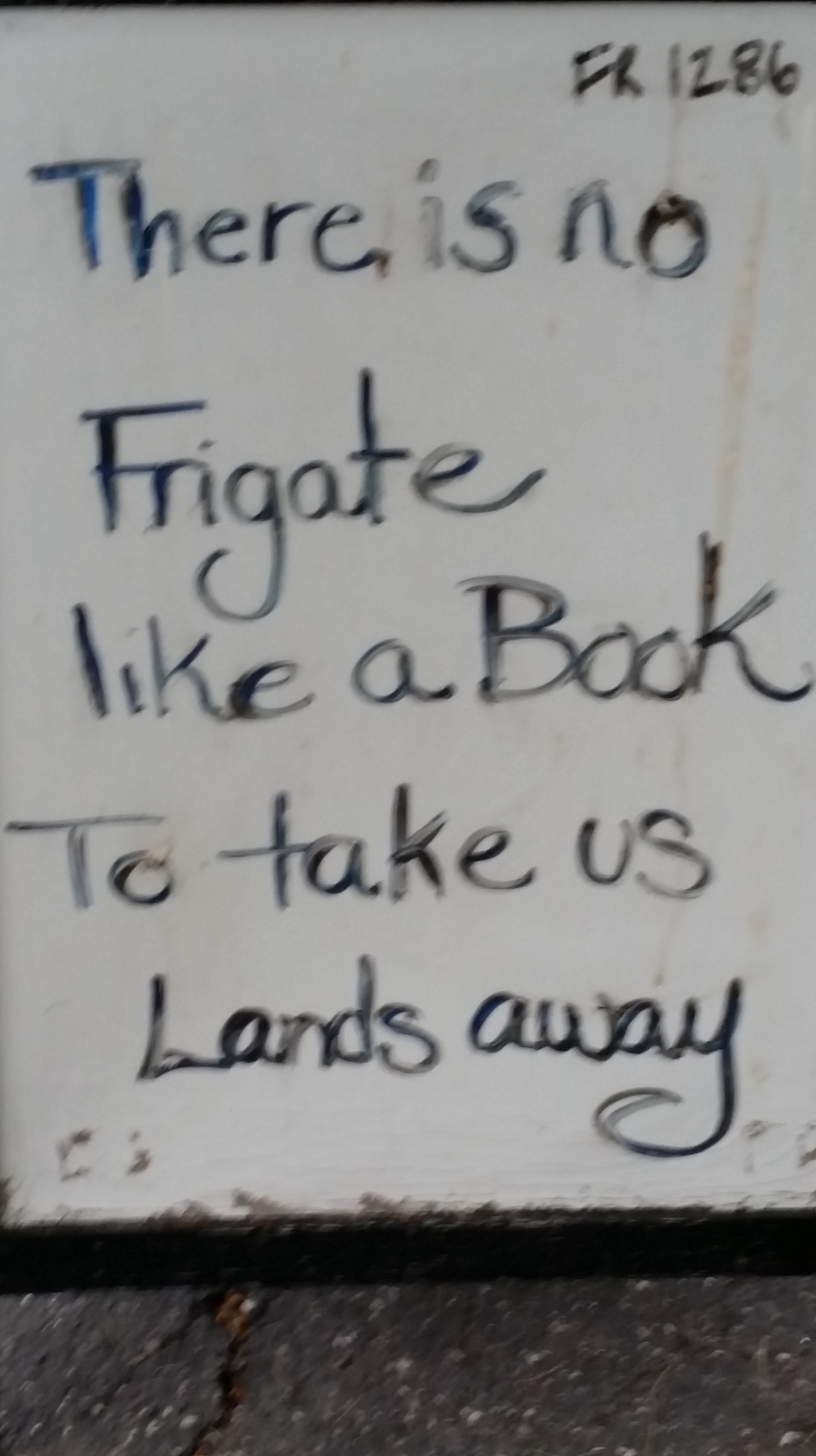
A sign on the grounds of the Dickinson House in Amherst. This passage is directly from Emily’s poetry.
FrostBust
A bust of the great man himself inside the Dickinson/Frost collection at Jones Library.

I had hoped by now, at my nearly 40 years of age, that such concerns would really be a thing of the past. After all, I continue to write, and I’m sure that one day I’ll see some wider recognition than my meager efforts have so far produced. Like all writers, I’d like a Pulitzer and maybe some other big awards (see prior posts), but honestly, at the end of the day, what I’m really aiming to do is preserve people, times, and places that have mattered to me the most. If my poetry results in just a few people gaining a broader appreciation of the heritage, values, and experiences I’ve received in this life, then I’ve won. And I don’t mean that all of my poems are totally autobiographical — certainly many are not. But all of them lend themselves toward ideas, visions, and perspectives that, however universal, have arisen somehow from the life I’ve lived.

Will people care about that life? Why should they? Will students sit through laborious documentaries about the different periods in my writing timeline? Will my work be anthologized in textbooks of the future? Such inquiries can drive one mad, if left unchecked. Spending countless hours in the homes of the greats might not make me a better writer, but it did accomplish one thing — it allowed me to see a shared humanity, a common thread of inspiration, motivation, and dedication.

Persistence, diligence, and  enormous creativity are shared traits among those we celebrate today, so long after their earthly departures. And perhaps it is these traits that we should take away from memorials and museums commemorating their contributions. More than the vanity of asking, “How can I attain their level of distinction?”, perhaps we (I) should be asking, “What can I do continuously and creatively well to positively affect my world?” Such a question surpasses the superficial desire for remembrance, and enters us into a more philosophical, even theological, realm. May our answers lead us not to fame, not to fortune, and not to solipsism. Rather, may they lead us to be better human beings, produce finer work, and seize the opportunities of the everyday.

Frost's Desk
Robert Frost’s writing space at Frost Farm in Derry, N.H.
FrostStatue
A statue of Frost just outside the Robert Frost Library at Amherst College.


poetry

Against Obviation of the Abstract

colorful-abstract-face-chris-bradleyIn just a few short weeks, I’ll be speaking to the graduating class of my alma mater’s MFA program. I’m supposed to be addressing “Life after the MFA,” a subject that I’ve become intimately familiar with over the last year and a half. In preparation for this talk, I’ve been looking over some of the notes I once took in MFA workshops, seminars, and synthesis sessions, and I’ve found that, while apart from the academic structure of the program, I’ve developed a discerning sensibility about some of the issues presented by professors in grad school.

One subject is that of using the abstract vs. using the concrete. Not one, not two, but three different professors in the MFA program at different times encouraged students to eschew abstraction in favor of concrete images. This is a good idea for beginning writers like the ones I teach, as their poetry is often littered with pathos in the form of notions like love, jealousy, rage, and abandonment.

But to lay down as a rule the idea that anything abstract or intangible must be omitted is incorrect, or at the very least, in need of refinement. The truth that I’ve found is this — using the abstract in poetry is much like using anything else in art: too much, and the work will become imbalanced; too little, and the work will lack relatability. This is especially true in the use of one of my favorite literary devices, the zeugma. For the unfamiliar, a zeugma is a combination of something concrete with something abstract in a line of poetry (or literature): “She spoiled her honor and her Sunday dress,” for example. Using too many zeugmas cheapens a poem and casts the image that the author must prevail upon parlor tricks to wow the audience rather than solid content.

But the right zeugma in the right place can make a piece sing. Just like similes, metaphors, oxymorons, and the whole array of other literary devices, the zeugma too carries its weight. And without abstraction, the zeugma is relegated to the status of a single image, a single item. Abstraction is necessary for this device and so many others to work.

“Everything in moderation,” the old saying goes, and in poetry as in life, this cliche actually holds true. Plenty of concrete imagery mixed with the right amount of abstract language can produce beauty, truth. Will I, like my former professors, prescribe my advice to near-graduates?  Probably not. I’ll probably discuss the pragmatics of literary life — the necessity of staying in touch with fellow writers and readers, the merits of continuing to submit work, and possibly the necessity of overcoming rejections.

As for using the abstract, my students and I will continue to ply the often-holistic, qualitative language in our everyday writings. Rather than removing a tool from the writer’s toolbox, we will use it as a carpenter uses a plane — the write tool for the right job at the right time.