poetry, Uncategorized

Against Resolutions

pencil_redDon’t get me wrong: Anyone who has read this blog for a while knows that in years past, I’ve posted the “obligatory” writing resolutions post. This year, however, I have a new perspective. Not only are resolutions cliche, they are made to be broken. “I’m going to ________ this year” ensures that most likely, the sayer of the statement will not, in fact, do whatever filled in the blank. Resolutions, because they seem forced and common, fail for the very reasons people make them in the first place. Every January 1, people around the world become motivational lemmings, jumping over the same cliff as their fellow resolutioneers. Research proves that, for the most part, people fail at keeping these well-intended goals. “Everybody’s doing it” doesn’t stop at high school, and the broken resolutions of the majority prove that the artificiality of popular sentiment will not sustain us individually as we seek after objectives in our personal and professional lives.

So as a writer, to say, “I resolve to (get my new manuscript published by Knopf, get work into The New Yorker, win the Pulitzer, etc.)” is a silly endeavor at best. One, because many of the victories of the writing life depend upon a healthy dose of reputation, timing and luck; and two, because we as authors and creators should be constantly resolving to put forth our best, not just at one time of the year. If we desire to really resolve something (in every sense of that word), it should be a daily effort rather than an annual one.

Do I have goals for 2014? Sure. Am I going to increase my likelihood of failure by framing those goals in the dime-store filigree of a resolution? Definitely not. Fellow reader, if you’ve made your resolutions for 2014, good for you. I wish you the richest of success in the year ahead. May you shed those pounds, quit smoking, write the next Dover Beach, or do whatever it is that this day inspires you toward. Best Wishes, Happy New Year, and Cheers. I’ll be at my desk.

poetry, Uncategorized

Little Rituals

20130919-224853.jpg

Admittedly, I used the title phrase recently in a poem about a couple who wanted to build a new house. This set me thinking, however, about some of those small things I do to “signal” to myself that I am officially writing. I use a hot beverage, a particular location, and a few technological idiosyncrasies to get my brain in “writing mode.” This post explains those weird little habits that tell my brain it’s time to go poet.

If I’m writing during daylight hours, I usually have a cup of coffee in the mug pictured above. It’s thick ceramic, and there’s no telling how many years I’ve had it, but it serves as one of my neurological cues for writing. If it’s night, then maybe I’ll opt for decaf or some kind of tea, but I must have access to some hot drink in the mug you see here.

Secondly, I write in my “quiet room.” I think I have enough posts on that little subject, however. I have one desk for drafts, which I write by hand, and another desk for computer writing; that is, final drafts that make their way into my little PC. My computer, though, has given me a number of quirks that I never would have considered without technology: I begin by setting my margin at the 2 inch mark, for example. If the poem later deserves different formatting, then that can happen. But for the initial go-round, 2 inches is the magic setting for effective starts. I also insist on 12 point Times New Roman font. Yes, it’s old school, but it’s also clean and widely demanded by editors at respected journals.

All these little rituals verify to my mind that my unique brand of creating is happening. I enjoy the regularity and routine of these seemingly insignificant customs; if I changed them, I’d probably miss them, honestly. We never know how much our writing depends upon a couple of inches and a warm mug. And as the old country expression goes, “If it ain’t broke, don’t fix it.”

Until next time, loyal readers, enjoy your odd and inexplicable habits. They might be more important than you know.

poetry, Uncategorized

Latest publication: The Wayfarer

What a beautiful journal! The free e-edition is very nice, but I would encourage my readers to purchase the print edition — it’s worth the price, and small presses can use all the support they can get in these times! Thank you to the editors of The Wayfarer, whose skills and sharp eyes made this edition a visual feast as well as a fulfilling reading experience.The Wayfarer magazine

poetry, Uncategorized

An honest offer

cover

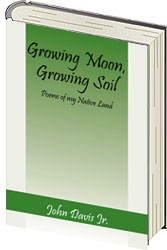
This is just a quick post to say that poetjohndavisjr.com has almost reached 200 followers! If I can pass the 200 follower mark by Friday, I will offer all of my blog followers free Kindle copies of my first book. The second collection is currently under consideration and should find a home soon. For now, spread the word about my site, and you can get a free Kindle copy of Growing Moon, Growing Soil!

poetry, Uncategorized

Epiphanies: A new blog entry series

brick All of us have them: Those ingenious revelations that visit us in a state of reverie, near-sleep, or near-awake. The problem comes for many of us when we decide to leverage our big revolutionary ideas in an approachable way for others. Epiphanies, elusive and sometimes seemingly divine, can be a source of pleasure or torture, depending on how we use them.

For the next several blog posts, I plan to highlight different types of epiphanies, and then present one way of leveraging them into applicable plans or products, especially from a writing standpoint. To begin, let’s look at one type of epiphany that regularly strikes the poetic mind: the analogy epiphany.

In this revelation, the poet or thinker is suddenly and shockingly aware of a similarity or relationship between two previously alien things. Usually, the two items in question are comprised of one concrete, tangible thing and one abstraction. For instance, when Robert Burns realized his love was a red, red rose, his writing documented that epiphany. Many may say that this thought lacked originality, as poets had been symbolizing love with roses for centuries. Often though, our own epiphanies are far from original as well. When we begin speaking in similes and metaphors about two previously disparate ideas, you can bet that an analogy epiphany is hard at work forming itself. Our “aha” moments need not escape us, however.

When the analogy epiphany strikes me, my first choice is to dissect the relationship between the two things using a plain, ordinary T-chart. You know the kind: Two columns created by one vertical line intersecting a shorter horizontal line toward the top. One topic goes on the left at the top, one topic goes on the right. From there, I’m able to list qualities, characteristics, and descriptors of the two things and see their similarities and differences with parallel acuity. Sure, this may seem elementary — a Venn Diagram or another instrument may work just as well for visual organization. But by having the two ideas side by side, I’m able to begin a larger process. About five or ten minutes into listing qualities, first lines begin to form inside my mind. I write these down. Maybe I’ll use them, maybe not. More often than not, refined versions of these first lines work their way into my poetry somehow.The two items often create a central metaphor around which the larger piece is built.

By examining relationships between tangentially connected things, the wheels and cogs of the mind begin to naturally create points of commonality that were previously unexplored. These connections are the creators of poetry, as well as products and plans in the business world. The more receptive we become to our analogy epiphanies, the better our world will be. Creators and connectors, keep your minds wide open. More epiphanies to follow.