life, poetry, teaching, Uncategorized, writing

What Robots and AI Can’t Replace

Everywhere we look, there are mentions of artificial intelligence (AI), robotics, and their implications for the future. News stories and social media feeds predict a heyday of ease and comfort as we assign more and more mundane tasks to technology (the art that accompanies this post was created by AI). In contrast, we’re also given the dark prophecies of Asimov and Bradbury come to life: When our computerized creations become so sentient that they can resent us, how will we control them?

More realistically, however, people are rightfully concerned about their jobs: Cashiers are already becoming obsolete, data entry by remote workers is becoming a relic, and countless other positions previously filled by people are slated to go extinct in the next few years. How, then, do we reckon with this revolution?

As the father of two older boys, one in college and one about to go there, I’m relieved that both of them have chosen irreplaceably human endeavors for their futures: One is in theatre, and the other plans to pursue architecture. These are professions that AI will never be able to fully usurp. After all, theatre is among the humanities, a select group of art forms and practices marked by their innate reliance upon authentic emotion and genuine experience. Our hamartia, the human condition, is ironically our greatest strength when it comes to livelihoods that are AI-proof. Architecture will be helped by AI, certainly, but to design and create livable spaces that consider the needs of complex people, we need human minds and hearts. Ask AI to design a mid-20th Century ranch house like the one on The Brady Bunch, and you’ll probably get a reasonable facsimile. But ask AI for a blueprint of a home that considers the individual needs of 21st Century family members, and confusion results — the blinking cursor begins to smoke.

As a teacher, I’ve already encountered the challenge of getting students to write rather than use ChatGPT or some similar product. For now, AI-generated writing is fairly easy to spot: Its reliance upon certain words and phrases, its preference for sterile-sounding language, and its occasional errors about obvious matters all make it detectable, even without running an essay or paper through an online checker or two. Combine those facts with a vast divergence from a student’s in-class writings, and AI use becomes obvious. But we know that technology consistently advances, and as time elapses, the fakes will become harder to spot, especially as classrooms become more tech-dependent. This is why some teachers and professors have gone back to old-school blue books, those lined-paper pamphlets of an earlier era, for class writing. And while I see the nostalgic appeal and hard-nosed devotion to justice driving such a practice, I also see its inherent temporary nature. Returning to number two pencils and canary yellow legal pads may get us by for a while, but students, parents, and clients of the new age won’t tolerate this Luddite approach for long. We need to find the middle ground between total AI reliance and achieved, owned learning quickly. Compromises like “You may use an AI editor for the writing you have authored independently in class” serve as a good start. This technique prepares students for the world to come without damaging their acquisition of knowledge. Further, they learn by seeing the corrections made by QuillBot, Grammarly, and other language-fixers. And if these products make a mistake as they sometimes do, so much the better. That’s where the real learning begins — technology has never been and will never be infallible, and the sooner students grasp this truth by experience, the better off they will be.

As a poet, I’m not worried about AI. I’ve seen the replica-poems it produces, and while some sound good on the surface, a closer look reveals that same artificial shimmer visible in the art that I’ve used above. Something’s missing; there’s a bad aftertaste like that of saccharine diet sodas from the seventies. An astute reader can tell that the cane sugar of the human touch is missing from this thing’s formula, whatever it may be. The “experiential resonance” — the sense that an event or product is organic — just isn’t there. Call it instinct if you will, but a reasonable human being can tell the difference between the things we do and make and the contrived, data-driven simulacra of thought-approximating algorithms. An initial, superficial “Oh, that’s lovely!” soon becomes an “Oh, this isn’t what I thought it was.” And that kind of deflating disappointment will toll the end of our infatuation with AI. Like any other once-novel discovery, this, too, will lose its luster.

So, what’s the big picture? The AI “scare” is similar to that of Y2K: Yes, we should consider it, but no, it isn’t Armageddon. As we prepare and adapt, we will add it to our toolboxes, become indifferent to it, and move on. Just as we healed the hole in the ozone layer, just as we eliminated acid rain, and just as we defeated diseases of long ago, we will coexist with this latest change until it no longer seems intriguing or threatening. We could easily theorize a future dystopia like those seen in science fiction, but it’s more likely that balance will prevail as it always has. For parents, teachers, and creators, AI is nothing to obsess over. Put simply, it’s just another thing. And if history has taught us anything, it’s that things are perishable.

Uncategorized

World Poetry Day, National Poetry Month, and New Opportunities

As World Poetry Day arrives (today!), and National Poetry Month waits just around the corner (April), I thought I’d offer a brief missive on literary matters both personal and universal:

Most people are poets to one degree or another, though some don’t like to admit it. When you walk outside and feel the temperature in the morning, your response to it is the beginning of poetry. The texture of the air on your skin, the combination of sunlight, birdsong, and environmental noise, and the state of the world around you (your seasonal lawn, the road nearby, the leaves that have fallen on your driveway)…these things are the earliest signals that your mind wishes to celebrate life by composing a poem. Most people immediately shut down this impulse with negative self-talk: “I’m not a poet,” or “That’s what somebody else would do,” or “That stuff’s too deep for me.” The truth is, we all want to record and respond to the world around us in artistic words; some folks just lean into that longing more than others.

There’s also that dreaded mental reservation called imposter syndrome. “I don’t know enough/haven’t done enough/can’t compete with experts” hinders so many earnest efforts. Nobody is the greatest at something the first time they try it, and there are plenty of metaphors and parables extolling the virtue of practice and patience. Being unwilling to try something because of initial frustration is ordinarily a child’s reaction, but in the adult world, too many creators quit before they’ve properly begun. Nowhere is this fact more evident than in poetry — the persistent thrive, even if they aren’t that great.

I won’t name names here, but walk into your mainstream bookstore and you’ll find the one shelf called a “poetry section” filled with poorly designed and badly written tomes by people whose greatest claim to fame is that they’ve penned trite cliches or radical malarkey for the last 25 years or more. And those “books” are placed alongside Dickinson, Shakespeare, and Frost. This literary injustice is a turnoff to those who may be considering writing well-crafted verses of their own, and it should be. But this sad fact should also be a motivator for producing better work for our current age. Make poetry great again!

So, how do we overcome a closed mindset regarding poem writing? The first step is to get inspired. Sometimes a little help can go a long way, and toward that end, I recently began a new mini-workshop by mail called “Metacreativity: The Process Behind the Poetry.” In this monthly letter, I offer one poem of mine, the backstory behind it, and the process it went through before becoming its final version. Sometimes seeing into someone else’s creative process inspires others to use their own, and this little communication allows readers to do exactly that. I also include a more traditional poetry prompt in every letter, and sometimes I add a QR code that links to an audio recording of the monthly poem. I also include news about my upcoming appearances, book signings, and other events when appropriate.

I’d love to add more subscribers to my growing roster for Metacreativity. Now more than ever, we need fresh voices putting more relevance into our world through poetry. And as celebrations of poetry begin in this first quarter of 2025, I hope you’ll join me in spreading good words. Whether it’s buying a fresh book of poetry or trying your hand at a sonnet, spring is a perfect time to appreciate beautiful language.

life, poetry, publishing, teaching, Uncategorized, writers, writing

Where Do You Get Your Ideas?

The title of this post is a question I often receive. Whether it’s in a writing workshop, a traditional classroom, or simply in casual conversation, people regularly inquire about the origin of creative ideas. Second only to this question is, “What do I write about if I’m not inspired?” Today’s post is an effort to answer both of these common quandaries with a single practice: Socratic Journaling.

Anyone who has spent a moment or two in school knows about the Socratic Method — that time-honored practice of invoking thought through questioning. First mastered by its namesake, Socrates, the method has served educators well over the years. And even today, we can use it to generate great ideas and to “get unstuck” in creative writing using a technique I pioneered over the course of 15 years.

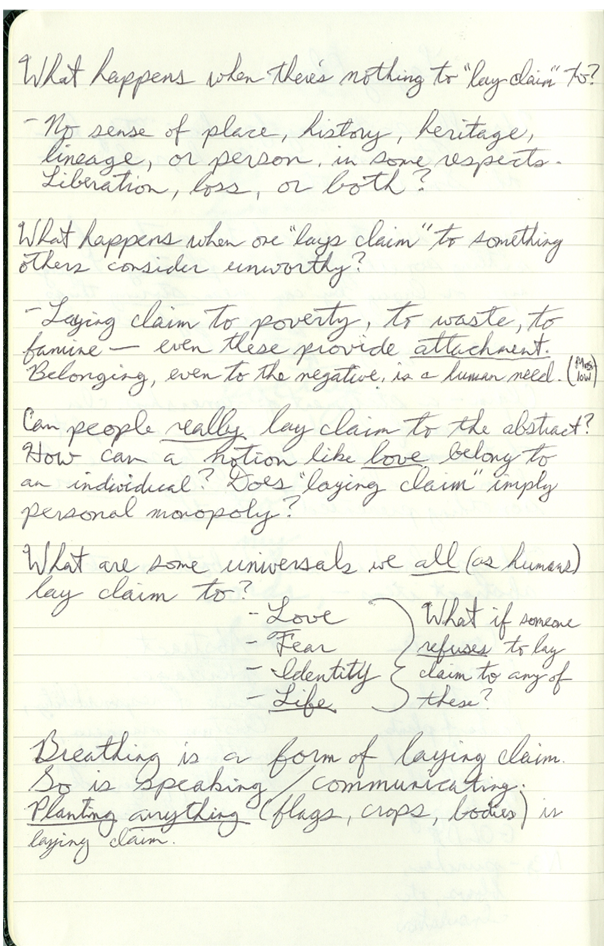
Socratic Journaling works like this: A writer begins with a “big” question (ideally, this should be one that is fairly philosophical or abstract) and answers it swiftly, almost without thinking. That fast answer then leads to another question, which leads to another answer that also then gets questioned. This process repeats until the writer finds within their questions and answers a subject to write about. See the example of Socratic Journaling below to get a better idea of what this process looks like:

A sample of my own Socratic Journaling that eventually led to a poem that was published.

In the sample above, I examined the nature of a simple phrase I heard growing up: “Laying Claim.” I thought the expression was odd, and so I gave it a thorough analysis through the wringer of Socratic Journaling. The result was a poem that integrated many of these initial wonderings and supplemented them with strong imagery. Occasionally, the act of asking and answering and asking repeatedly yields something different:

A response to a curiosity I had about sash weights in old farmhouse windows. This, too, became a longer poem later.

Drawings, scraps of curious artifacts, and other non-text items can often wind up in the pages of a good Socratic Journal. Historical notes, scientific questions, and even the logging of sensory impressions can serve as good kindling for the fire of creativity. By asking and answering sequentially, we break the often self-imposed limitations on our inspiration. This practice represents a kind of liberation, an unmooring from the safe harbor of pragmatism, and a break from mundane normalcy.

The great American poet Theodore Roethke once advised young poets to “…live in a state of constant astonishment.” Socratic Journaling aids in this quest for seeing wonder in everyday life. As the holidays arrive, what better gift could someone give than inspiration? I have collected and published some of the biggest “starter questions” for creatives of all sorts in the workbook pictured above. To give the thinker in your life a real present, spend $10 and watch their inspiration thrive as they encounter The Socratic Journal. Not only will you be providing the recipient hours of creative engagement, you’ll also be helping out a poet and educator who has some holiday bills of his own to pay.

Obviously, I’m a big believer in Socratic Journaling, not just because it has worked for me as a creative over the years, but because it has served so many of my students so well. When young writers especially feel mental drought, this practice stimulates them back into productivity. And if it works for the young, it can work for the…shall we say, mature? Give this a try. You won’t regret it. Thinking more deeply and more creatively is an incredibly rewarding experience, and The Socratic Journal can get you there. Click the link below to get your copy:

THE SOCRATIC JOURNAL by JOHN DAVIS JR.

life, poetry, writers, writing

Reflecting Further on Rockvale

Lately, I’ve been looking over some of the writing I did at Rockvale Writers’ Colony during the summer. As I’m doing so, I’ve discovered that some of the poems I created were more for myself than for publication. This is as it should be, I suppose. When one goes on a retreat for creative purposes, usually there’s a project in mind (as there was this time), but also, the getaway serves as a kind of “reset” switch for the creative brain. One such “just for me” poem came from the experience of wading Flat Creek:

Flat Creek at Dusk

All day, cicadas have echoed each other,
but now their calls grow soft
as the warren-drawn rabbit:
brown omen of evening.
Otters have stopped their playing,
the small black fish have gone,
limestone bed rocks settle their quarrels
as clear and shallow water darkens.

Creek, I have felt your cool
across my hike-tired toes,
pressed your slick moss with aching soles,
and wondered how many have trod
your stony, whispering trail
before me — another pilgrim
feeling Tennessee beneath
bare flesh smoothed by water.

It is likely I will never submit this piece to a journal or contest. I will probably refrain from including it in a packet of poems to an editor or publisher. This poem was a visceral response to a single and solitary experience, and it is precisely the kind of personal writing I referred to above. It isn’t intended for a large audience, but rather, it allowed me to be more present in the moment I encountered. Writers’ retreats often have this effect: They center the author, providing balance through seclusion. I am thankful for the time I spent at Rockvale Writers’ Colony, and one day, I may return. For now, the returns keep pouring in. I have a set of poems I “intended” to revise and perfect during my time there, but I also have these little treasures that allow me to return to a particular experience and feel that response to it again and again.

Sometimes people ask, “What good is it to go to a writers’ colony?” The evidence you see here is the answer. Time spent there is an investment that can never become lost or depreciated. Well after the stay is over, creativity continues to grow and flourish. Thinking back on the place and the emotional resonance of it gives the writer a small taste of peace, and often that taste is enough to open the channels of thought and innovation. Peace, after all, is a priceless and timeless gift.

life, poetry, Uncategorized, writing

What I Write When I Don’t Write Poems

Back-porch scribblings while looking across the pond.

Sometimes people ask me, ”Why don’t you write fiction or nonfiction?” My answer to them is, ”I do; it’s just not my first love or my calling.” I sometimes begin with prose before arriving at a poem. Today was one of those days. Sitting on my back porch with a yellow legal pad in my lap and a cup of coffee nearby, I began writing something, anything, to prime the mental pump. Gym-goers, consider this like the cardio before the weight training. As I cursived out a few initial throw-away words, the garbage truck pulled up out front, its brakes emitting that high, industrial screech that precedes a brief stop. This quick encounter prompted the following to appear on my notepad:

The sound of our neighborhood garbage truck takes me back to Fort Meade, circa 1986, when garbagemen (yes, that’s what we called them) would leap from the backs of slow-moving, dirty white trucks and, with Herculean muscle, lift and empty our large metal trash cans into the waiting, hungry mouth of the compactor in the truck’s rear. The work was filthy and stinky, and the men who did it went home every night smelling of other people’s refuse. But the men who did it grew strong and made a decent enough living to send kids off to college so they’d never have to become “sanitation workers.”

Today, the truck extends a mighty mechanical gripper. The machine lifts, empties, and returns the dumpster, which is lifeless gray plastic. There is no poetry in this process. No clang of cans, no yelling among workers. No Clyde, no Cecil [whose names we knew because they were embroidered onto gray-blue name-strips above their breast pocket, sometimes ripped]. No quick wave before the resumption of a route. Just an ugly claw taking waste, leaving vacancy.

Ironic, I suppose, that I openly stated the lack of poetry in modern rubbish collection. Had it not been for the shiny blue truck’s arrival and the sensations that went with it, my recollection would not have been triggered. I know that Cecil and Clyde (conveniently two C names) will probably make an appearance in a future poem. I know that those noises and memories will probably appear in that poem, as well. And I know that right now, I must allow those images and ideas to rest a while before they become something else. I’ll stash away this yellow piece of paper, and some morning at 4 a.m., much to my family’s chagrin, I will revisit this small vignette, and it will take on new life in my chosen genre.

This is what a life in literature sometimes looks like: not the gleam of an award or the bustle of a book-signing, but the simplicity of a legal pad, a ballpoint pen, and a cup of coffee. A view of a pond, a quick sensory stimulation, and a ready place to process all those thoughts that arrive. This is what I write when I don’t write poems.

life, poetry, Uncategorized, writers, writing

Writing the Living

There once was a famous poet (Robert Penn Warren, I think) who said something like, “Poetry is found in the living of life.” Obviously I’m paraphrasing there, but I’m doing so to make a point.

Recently, like so many other people in this weird time, I was furloughed from my full-time university teaching job. I have another three weeks or so before the furlough is supposed to be over, and even that expectation may prove false — who knows?

In the meantime, I’ve been devoting myself to other endeavors: my podcast, for example, or the Skillshare classes I create. But this past weekend, as my in-laws took my sons for a sleepover, my wife and I undertook a different venture: Kayaking.

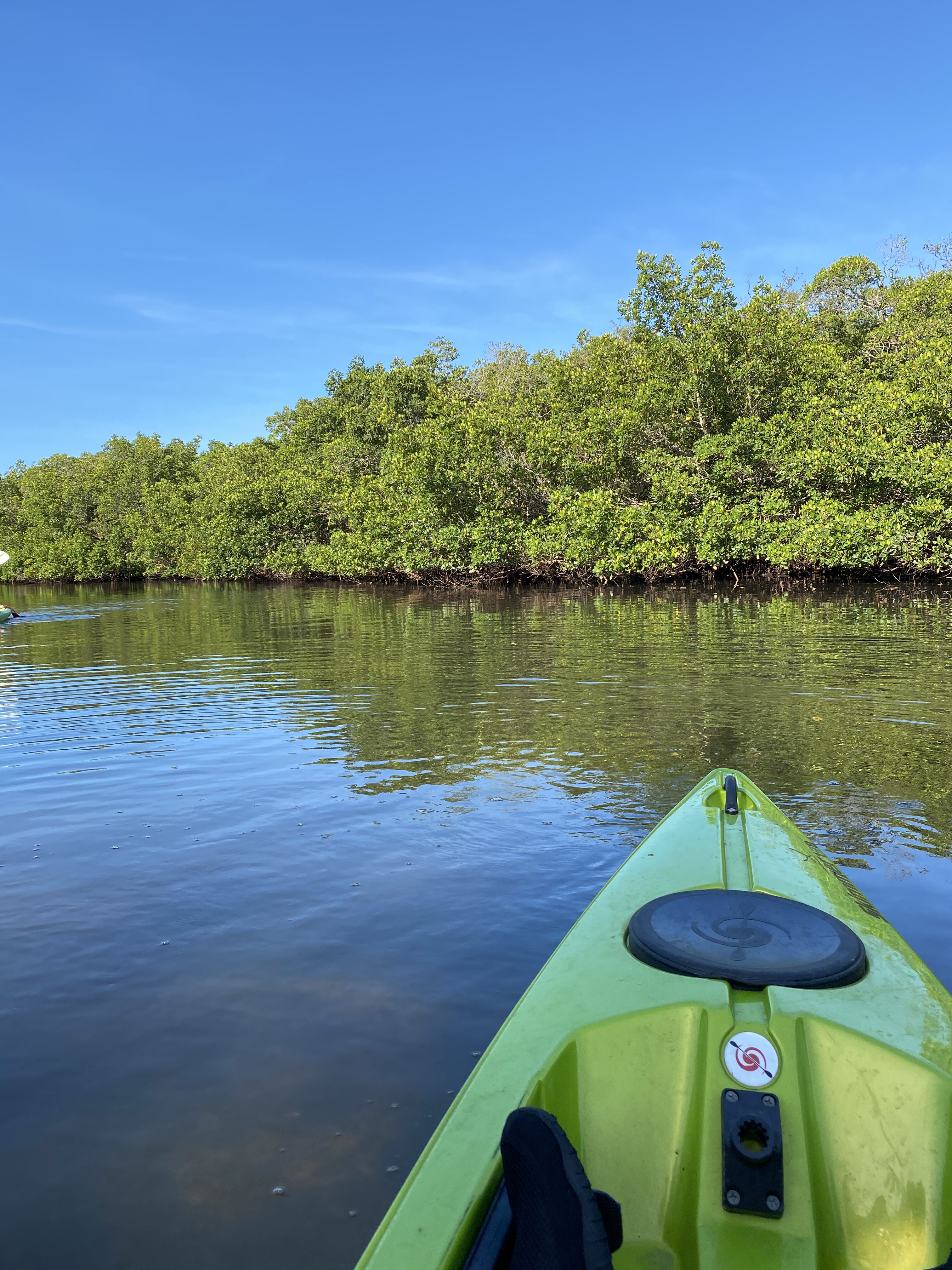
Kayak1

If you’ve followed this blog very long, you know I’m a pretty outdoorsy guy. I camp, fish, shoot sporting clays, and generally enjoy being in nature. But kayaking makes your mind different every time you go.

About this time last year, I was serving as a faculty member at the Word and Community writing retreat in Arbor Vitae, Wisconsin. While there, I kayaked almost daily. I’d set out at dawn and cross Trout Lake, visiting a small island in the middle of it. Some days the wind made the lake choppy, and staying stable was challenging. Other days, the water was like glass, the paddling was easy, and the big-windowed houses on shore seemed to smile at my presence there as loons sounded their cries in the distance.

That kayaking was different from the trip I took this weekend. For one thing, while at last year’s retreat, my mind was in a very “literary” place, and it was busy seeking inspiration (almost artificially) in minute details and newfound sensations brought on by foreign geography. Inspiration was found, but only when I allowed my mind to relax and stop trying to force poetry from every ripple in the water.

In contrast, this weekend was less about the literary and more about escape — Getting away from my stalled professional life, from my pessimism, and yes, even from my poetry. As much as I love writing, it has the propensity to consume me, too.

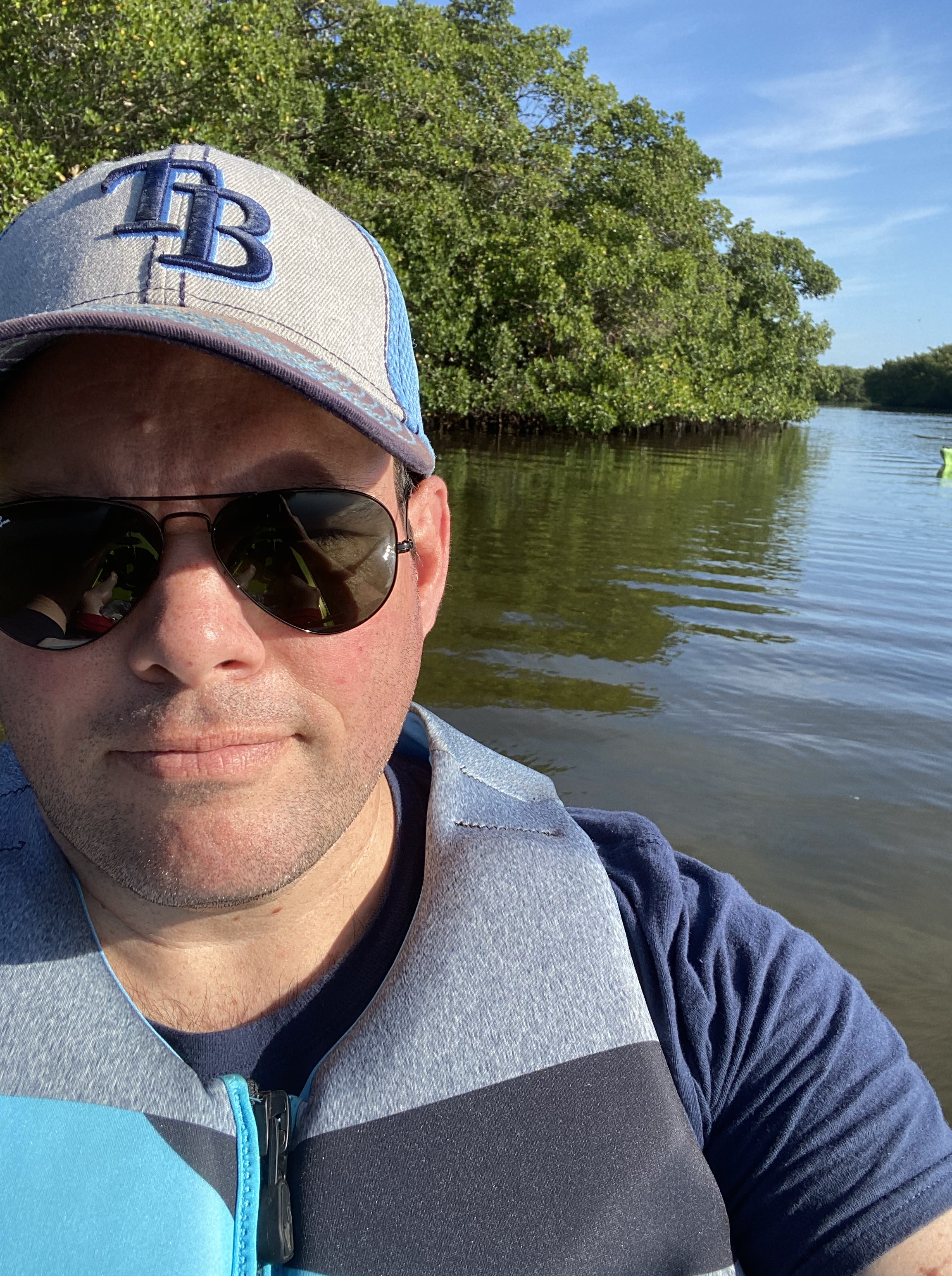
Kayak2

But what does all this have to do with Warren’s quote, you may ask? Kayaking is perhaps one of the best examples to demonstrate that writers need to go and do, not just write. The canonized masters of the 20th Century weren’t just sitting in their studies, thinking lofty thoughts and scribbling philosophical diatribes — they were men and women of action, and through those actions, they found literature.

Even if no immediate epiphanies arise from an activity, it is the living of life, not the recording of it, that counts. So often in our present, we think of travel and events in regards to their photographic potential. How will this trip or this exercise look on social media? Maybe it’s time we started enjoying things simply for their essence again. Rather than speculating about what kind of poem, story, essay, or photograph something will create, can we just live? Because I can promise you, if Warren is right (and I believe he is), inspiration will come to us. When our minds are clear and our worries are fewer, the words will arrive. In the meantime, there’s a new day ahead. Let’s seize it.

Kayak3

life, poetry, publishing, teaching, Uncategorized, writers, writing

The Joy of Writerly Objects

With all due respect to Marie Kondo and other “organization” experts, I’m not making my space utterly devoid of stuff. Here’s why: Stuff has history. Stuff is full of inspiration, and sometimes it can make us think in ways we ordinarily wouldn’t. And finally, stuff has meaning. If a thing has beauty as well as function, then it ceases to be what some experts would call “clutter.”

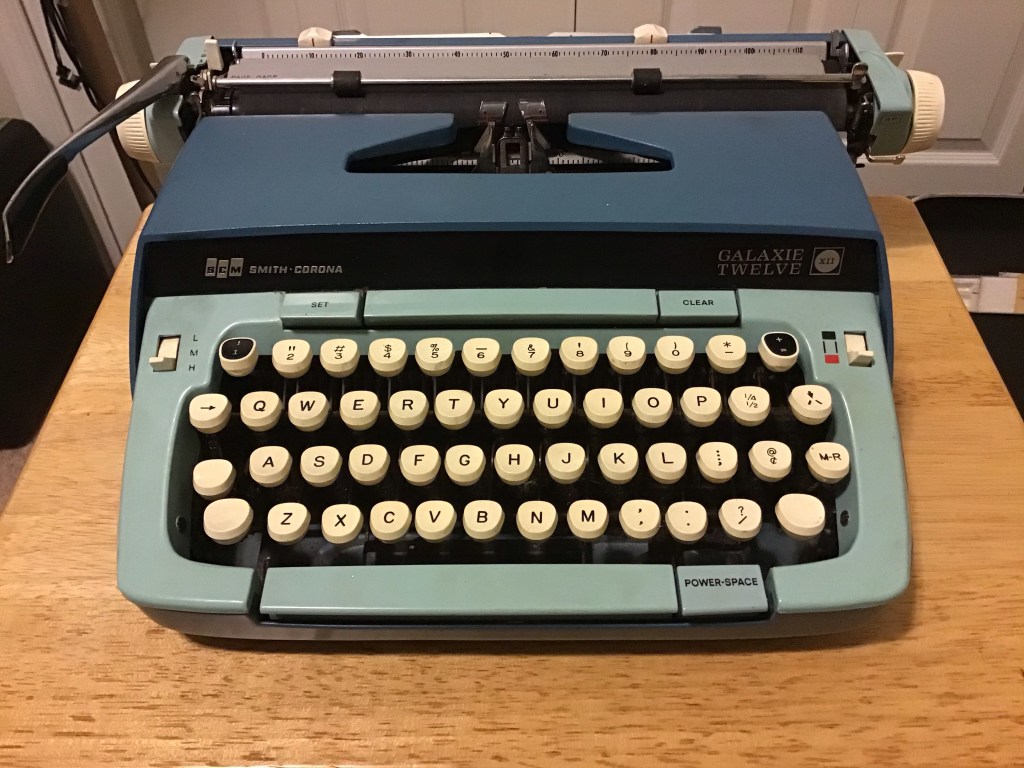
My Smith-Corona Galaxie Twelve typewriter. Molon Labe, home arrangement experts. I dare you.

Now before you call Hoarders and report me, let me say that there’s an extent to everything. My study is not overflowing with so much junk that I can’t even move, let alone think. But I do have a number of objects that I keep because of their inherent aesthetic value. Here, I’d like to talk just a little about the items I hold dear as a writer, and how my practice might suffer without them.

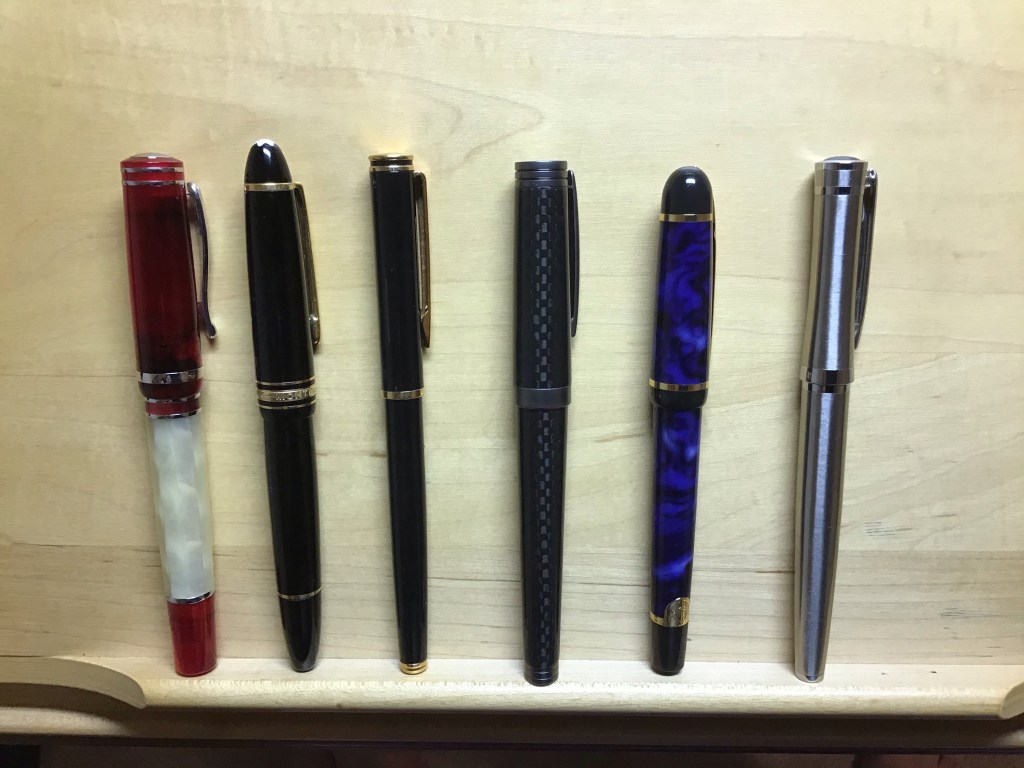
An assortment of fountain pens by Waterman, Montblanc, Levenger, and other makers. Vital to step one of poem creation.

Good pens are the frontline workers of the creative life. When smooth ink is flowing freely, filling good paper with artfully rendered words, the whole experience of writing is improved. I prefer old-school fountain pens because they connect me to generations of great minds well before our all-things-temporary present. Watching a crafted nib do its work motivates a writer to do his work in an equally elegant way. On my podcast, I talk about how connecting to things by touch can result in artistic revelation, thereby generating more output (writing or otherwise). Good fountain pens are probably the prime examples of this idea in action, and they’re good for Socratic Journaling, another idea explored on my podcast.

Uncle Hy’s ashtray — historically used in the evenings, when he’d puff on his pipe after reading the paper.

Some of the stuff I keep has sentimental value. My Great Uncle Hy was a swell guy — he was a businessman through and through, and over his lifetime, he did well for himself. One relic of his that I’ve kept is the translucent heavy green glass ashtray he used when smoking his after-dinner pipe. While I’m not a smoker myself, I use it these days to hold the aforementioned fountain pens and other office sundries. It catches the light the same way it did when I was a boy and became fascinated by its color and brilliance. The memory of Uncle Hy and his industriousness keeps me going when I feel like slacking off.

The compass box — just because it’s cool.

Some things call out to you when you see them. Such was the case when I saw this little faux ivory box at The Oxford Exchange in downtown Tampa. It holds paper clips and thumbtacks mostly, but it also reminds me to stay true in my direction. Its weight is pleasantly permanent, and opening it is always an experience filled with possibility, even though I’m well aware of what’s inside. There’s a kind of Indiana Jones mystique about it, so yes, it stays.

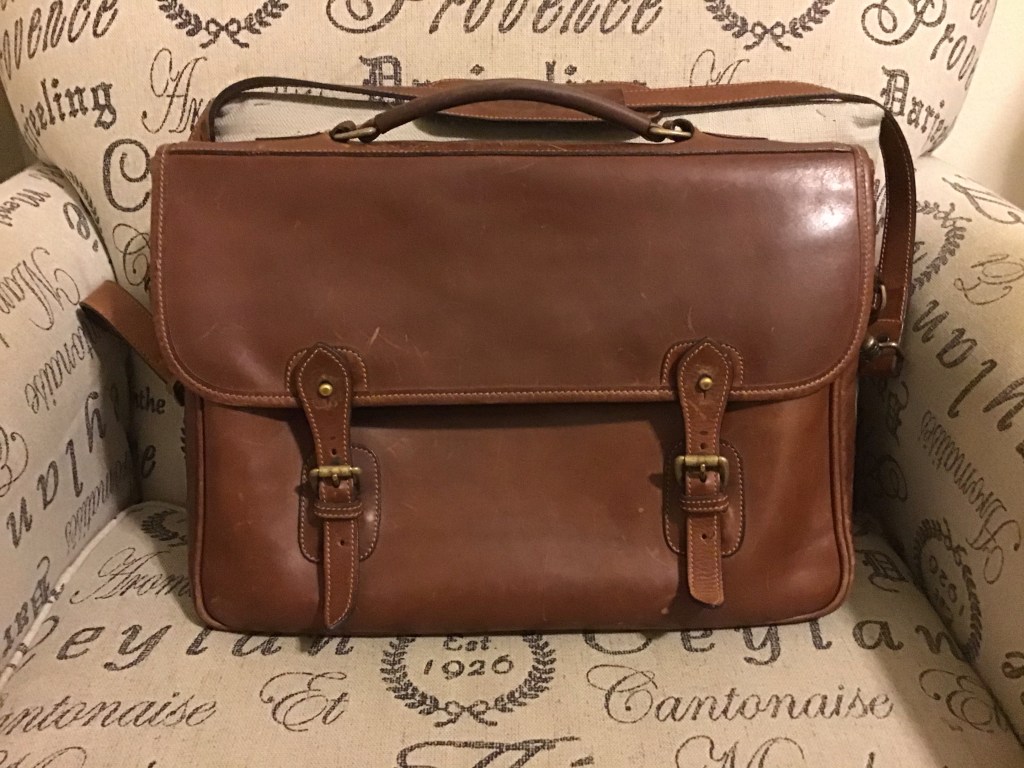
This briefcase has so many stories behind it…

My leather briefcase was given to me by my mother after I received my first master’s degree. Over the years, it has been to Lisbon, Portugal, Santa Fe, New Mexico, and lots of other spots. It holds everything I need, and frankly, it has become an extension of me — rare is the day when I walk onto campus without it. It even smells like literature.

So there you have it — an assortment of objects and keepsakes that make my literary life a little more inspiring. Minimalists and Feng Shui practitioners take note: These items might not be totally utilitarian, but they absolutely influence my creative process. Maybe you’ll say I should be willing to part with some of what I’ve mentioned here — my reasoning is too maudlin or clingy for your taste. Therein lies the beauty of stuff: Shakespeare was right when he said, “Beauty is in the eye of the beholder.” I enjoy beholding everything you’ve seen here. End of story.

Are there things that you can’t part with? Items that you’d feel a little more empty without? Use the comments section below to tell about your most cherished or prized creative possession…

poetry, publishing, teaching, Uncategorized, writers, writing

What’s your process?

abstract blackboard bulb chalk
Photo by Pixabay on Pexels.com

When I give readings, seminars, and workshops, I’m sometimes asked what my “process” is for writing a poem. That’s been pretty hard to elucidate until now. I just put together a new for-fun class on Skillshare here: Skillshare Poetry Class

In this course, I take students through the process of writing a poem. We begin with inspiration and how it gets generated, and then we proceed all the way through to the final, publishable draft of a poem. If you’re interested, I’d really love for you to join and be my “student.”

I’d also really like to see the poems that you create as a result of this class — Who knows? Maybe the next “Dover Beach” will happen thanks to this little endeavor…