poetry, Uncategorized

Faith, Cognition, and Creativity

It’s always dangerous to start blogging about potentially divisive issues like religion, especially on Sunday. But this post really isn’t about religion; it’s about faith and its role in the creative process. It’s also about how others within the creative and academic community perceive writers of faith. This post will probably cost me some readers, and I’m okay with that. I respect your views, and I’d like for you to respect mine as well. If you don’t, so be it. This is America, after all.

I have a lot of friends within the writing and arts realm who generally frown upon Christianity. They’ve had bad experiences with churches, pastors, congregation members, or other entities (choir directors, for instance). They’ve been fatigued by petty squabbles over methodology or order of worship. Their doors have been knocked on by cult members who say the path to prosperity and eternity is “my way or the hell-way.” It’s too bad, really.

In workshops and in seminars, there always seems to be a faction of holy-haters, and inevitably, they flock together to build the fire of their ire with the fuel of others’ guile. I happen to be a Christian, and I’m saddened by their disdain. Now before anyone gets the wrong idea, let me clarify: I am not what certain popular media portray as “Christian:” Quran-burning, hate-filled, condemnation spewers who bomb abortion clinics and wave “God Hates F*gs” posters. My Jesus wouldn’t do that.

My position is just this: In order to be “whole” people, individuals must engage not only their minds, but also the other aspects of their humanity– the physical, the emotional, and yes, the spiritual. My soul happened to be spoken to at an early age. I felt a sincere and innate desire to choose Jesus Christ as my Lord and Savior, and since that time, my Faith has given me “life more abundantly:” My highs have been the highest, my lows have been the lowest, but in every circumstance, my God has seen me through in a way that secular logic never could. Whether it’s been near-death experiences (I’ve been on life support twice), experimental brain surgery in my early thirties, or the thousands of smaller instances along the way, I feel certain that my life would have been much worse and less significant without Christ.

My personal faith isn’t the way some choose to engage their soul, and I get that. For some of my writer friends, Yoga is their spiritual exercise of choice. For others, they lean toward a different set of traditions. These same friends have sent me their “happy thoughts” or their “positive vibrations” when they’ve been doing their religious practices. I am not offended. We agree to disagree, and they acknowledge my prayers and practices just as I acknowledge theirs. Call it the spiritual equivalent of the “two-finger wave” off the steering wheels of our separate supernatural vehicles.

But herein lies the key to this matter: Faith, you see, is exactly that — metaphysical belief. It’s not a scientific theory to be diagnosed and dissected by the mind, and that element of mystery disturbs some of my colleagues. You cannot solve a spiritual question with a cognitive answer any more than you can use your heart as your brain. The two (in both cases) carry specific demands and capabilities that cannot be met or found in other ways.

Likewise, having a science-based argument about religion is like trying to apply duct tape to a rainbow. It ain’t-a gonna happen, friend. I know that my writing is stronger and my life is better when both most closely reflect and exhibit the tenets of my beliefs. When I’ve tried to “be someone else”  or write like someone I’m not, the product was passionless, synthetic, and ugly. I cannot “write like a Buddhist” any more than Richard Gere can act like he’s me (trust me, he can’t).

My faith has given me inspiration many times over the years. Granted, my poems have not become evangelical daggers that stab scripture into people; that wouldn’t help anyone, and it’s not my style. However, chances are good that if you’ve had a strong emotional (even spiritual) response or connection while reading my work, that’s probably not accidental, either. I’ll let the reader decide that little detail.

The purpose of this post, I hope, has been clearly conveyed. My intent here is not alienation or division, but explication and perhaps some provision of understanding. The closer we can come to being real with each other about all the diverse facets of our lives as writers, artists, and whole human beings, the better our world will be. If this transparency offends you, reader, I apologize. I would offer my warmest regards and highest hopes for all of us in the week ahead. And if you’d like, I’ll say a little prayer for you, too.

poetry, Uncategorized

The “Not Knowing” and its Value

Sometimes, the question IS the answer.

After the recent success of my post about Arthur Flowers’s advice to writers, I felt obliged to write another quicker but equally applicable piece about something else that emerged during my last MFA residency: “The Not Knowing.”

It seemed this phrase was everywhere over the 10 June days I spent at University of Tampa. Fiction writers, especially, swore by it. They recounted tales of how their stories simply “took on lives of their own” after a truly boffo first line or a vague inkling concept drove pen to page. As a poet, I failed to see the relevance. After all, poets like me are in the business of crafting lines one by one, giving explicit attention to the sound, the sense, the structure, and even the symbolism of each individual word. “The Not Knowing” seemed to be something that prose writers did, and even then, with sketchy success at best.

Usually, I have a pretty good idea about where a piece is headed when I sit down to REALLY begin writing. My brainstorming methods are sort of standard: If there’s a central metaphor at work (as there usually is), I start with a two-column note chart. This is a T chart, for those in business. Using this visual organizer, I’m able to see similarities, differences, and relationships between two things, be they objects, ideas, or something else entirely. Then, as the prewriting begins to hum, I usually have a few real zinging lines come into my mind. I write these down. I’ll use them later. Once I have  a pretty good collection of these musical lines, then I’m ready to begin really putting pen to paper in the poetic endeavor. So, as you can see, I’m fairly methodical.

There are always a few surprises that creep into poems: pleasant wordplay or unforeseen ironies. But usually, the act of creating poetry goes pretty much according to plan. I know that sounds terribly boring, but it’s true. I have an idea, I explore the idea, I create a product from the idea. Then there’s the refining and the rewriting. I go through A LOT of drafts on legal pads, and usually 4 or 5 on the computer screen. In all this process, there isn’t much room for “not knowing,” as my prose-writing friends described it.

So when the great “not knowing” happened to me, I was pleasantly surprised, both with its advent and its outcome. I had a pretty decent first line written down on an index card: It was comprised of a single striking image that had a few different elements working within it. This line had occurred to me during one of those between-class lapses when the tardy bell has not yet rung, and students are idling about, yakking and poking at one another.

When I pulled the index card from my pocket later at home, I just started freewriting (something I virtually NEVER do) based solely upon that single first line that really sang to me. I’d like to tell you the piece that came from this inspiration won me a Pushcart and a Pulitzer simultaneously, and that Natasha Trethewey has written me envious hate-mail because of it. That didn’t happen. However, what did happen was this: I was now able to look at a “spontaneous” piece, one that was driven completely by the great “not knowing” I’d heard about, and I could relate. All I had to begin with was one line — one line that had beauty, had potential, and had heart. And that was enough.

I know, I know. You probably want to see the poem now, right? Here’s the letdown, reader: I’ve sent that poem out to several potential publishers with packets of other works I’ve generated, so, sorry about that. It’s going to have to remain “in the dark” for now. However, when it does find a home, please rest assured that you’ll see it here first. And in the meantime, please feel free to explore your own “not knowing”-driven work. I’d love to hear how that works out for people outside the literary realm. Who knows where the uncertain might lead us?

poetry, Uncategorized

The Poet as Peddler

I’ve never considered myself much of a salesman. As a kid, I sold a few candy bars and other fundraisers for school, but other than that, I’ve never had much of a knack for getting people to part with their money. Truthfully, it feels kind of dirty. Even when I’m selling a product that I firmly believe in (like my own writing), I find it difficult to persuade others to buy.

This past weekend, I had the benefit of participating in the Polk Authors and Illustrators Festival, a downtown marketplace-style gathering of writers and artists in Lakeland. There I was, hawking my wares to Joe Public, having the grandest of conversations about poetry, Florida, and a thousand other topics. I fell into sort of a groove at one point where people were buying books left and right, not because I was pushing my product on them, but because I engaged their natural desire to talk about themselves.

As they spilled their guts about their childhood or their daughter-in-law, I found some kind of remotely related tie-in to my work. I opened the book up, showed them a verse or two that had to do with our conversation, and by George, they bought the book. I’m sure that those of you in sales have a name for this kind of approach, but far be it from me to know such things — I remain a poet and schoolteacher at heart.

The lesson, I guess, was just this: If you show up to a place all worried about how many books you’re going to sell (or not), then you reap the results of your anxiety. If you just take it easy, talk to the people like a normal human being, and do your best to be a good listener, the sales take care of themselves. Events like the Authors and Illustrators Festival help me to remember my place in this world; I’m not a pitch-man or a carpetbagger, thank goodness. I do, however, know good-sounding words when I come across them, and I’m a pretty fair peddler of free knowledge. I might do the festival again next year, but for tonight, there’s writing to be done. Time to close up shop.

poetry, Uncategorized

Writing in “Real Life”

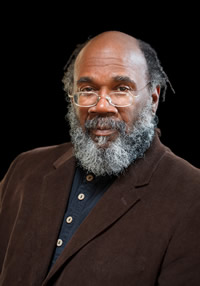
Before my cohort and my other fellow MFA candidates left from our last residency in June, we were given a final warning by the inimitable Arthur Flowers (see photo, left): “So, what are you going to do? You’re about to go back out into real life, where there’s bills to pay and mouths to feed. … People are going to tell you that you’re chasing a fantasy. People are going to say to you, ‘Just do like the rest of us.’ Don’t you do it. Follow that dream you’ve begun here. Never let anybody tell you that you’re not a writer.”

The truth is, I’ve had to replay this little lecture to myself on more than one occasion. As my teaching gigs and the mundane suburban duties of yardwork and such pile up, I sometimes tend to forget that I am also a poet. After all, the labels of father, husband, and professor seem to hold so many more responsibilities. What’s more, the immediacy of providing for my family tends to obscure the more long-term goal of poetic success.

It is indeed a dog-eat-dog world out there, and poets, like everyone else, are scrambling in a fight to the top: networking, assuming new titles, taking on the challenges of work-home balance, and ensuring that all the parts of life are functioning smoothly. In the midst of all this, it becomes pretty easy to allow writing and those related goals to take a back seat. I even found myself telling my wife recently, “Writing’s not as important as (insert bigger priority here).” And while that may be true, I must remind myself not to throw out the proverbial baby with the bathwater. Just because life demands greater attention to things of necessity doesn’t mean that I should completely cast aside any and all writing endeavors. And neither should you, reader.

“We do what we have to do so we can do what we want to do,” the old saying goes. But occasionally there’s a blurry line between those two ideas. Where the needs meet the wants, in that blurry gray space, is poetry. Yes, I could live without writing. But it would definitely be a sad and colorless existence, devoid of any creative sparks or intrinsic cognitive satisfaction. It is unimaginable and unimaginative. I have no plans to cut out my essence, just as I have no plans to desert my family or my career. Join me, readers, in this persistent striving toward the bigger, toward the better, toward tomorrow. Let us be pilgrims on this journey together. May our walk be filled with abundance, and may our pens never run dry.

poetry, Uncategorized

Old-style submissions: A lost art

Not so terribly many years ago, magazines received writer’s work using that method that we today refer to as “snail mail.”

In the first writer’s guide I ever bought (I think I might have been 17 at the time), every market entry included the following instructions: “Please include a SASE with adequate postage for reply, and a cover letter that includes a brief writer’s bio.” The words sometimes included other instructions for submitting by mail, some including “reading fees” and the like, but for the most part, the standard editor expected you to include A.) a well-written and properly formatted cover letter, B.) your submission of 3-5 poems (some more, some less), and C.) the all-important self-addressed stamped envelope.

Today, the process has become much more mainstreamed and fast-tracked, with online submission sites like Submittable making life easier on the industrious writer. There is a space for a cover letter through such services, though editors today seldom expect it to be the eloquent and elegant communication that it was once supposed to be. Moreover, the modern submissions process takes perhaps a few seconds as opposed to the elaborate endeavor that it once was. Some would call this progress, including me. By the same token, however, there are some points about this slicker model that make me somewhat nostalgic for the “good old days.”

First, the tree-free model lacks the air of refinement that stationery and bone-colored, fibrous papers promised. Yes, I am aware that all this shipping and mailing taxed our environment to a degree, but by that same token, it carried with it a certain degree of class and culture that we have lost today in the effluence of digital missives. No more can people be identified by their cursive, and no more do wax seals bear the impressive monogram of a sender. Instead, we have yet another heading in yet another database.

When historians want to trace the personal writings of famous authors of our era, will they be limited to the “comments” section of some submission site? Where will the personality of the writers shine through, other than their “professional” writings? No more will there be pointed handwritten notes to indicate the passion or the passivity of the correspondent. No more envelopes sealed by a variety of methods. No more yellowed, saved and folded notes. We are slowly but surely losing a vital piece of our humanity to the name of efficiency.

It was my pleasure recently to send off an old-school submission to a chapbook contest. Yes, I had to use my own printer ink. Yes, I had to include that SASE. And yes, I even had to write a check and a writer’s bio. Plus, I had to buy postage. But all that, I felt, was worth it. At least when that editor receives my submission, he or she will be grasping some small piece of my personality beyond my poetry. Win or lose, a piece of myself has reached another fellow human being, and the intrinsic value to that small act is beyond the price of any printer cartridge.

poetry, Uncategorized

Literary Wingmen

ImageT.E. Hulme wrote six poems in his life, with the best known piece being a short little near-pastoral titled “Autumn.” But this Englishman, who fought in World War I, is known better for his attachment to other greats. The company he kept included big names in the world of poetry, including Eliot, H.D., and a number of well-known imagists. He joined poetry clubs and took part in literary events where better-known authors read and were celebrated, and in 1917, he was shot and killed in wartime. He was only 34. His legacy today is largely attached to the reputation of better-known names from literature like those mentioned above. Scholars today refer to him more as a “critic” than a poet.

The lesson of Hulme’s life is one all writers, and especially poets, should take to heart: While being around “names” might be exhilirating, and doing so may have its own benefits, it is imperative that we not forget who we’re really in this business for — ourselves. Oh sure, I could go on some great philanthropic rant about how writing is “all for the readers,” or “to make society and culture better,” but at the end of the day, let’s get real: The reason writers write is to be read and recognized by others. No matter how charitable or noble our other motives may be, the one driving force behind writing is the thought that someone else will take in and appreciate our words.

So, if one is constantly “hanging around” others who are already established, that might be fun and even rewarding, but honestly, when the fat lady sings, who wants to be remembered as “that guy who hung around (famous name here)?” Making a literary contribution demands more than being the bookish equivalent of a Kardashian. Staking out one’s own path and territory is as necessary in the writing world as it is in business. Warren Buffett didn’t get where he is by riding the coattails of Rockefellers, and today’s writer can’t expect to be remembered by sitting on Grisham’s front porch, either.

Certainly this isn’t to say that receiving mentorship from “names” isn’t helpful; it definitely is. But at some point, it’s time to leave the nest and spread one’s own wings. My aspiration is that, when my time comes, I’m not put into the history books like Hulme; by then, I will hopefully have made a significant impact that is beyond “knowing and imitating good poets.” No doubt my writer friends desire something similar. Let’s begin forging that path today. Our literary legacies depend upon it.

poetry, Uncategorized

Treading the Mason-Dixon Line softly

Image

Here’s the thing about writing regional poems: you have to be careful.

As a native of Florida (and of the South, no matter what some folks may say), I find that an awful lot of my work takes on the dialect, the idioms, and the culture of our southeastern United States. However, that gift of geographic identity is a double-edged sword.

It becomes very easy to cross over from the easy grace and subtle lilt of Southern verse to something that is pure cornpone. When I find my work sounding like bad country music, I know it’s time to drop back and rethink. I’ve always been a firm believer in central metaphors — those comparisons that build poems from the outset. However, when those metaphors are already overdone (sunsets=symphonies, etc.), then it’s time to step away from the work for a while and allow the creative juices to do their job.

The South has a far too dynamic history to be denegrated by bad poetry. There are already enough cheesy lines about Mama’s Cookin’ and Daddy’s Workin’ without more people contributing to the drivel. Certainly, food and labor are staples of life here in the American South, but expressing those same sad sentiments in echoed cliches does nothing for literature or culture.

To my fellow Southern Writers, I urge you (as I urge myself) to examine and edit closely. Much like hard-core evangelicals’ “WWJD” bracelets, I would ask a similar and perhaps slightly blasphemous question of our work: What would Robert Penn Warren think? You could replace the name here with the exemplary Southern poet of your choice: Natasha Trethewey, Kevin Young, Rodney Jones, whomever. But in the end, if our work doesn’t measure up to the high standard set before us, we’re just wasting our ink.

poetry, Uncategorized

The Necessity of Interruption

So, this post probably won’t win me many writer friends. Be warned.

I have found over the years I have written poetry and prose that I am different from my colleagues in one regard: I actually prefer to be interrupted from writing.

Now, before all you secluded-in-solitude writers go nuts, let me clarify: My writing room has no “doors” to speak of. My children can come in at any time and speak to me, get hugs, whatever. And in retrospect, those interruptions have actually made my writing stronger.

Here’s what I mean: My brain actually has to work harder to power through the static and the outside influences, and thereby comes up with things that my brain at total ease would never think. In fact, when I’ve tried to write in areas that are too quiet (the library, my local college study room, etc.), I find myself encountering greater difficulty. There has to be some background noise, and it can’t be something like music with lyrics or that artificial white noise garbage. The sounds in the environment have to be things I know are real: the drip of the rain beyond my window (like right now), the TV in the adjoining room mumbling about…I can’t tell what, the coffeemaker gently whirring forth a stream of fuel, my boys playing pirates in their bedroom down the hall. These noises actually help me to focus better. And while many of my poet friends would cringe at the thought of such “racket,” I’ve found that writing locales without these sensations rob me of something. Maybe it’s the familiarity, maybe it’s a degree of undiagnosed OCD — I’m not sure.

Whatever the cause of this scientific fact, the thing that matters most is its effect. I know how and where I write best, and life’s little interruptions are as necessary as pen and paper. Do I still fantasize about being that “lone wolf” author who has blackout blinds and acoustic paneling just to ensure that his thoughts aren’t “tainted?” I suppose. But given my druthers, I’ll take my boys’ imagination-chatter and the soft hum of life in the suburbs over celebrity sanctuary any day.

poetry, Uncategorized

A New Meaning for “Writing Rut”

Fall in Florida is difficult for visitors to detect. We don’t have glorious leaf color changes, the temperature doesn’t dip drastically, and more often than not, our autumn feels like extended summer to those from beyond the state line. But natives and those who have lived here for decades can feel the subtle changes: Lower humidity makes the air a bit less sticky. Breezes begin to border on full-blown wind. And then there’s the change in sounds — the trees themselves, as the weather grows drier and slightly cooler, take on a different pitch as their boughs are swayed by a new incoming season. Birds’ songs grow a bit more excited and resonant as they prepare for a colder period yet to come. No, Florida’s version of fall might not be as visually grand as the displays in other parts of the country, but it’s a poet’s best friend. It requires heightened sensitivity, and is perfect outdoor weather for time in nature’s splendor.

All this reflection takes me back to my boyhood and adolescence, when fall also meant deer hunting season. This post is no rant for or against the act of hunting, but is instead intended to give a new definition for a very old term: For hunters, the word “rut” means that animals are seeking mates and are active in the woods. They forage, they frolic, they are generally more lively during mating season or “rut” than they are during more docile times of the year. Much like some big game animal, I’ve noticed that I also am enlivened by this time of year. Its different sensations and its invigorating climate make my “poetic brain” shift into overdrive. My wife has noticed this over our 10 years together; fall means that my writing takes a front seat.

So, rather than being a victim to a “writing rut” under its old definition — a time of hindered or stilted writing production due to “writer’s block” or other problems — perhaps we as poets and writers need to reclassify this term. Take a lesson from the hunters: Rut is a time for greatest activity, and so, let’s proceed into this autumn’s mating season of ideas with utmost optimism and highest ambitions for our work. Good luck, and here’s hoping you “bag” a few “trophies” along the way.

poetry, Uncategorized

You win some, you lose some…

Some days you have to ask yourself, “Is it really worth it?”


Recently I received a letter in the mail informing me that I had (yet again) not been selected as the winner of a recent writing contest. Not a great surprise; I’m pretty used to getting bad news from publishers. This particular one, though, had my hopes really high — the contest judges were known for favoring my type of poetry, I had closely studied past winners and their work, and in general, I had prepared myself to take on this contest with the dead-level best of my abilities.

So much for that. In response to this letter, I took some of my own advice and revamped the manuscript, added in newer, even more high-quality works where they best fit, and spruced up the formatting a wee bit. I don’t anticipate that these changes will ensure my victory over 500 or 1,000 other entries, but at least I feel better about the whole situation. I am, by the way, submitting the manuscript to two other contests in response to this news also. Down, but assuredly not out.

I suppose the point of this post is, if you’re going to be a poet, you have to take the bad with the good. As my mentors would say, be persistent and don’t get discouraged. When you know your work is good, it’s bound to find a home somewhere. Pardon me while I go get this beautiful collection ready for its next journey. I’ve got work to do.