life, poetry, publishing, Uncategorized, writers, writing

About Controversial Editors

man couple people woman
Photo by Gratisography on Pexels.com

Recently I had a piece published by a journal that is edited by someone who has received, shall we say, “mixed responses” from the literary community. This editor’s political and religious views are certainly not “mainstream” in the poetry world, for certain.

That being said, I love this editor’s written work and [their] journal’s style. The fact that this person has been berated for unconventional beliefs is inconsequential to me as a writer. If anything, I admire the editor more for that willingness to stand on principles, whether I agree with them or not.

Nonetheless, I’m aware that in the future, my work being published by the editor’s journal may be a “dark mark” against my name. Guess what? I don’t care.

Too often writers inform their choices based on what is “acceptable.” I have reached a magical middle age where such considerations don’t enter my radar anymore. Good journal? Submit. Bad journal? Don’t. It’s really that simple. I don’t base my submissions on who nominates how many for which awards. I don’t look at percentages of rejections or acceptances. I don’t even give an inkling to a publication’s “prestige.” I send my work to places I respect. The end. Accepted? Hooray! Rejected? Keep going.

“But don’t you want to be on ‘the right side of history?'” my socially concerned friends may ask. My answer: Not especially. The annals of literature contain heroes and villains alike — those we’ve forgiven and those we haven’t. If I’m eventually judged by the same politically correct mob that hates the Fugitives but adores Ginsberg, so be it. Their sensitivity to prevailing mores has blinded them to a great span of sterling work, and frankly, my words aren’t for them anyway.

My poems speak of old-fashioned values, hard work, forgotten places, and flawed people. These topics exclude me from certain bookshelves, and that’s okay. Furthermore, it’s equally okay that my work is published in places that may one day “fall from grace.”

For today, my poetry is there, chosen by an editor who might or might not share my vision of the world. If that bothers you, dear reader, please heed this message: None of us is perfect. Let’s forego the hypocrisy of pretending that any man-made philosophy is fallacy-free and just enjoy the show. History will write (and right) itself.

life, poetry, publishing, Uncategorized, writers, writing

National Poetry Month Concludes


2018-npm-poster-image

View at Medium.com

View at Medium.com

April has certainly been less than “the cruelest month” this year. I’ve had some pieces published, spent some time with excellent poets, and with spring has come that sense of hope and relief. Soon, my boys will be out of school, and summer will press its Floridian heat upon us, urging us to the community pool and the beach. But for now, I’d like to spend the last little bit of a great month celebrating a victory or two:

1.) Deep South magazine, a publication that has been friendly to my work since its very beginnings, recently published “My Grandfather’s Exhibit,” a newer piece of mine that deals with a subject very dear to me:

http://deepsouthmag.com/2018/04/19/my-grandfathers-exhibit/

I’d appreciate folks visiting the link and hitting “like” or offering a comment, if you can spare the time. The editor loves for people to interact with content, and maybe this piece will inspire a few memories of your own. I’ll also share the audio version below:

2.) Alternating Current Press, who publishes a great online journal called The Coil, recently awarded an ekphrastic piece of mine in its Daguerrotyped competition. Using the photo provided from them, I put together a piece celebrating the contributions of women during the mid-20th Century:

https://medium.com/the-coil

Here again is an audio version for those who prefer to both hear and read works:

I also have some pieces forthcoming in other venues that I’ll announce as I’m able. I hope that National Poetry Month has treated you well, reader, and that as the year progresses, poetry will continue to be a valuable part of your everyday life.

View at Medium.com

View at Medium.com

View at Medium.com

View at Medium.com

poetry, publishing, writers, writing

The Personal Touch Still Matters

“This is a very, very fine poem. I just wanted to call you and let you know that we’ll be including it in our July issue. Thank you for sending it to us.” …And my day was made.

It isn’t every day one receives a phone call from the editor of a literary journal, especially one as busy as The American Journal of Poetry, founded and operated by Robert Nazarene (who called me) and James Wilson. Readers may recognize these two esteemed gentlemen as the former editors of MARGIE, a literary magazine that was legendary in its time for inclusion of high-quality and award-winning material.

Their July issue of AJP will include such renowned poetry giants as Mark Jarman, Alice Friman, and Tony Hoagland — and it will also include yours truly. The fact that my work is being published alongside these poets and others I deeply respect would have been enough to send me over the moon. But the fact that the editor reached out by phone, a nearly unheard-of act of kindness in the poetry realm, was the icing on the proverbial cake. His praise of my work combined with his personal interest spoke volumes about his work ethic and his dedication to an oft-underappreciated task.

So as you’re reading over the ugly remarks about editors on sites like Duotrope, bear in mind that there are still a few out there who do the task in a timely and proficient manner. Some even care enough to make phone calls, and by doing so, rekindle the fire of poetic passion beneath skeptical and world-hardened writers. Even in a time dominated by online submission trackers and digital everything, the personal touch still matters. Thank you to those gatekeepers and decision-makers who continue to do their jobs in a way that enhances the humanity of the literary community. Now more than ever, you’re needed.


life, poetry, publishing, teaching, Uncategorized, writing

A Farewell Book Launch

cover-for-adIn one week, I will be launching my latest collection, Hard Inheritance, at one of our city’s nicest art galleries. It is bittersweet, as this will be both the first and last book launch I hold here. I’ve loved my current city for 17 years, but this summer, my family and I will be moving to the west coast of Florida. My newest university teaching gig is a 70-mile drive from my present home, and making a 140-mile round trip daily is simply infeasible. By spring break, we plan to put our house on the market, and hopefully by summer, we will be in a new house in the Tampa Bay area. Timing, the market, and other factors will determine how quickly all this occurs, of course.

In the meantime, I’m excited to offer this new book, much of which has been inspired by our city, to the people of Winter Haven. My cover artist, a Winter Haven native herself, will be on hand to sign copies of the book with me, and invitees include people who have been supportive of my craft over the years that I’ve resided here. In many ways, this book launch is a fond goodbye to a place that has been kind to me and my family. The time I’ve spent here hasn’t been perfect — the same is true anywhere called home — but it has been inspirational.

Winter Haven’s people, its lakes, its nature, and its history have all woven themselves into my poems at different points along my artistic journey. I’ll miss all that over on the west coast, but there will be fertile material for writing there, as well. I’ve enjoyed seeing the vast salt water every day as I cross the Courtney Campbell Causeway or the Howard Frankland Bridge, and I feel certain that soon enough, my writing will take on a flavor that is more beach-driven. My hope is not to become one of those poets who creates trite rhymes about the sea, but rather, one who allows the environment to speak in its own way. Certainly that has happened here among the lakes of Winter Haven.

My wife’s family lives in Winter Haven, and doubtless we will be returning to visit often, especially during the summers. And yes, it will be a while yet before we’re out of the area. But this book launch allows me to reflect upon and salute a place that has been meaningful. The future is uncertain but hopeful, and it wouldn’t be possible without history. So, Winter Haven, a place of history, beauty, and opportunity, this book launch is for you. Best wishes.

life, poetry, publishing, Uncategorized, writers, writing

The Big Announcement

After years of writing and months of preparation, Hard Inheritance is now available! Just in time for the holiday season, this new volume contains works first published by such literary powerhouses as Nashville Review and similar respected journals.

Perhaps more importantly, though, it is a testament to life lived in rural Florida. Following in the footsteps of its older brother, Middle Class American Proverb, Hard Inheritance offers readers a glimpse into the trials, joys, and landmark events of time spent in places that barely get their own map-dot. Moreover, it presents a portrait of such places’ people — the hard, the charitable, the native.

Notable southern poet Andrew Hudgins says this about Hard Inheritance:

“The poems in Hard Inheritance are set firmly in the poet’s ‘ancestral terrain’ of small-town Florida. The landscape is lovingly but unsentimentally brought to the page, and it is peopled by the poet’s family, friends, and fellow parishioners. … These truly are ‘songs sculpted by home’s hard structures.'”

And award-winning poet Sandra Beasley adds:

“What is architecture, without its inhabitants? ‘In our heart pine handmade farm house, / my grandparents were window weights: // cast iron bars tethered in country wood, / plumb and place-holding pendulums.’ What is a field, without the hands that tend it? In HARD INHERITANCE, John Davis, Jr. recognizes the potent ecosystems of everyday life, as in “What the Grove Knows”: “Stirred soil lifts its secrets to the sky. / Revealed and overturned crickets / invite snowy egrets who eat them.” Readers will enjoy taking a joy ride on an untethered dock, hunting down poisonous white frogs, harvesting worms before a father and son’s angling expedition, and hand-nestling one newspaper section into another before the morning’s delivery. Yet these poems resist mere nostalgia; the author’s voice is attentive, conversational, and wise to how class shapes the landscape at hand. Given graceful and balanced stanzas, consonance of word choice, and the unexpected glimmer of a pantoum, I admire both Davis’s rigors of craft and vitality of spirit.”

I’m incredibly excited by this new release, and I hope you’ll pick up a copy to fill a stocking or to surprise that word-lover on your list. Get one for yourself, while you’re at it. Here’s wishing everyone the warmest of holiday seasons! Happy Reading!

BUY HARD INHERITANCE HERE: Link to purchase the book


poetry, publishing, Uncategorized, writing

Cover Revealed!

hardinheritance

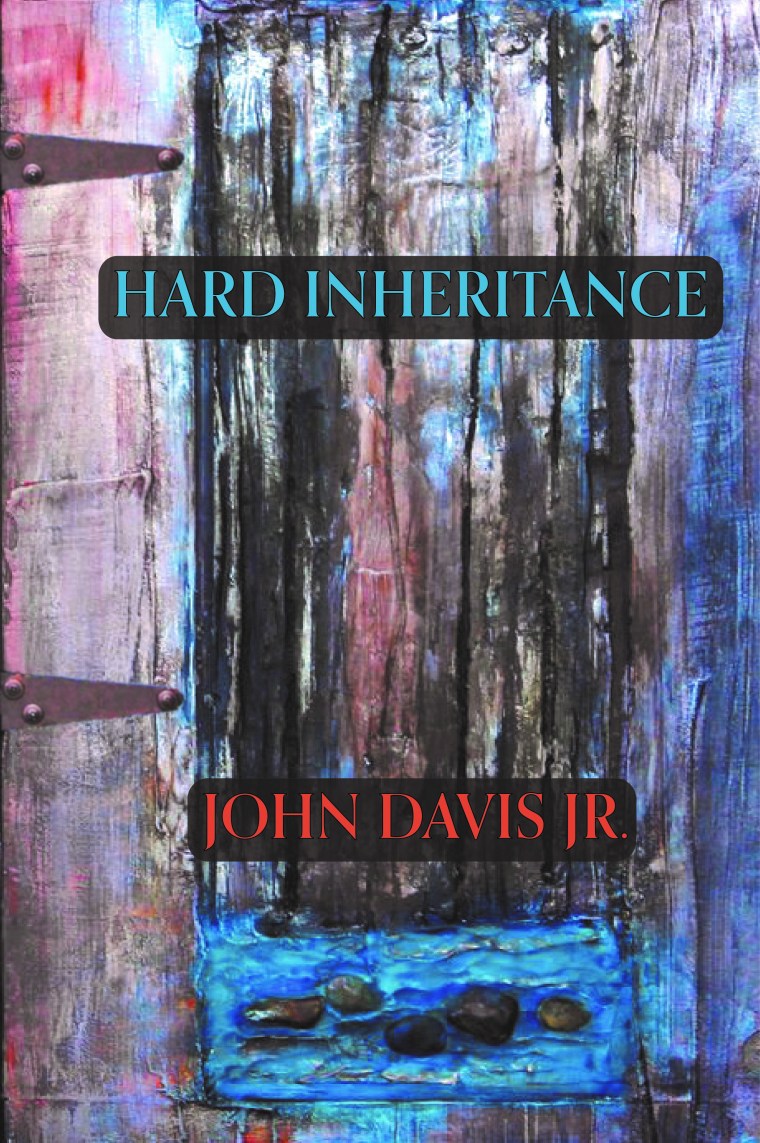
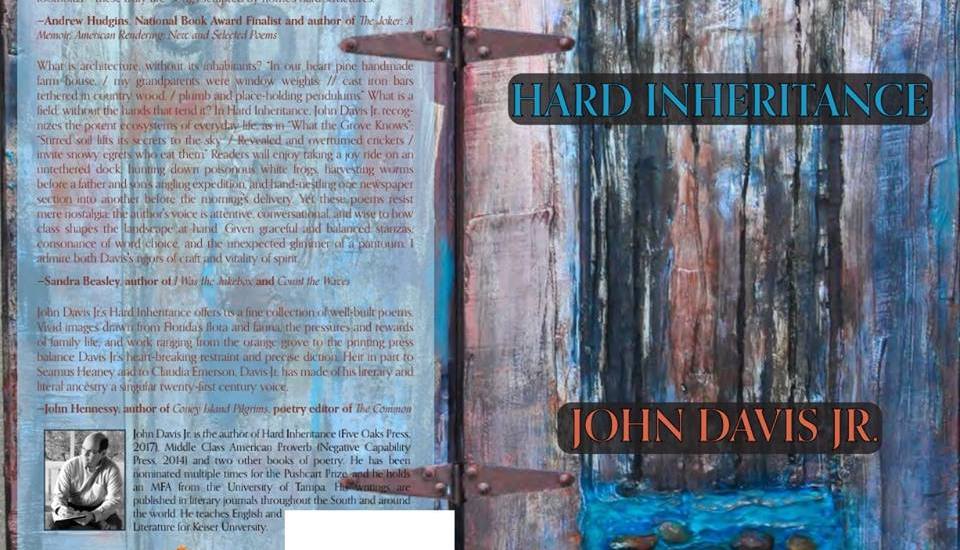
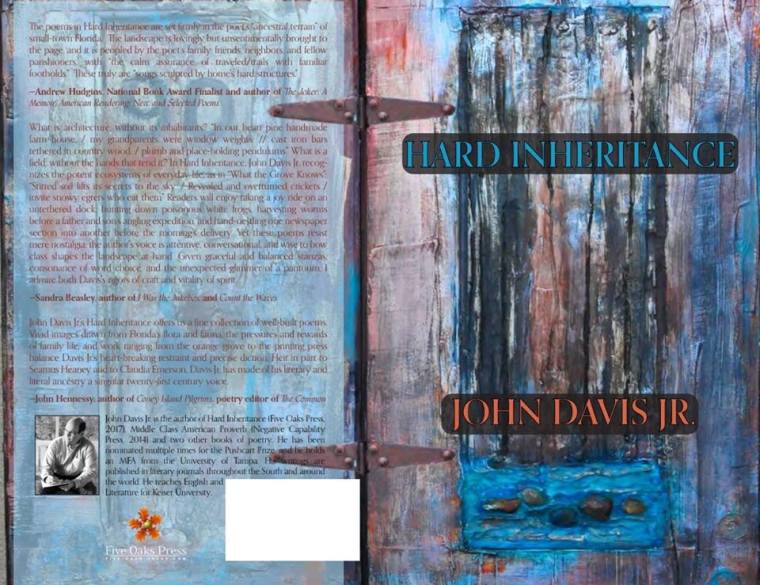
Thanksgiving is always a great time for my family, but today was made even greater by some unexpected news: The cover for my latest collection is now completed! The wonderful people at Five Oaks Press emailed me to let me know that the cover, complete with art from the inimitable Tinia Polk Clark, was ready. So here it is for your enjoyment. If you think this cover is great, however, just wait until you read the book!

My greatest pleasure is that my book was honored by blurbs from the likes of Andrew Hudgins, Sandra Beasley, and John Hennessy — all highly esteemed voices in the literary community. Their vote of confidence means a great deal to me, and I’m hopeful that their words, seen here on the back (left) cover, might give you, reader, some idea about the book itself.

Soon it will be time for book launch arrangements, readings, signings, and the like. Stay tuned here for all the details. In the meantime, Happy Thanksgiving, and thanks for following!

life, poetry, publishing, teaching, Uncategorized

On starting small

Earlier this year, brilliant mathematician and Nobel Prize winner John Nash and his wife Alicia were killed in a car wreck. Nash’s work and life were the subject of the film A Beautiful Mind, directed by Ron Howard in the early 2000s. Like many moviegoers, I too was touched and inspired by Nash’s biography (even if it was “adapted” for film). His humble West Virginia origins, his battle with personal demons, and his eventual rise to academic and economic prominence spoke to audiences everywhere.

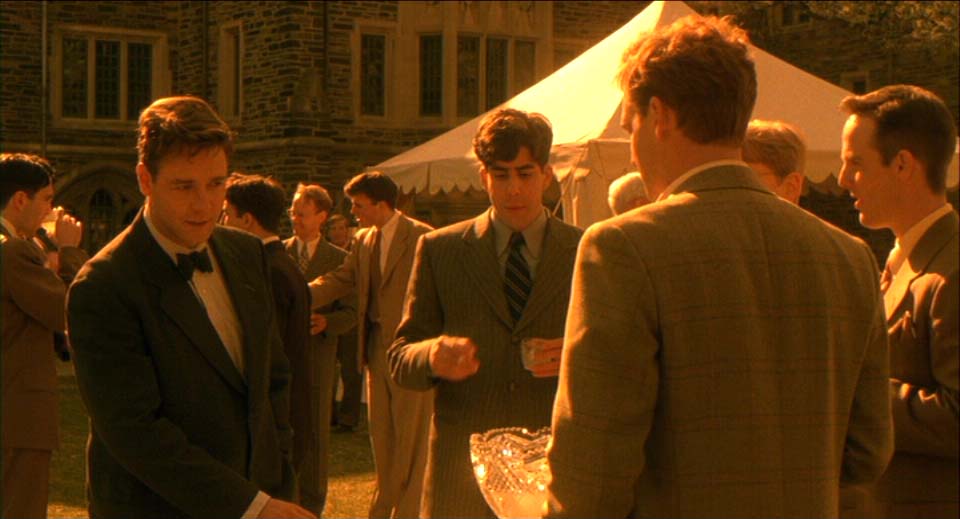
A Beautiful Mind scene, courtesy of Universal Pictures
Martin Hansen, played by Josh Lucas in the foreground, engages in some party snobbery toward John Nash (Russell Crowe), at left.

Recently, one scene from Howard’s movie replayed in my head as I encountered a situation similar to one faced by Nash early on in the film: Upon his arrival at Princeton after receiving a substantial scholarship, Nash is confronted by Martin Hansen during a reception. Hansen indicates that he “simply assumed [Nash was] the waiter,” due to his appearance. This barbed condescension is a hallmark of the early Nash-Hansen competitive relationship as portrayed in the film.

People from small towns or rural upbringings often face this kind of slight, even today. I grew up in a town of 3,500 people. Everyone knew everyone else, and the main vocation was agriculture. So, when I eventually moved to a city of 35,000 people (and growing), I felt as though I’d made my home in a more metropolitan area. Even though the culture here is still one of welcoming and warmth (see prior posts), my city has many markers of being a larger, slightly more urban place than many of Florida’s smaller map dots.

While I was serving as a guest lecturer at an area university some months ago, a student I met had the audacity to insinuate that small to mid-sized cities are undeserving of artists in residence or poets laureate. His contention was that only large cities and crowded urban areas should pay attention to literary and arts-related matters, because, after all, creative gifts can only thrive in such a vast and populous setting. There was more “talent” to choose from, he indicated, and more educated people inhabiting the big cities.

So, let me set the record straight, if only to repudiate this student’s erroneous assumptions. Many highly educated and erudite individuals choose to be country-dwellers, suburbanites, and big city expatriates (I’d supply a list, but it would be far too long). Their decision is made not because they desire to be “bigger fish in smaller ponds,” but because they desire a truer sense of community, a safe and clean place to raise a family, or maybe because they hold dear the virtues that modestly populated areas often embrace. In the end, there are several reasons to eschew the hustle and bustle of the sky-scraped city, especially if one is an artist. Certainly, there are benefits to larger metropolises, just as there are drawbacks. And yes, arts and culture do thrive there in most cases.

However, assuming ignorance or lack of refinement exists solely in smaller towns or mid-sized cities is the height of arrogant urban imperialism. I believe that Annie Dillard, Mark Twain, and John Nash would agree, for starters. And for me, smaller places yield bigger ideas. It is not by accident that Richard Hugo encouraged poets to seek out “triggering towns” that seemed to be more tight-knit communities.

I’m not attempting to prescribe small-town living to those accustomed to bigger cities, nor am I advocating one particular mode of residency. But I do know that, for my creative purposes, small and medium places work. Those who denigrate them, somewhat ironically, need only a broader mind.

poetry, publishing, writers, writing

On the Color of Names

Asian-sounding Pen Name Gets White Guy in Trouble

So, I read the story linked to above from the Washington Post. Here’s my two cents, for what it’s worth:

As a plainly named, semi-average white guy, I too have considered using a name that sounds “less Caucasian.” In today’s literary marketplace, it sometimes feels like people with humdrum, plain-Jane names get overshadowed by those without them, no matter what the ethnicity, gender, or background in question may be.

“Oh, to be a Li-Young Lee, a Marina Tsvetaeva, or a Yusef Komunyakaa!” say the Joe Smiths of the writing world. Of course, poets’ names are not their strength (although the aforementioned ones, especially, are impressive and beautiful sounding). It is the authors’ fine work that has earned them their spot in the literary marketplace. Their awards are many, and rightfully so. It is not a matter of name alliteration, length, or origin that has raised them to prominence; it is the quality of their writing, and a strong history of artistic contribution.

Statistics from a number of sources show us that writers from historically underrepresented communities still struggle to get their work in front of readers, and the good folks at Vida: Women in Literary Arts have demonstrated the imbalance between published male writers and their female counterparts. Nonetheless, when one opens a copy of Poets and Writers, AWP Chronicle, and other trade pubs that scribblers like me regularly receive, the most highly publicized writers can seem to be comprised of those with extraordinary and uniquely identifiable names, no matter what their color or creed.

Consider if you will the glossy back cover of the September 2015 issue of The Writer’s Chronicle: There, in a full-color ad for Grand Valley State University’s Poetry Night 2015, are Kwame Dawes and Aimee Nezhukumatathil. I wish I could be at the advertised event, not because I want an excuse to form such lovely names more often, but because these are exceptional writers. Inside the back cover, a full-page ad for the Sanibel Island Writers Conference (another event I wish I could attend this year) proclaims the presence of Edwidge Danticat, another brand-name poet whose work is as striking as her name, if not moreso. A quick flip through the magazine reveals Nikki Giovanni, Ravi Shankar, Minal Hajratwala, Luisa Igloria, and Natasha Trethewey, among other names like poems.

Admittedly, my name has sometimes raised an editor’s eyebrow or two because “John Davis Jr.” could belong to someone of any number of races. Sure, it’s a white guy’s name, but it could belong to someone of African-American descent, Native American descent, or any one of many other races, I’ve found. A quick run of my name through Google reveals a rainbow of people from all walks of life. Some are realtors, some are doctors, and one even ran for president in 2012. I’ve had editors presume I was African-American because my name reminded them of another famous “Davis Jr.” — Sammy Davis Jr. No joke. I didn’t mind the confusion, nor did I take offense. But then, I’m a member of this country’s majority. My people are not disenfranchised, nor have they faced excessive hurdles in society. And maybe that’s why Michael Derrick Hudson’s decision irks me.

It irks me for the same reasons that dialect-discrimination irks me, actually. I’ve had plenty of people assume over the years (based upon my size, appearance, and Floridian accent) that I am ignorant. “Dumb Southerner” is the label some have attached without knowing my full story. They hear my use of the colloquial “y’all” and jump to their conclusions, which are, ultimately, dead wrong. Yes, my family has farmed for three generations (at least). But we’ve also been educators, doctors, lawyers, professors, and Air Force pilots, just to name a few other roles. I don’t appreciate others assuming we’re hillbillies any more than writers of Asian descent appreciate “Yi-Fen Chou.”

So what’ll it be, Mr. Hudson? You think your name sounds too Anglo-Saxon? Oh, gosh. Better fix that right up. You’ll never get published now. It’s not like Billy Collins, Ted Kooser, C.K. Williams, or — let’s go back a ways — Edgar Allan Poe, Robert Frost, or W.B. Yeats have had any luck. I can see your quandary, what with all the illogical repression of white male names and voices, It’s clearly a wonder that your work has managed to see the light of day.

But I get it. I really do. All those delicious-sounding syllables from diverse cultures are out there, just waiting to be exhaled. And they’re tempting. I know they are. That, however, doesn’t make them yours to appropriate. Might I be so bold as to suggest Mr. Hudson read an excellent essay by Henry Louis Gates Jr. entitled “What’s In a Name?” I assign it to my students regularly. When you read it, consider yourself Mr. Wilson, Michael. For in essence, you have called Asian and Asian-American writers everywhere “George.” And that’s not okay.

poetry, publishing, writers, writing

When should you blacklist a publisher?

magazinesI’m not usually one to post one negative thing after another, but recently, circumstances in my literary life have been causing me to offer a few “no-nos” to the general public. In today’s edition: How to know when you should never submit to a magazine/journal/publisher again.

Without naming names, I’ll tell you that I’ve recently scrawled a list of literary venues that I will never offer my work to again, and posted them to my bulletin board as a reminder. As a younger writer, I did this after a single rejection (or even two or three), which was hot-headed and foolish on my part. However, the places that I’ve listed and “sworn off” recently have committed editorial faux pas that I consider frankly unforgivable in the 21st century. And so, without further adieu (punny, yes?), here’s why I said goodbye and good riddance to a few literary outlets lately:

1. No response unless accepted. One journal is on my list because the editors cling to a policy that states, “We will communicate with you only in case of acceptance.” Hogwash. There is absolutely no reason that a magazine of any size should refuse sending a simple “no” to a waiting and hopeful writer. Their exclusive practice is rude, and rudeness doesn’t fly, even today.

2. Hostile, condescending, or insulting rejections. Another place is on my list because the editor could have sent a simple form rejection letter or a polite “This doesn’t fit our current needs,” but decided instead to engage in blatant snobbery and offer a few ad hominem cutting remarks. Where “no thanks” will suffice, subtle or obvious condescension has no place. Farewell, editorial ugliness. You have no home here.

3. Rampant inefficiency or gross incompetence. My third blacklisted venue accepted my work more than two years ago, and published it about a week ago. No, I haven’t mentioned them by name here or on social media. I thought the place had gone belly-up, honestly, as my attempts at communication were never returned, and I had already submitted the pieces they accepted to other venues. This could have created a major legal snafu, among other issues. Also, my author’s bio was grossly outdated in this publication due to lax oversight and poor management. Never again, (name withheld) Review. Yes, I know publishing is tough and time-consuming, but not to the extent that it should cause literary malpractice.

4. Emotional/personal affairs affecting editorial discernment. The final place to which I will no longer submit is operated by a novice publisher who sees every “no thank you” as a personal attack, or as an affront to the integrity of her/his operation. This same publisher overshares his/her personal problems when deadlines are missed or when quality is questionable. When the boss has problems, everybody has problems, much like the old adage “When momma ain’t happy, ain’t nobody happy.” I’ll steer clear, thanks.

So there you have them: my reasons for “blacklisting” certain publishers. Some of these may seem hasty or even unfair, but in every case, my personal experience has been such that I felt compelled to write them off. I would be interested to know why you, the reader, have stopped submitting to various places, as well. Feel free to posit your experiences in the comments section (please keep it clean and non-libelous). We’ve all been there. Keep writing!

poetry, Uncategorized

The Awards Game

Award_imageIt’s that time of year again: Editors and publishers are nominating works from their magazines and bookshelves for a broad range of laurels. Most notably at this time of year, writers receive word of Pushcart Prize nominations. As a younger writer, I used to get all tingly when those nominations arrived by email — kindly journal editors who liked my work sent it on to that mystical committee that views thousands of submissions every year from literary journals all over. I am still honored to have my work nominated for the Pushcart (as it was again this year), but in speaking with mentors and writer-friends of mine, I’ve come to understand something: Poets “worth their salt” are nominated for the Pushcart almost annually. Venerated veterans of poetry take such nominations for granted, apparently, even though those of us who are still “emerging” think them a big deal. So, I’ve learned to cool my jets a little. Once my work is actually included in the honorable Pushcart anthology, I’ll certainly add that detail to my author’s bio. But for now, I suppose I should join the ranks of my fellow authors who see nominations as a nice thought, a kind gesture, but ultimately, little more than a tip of the hat toward one’s work.

I’ve learned also that the awards one reads about in other writers’ portfolios aren’t always as glamorous as they seem (take note, young writers). Certain awards may open some doors, they may add something to one’s CV, but outside the literary community, they don’t amount to a hill of beans. Robert Frost was a fan of the old saw “Fine words butter no parsnips,” and I suppose in the world of literary awards, a similar thought exists — shiny trophies, parchment certificates, and faux-wood plaques don’t make you a writer any more than a fancy hat does.

Recently a publisher friend of mine let me know that my book has been nominated for a couple of other awards, as well. If I win, it will be a wonderful experience, and I’m trying hard not to get my hopes up too much prior to the announcements. These awards are entered by many of my most respected fellow writers and their publishers, as well. To even enter the field is an honor unto itself. The danger, of course, in winning awards is the temptation toward stasis — many a great writer, after earning the Pulitzer or the National Book Award, has lain down his pen. The award was an end rather than a milepost on the journey. Writers, as awards season enters full swing, the temptation is great to see pinnacles where only plateaus exist. Gilded honors are stations on the path, not summits to be conquered. Let us be grateful and humbled, but let’s not be complacent. There’s writing yet to do. Stick that award on the shelf or on your book cover, and let’s keep going.