The view from my current home, which has inspired so many poems.
My wife and I are trying to find our next house. I’ve been driving a 140-mile round trip to work since September of last year, when I accepted a position teaching college English and Literature in Clearwater. I love the job, and she just accepted a position in a doctor’s office over there, as well. This, of course, has necessitated a lot of house-hunting.
I’m not a firm believer in new-age spirituality or that kind of thing, but I do think it’s interesting when you walk into a potential new home and pick up the energies that the last people left behind. In divorce homes, you can feel the tension and anxiety. In foreclosures, you can feel the dread, the sleeplessness, and occasionally the hatred. In homes that have been well-loved, you can sense that, too.
All this house-hunting and its associated investigations have brought me back to my reporter days, when I had to enter crime scenes and disaster scenarios: Every time, there was some kind of toxicity in the environment. It came not from the smells of violence or destruction — it was intangible. I am grateful that the homes my wife and I have entered so far have been free from that same toxicity, even if the air feels tense or unhappy.
And in addition, going into so many houses makes fertile ground for poetry. The way others live is a fascinating and often striking subject, and no doubt these forays into real estate will result in some creative work as time elapses. For now, though, we continue to go about the nuts-and-bolts processes of home buying and selling. The whole transition is the stuff of literature, and here’s hoping that the eventual words will do justice to the experience.
P.S.: Realtors, financiers, and other business-types, please don’t contact me via this site peddling your wares. We’re already well taken care of. Thanks for respecting our wishes.
“This is a very, very fine poem. I just wanted to call you and let you know that we’ll be including it in our July issue. Thank you for sending it to us.” …And my day was made.
It isn’t every day one receives a phone call from the editor of a literary journal, especially one as busy as The American Journal of Poetry, founded and operated by Robert Nazarene (who called me) and James Wilson. Readers may recognize these two esteemed gentlemen as the former editors of MARGIE, a literary magazine that was legendary in its time for inclusion of high-quality and award-winning material.
Their July issue of AJP will include such renowned poetry giants as Mark Jarman, Alice Friman, and Tony Hoagland — and it will also include yours truly. The fact that my work is being published alongside these poets and others I deeply respect would have been enough to send me over the moon. But the fact that the editor reached out by phone, a nearly unheard-of act of kindness in the poetry realm, was the icing on the proverbial cake. His praise of my work combined with his personal interest spoke volumes about his work ethic and his dedication to an oft-underappreciated task.
So as you’re reading over the ugly remarks about editors on sites like Duotrope, bear in mind that there are still a few out there who do the task in a timely and proficient manner. Some even care enough to make phone calls, and by doing so, rekindle the fire of poetic passion beneath skeptical and world-hardened writers. Even in a time dominated by online submission trackers and digital everything, the personal touch still matters. Thank you to those gatekeepers and decision-makers who continue to do their jobs in a way that enhances the humanity of the literary community. Now more than ever, you’re needed.
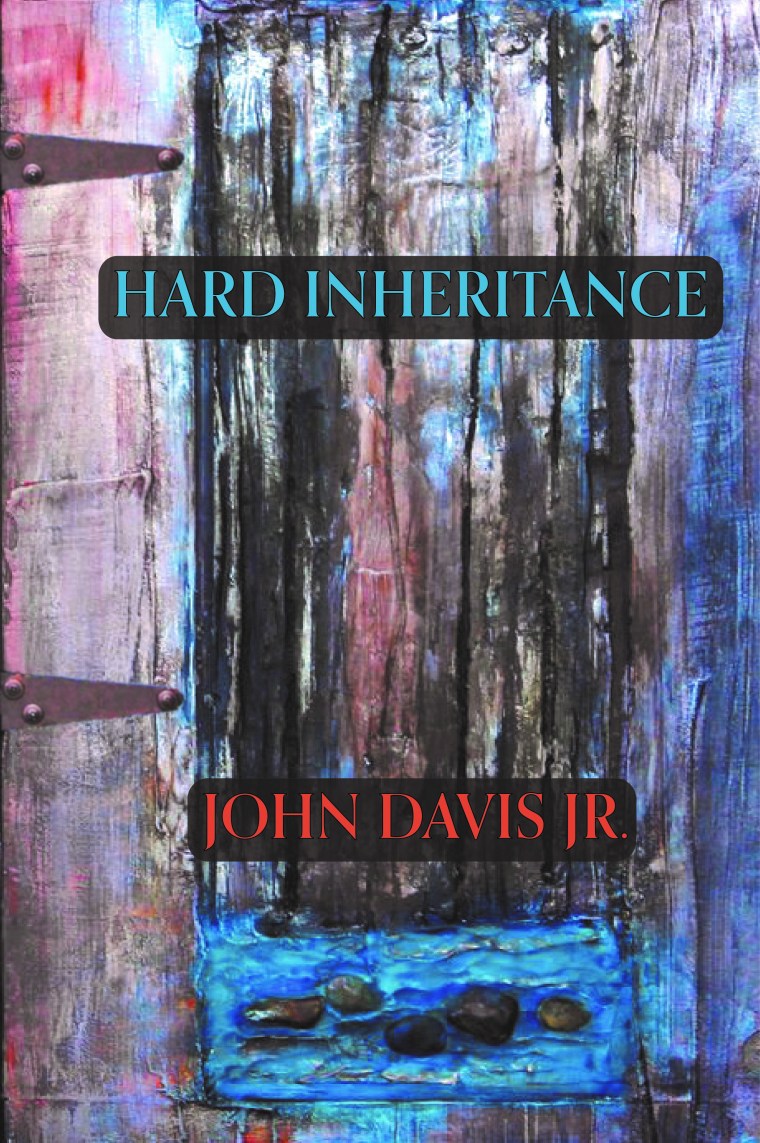
In one week, I will be launching my latest collection, Hard Inheritance, at one of our city’s nicest art galleries. It is bittersweet, as this will be both the first and last book launch I hold here. I’ve loved my current city for 17 years, but this summer, my family and I will be moving to the west coast of Florida. My newest university teaching gig is a 70-mile drive from my present home, and making a 140-mile round trip daily is simply infeasible. By spring break, we plan to put our house on the market, and hopefully by summer, we will be in a new house in the Tampa Bay area. Timing, the market, and other factors will determine how quickly all this occurs, of course.
In the meantime, I’m excited to offer this new book, much of which has been inspired by our city, to the people of Winter Haven. My cover artist, a Winter Haven native herself, will be on hand to sign copies of the book with me, and invitees include people who have been supportive of my craft over the years that I’ve resided here. In many ways, this book launch is a fond goodbye to a place that has been kind to me and my family. The time I’ve spent here hasn’t been perfect — the same is true anywhere called home — but it has been inspirational.
Winter Haven’s people, its lakes, its nature, and its history have all woven themselves into my poems at different points along my artistic journey. I’ll miss all that over on the west coast, but there will be fertile material for writing there, as well. I’ve enjoyed seeing the vast salt water every day as I cross the Courtney Campbell Causeway or the Howard Frankland Bridge, and I feel certain that soon enough, my writing will take on a flavor that is more beach-driven. My hope is not to become one of those poets who creates trite rhymes about the sea, but rather, one who allows the environment to speak in its own way. Certainly that has happened here among the lakes of Winter Haven.
My wife’s family lives in Winter Haven, and doubtless we will be returning to visit often, especially during the summers. And yes, it will be a while yet before we’re out of the area. But this book launch allows me to reflect upon and salute a place that has been meaningful. The future is uncertain but hopeful, and it wouldn’t be possible without history. So, Winter Haven, a place of history, beauty, and opportunity, this book launch is for you. Best wishes.
After years of writing and months of preparation, Hard Inheritance is now available! Just in time for the holiday season, this new volume contains works first published by such literary powerhouses as Nashville Review and similar respected journals.
Perhaps more importantly, though, it is a testament to life lived in rural Florida. Following in the footsteps of its older brother, Middle Class American Proverb, Hard Inheritance offers readers a glimpse into the trials, joys, and landmark events of time spent in places that barely get their own map-dot. Moreover, it presents a portrait of such places’ people — the hard, the charitable, the native.
Notable southern poet Andrew Hudgins says this about Hard Inheritance:
“The poems in Hard Inheritance are set firmly in the poet’s ‘ancestral terrain’ of small-town Florida. The landscape is lovingly but unsentimentally brought to the page, and it is peopled by the poet’s family, friends, and fellow parishioners. … These truly are ‘songs sculpted by home’s hard structures.'”
And award-winning poet Sandra Beasley adds:
“What is architecture, without its inhabitants? ‘In our heart pine handmade farm house, / my grandparents were window weights: // cast iron bars tethered in country wood, / plumb and place-holding pendulums.’ What is a field, without the hands that tend it? In HARD INHERITANCE, John Davis, Jr. recognizes the potent ecosystems of everyday life, as in “What the Grove Knows”: “Stirred soil lifts its secrets to the sky. / Revealed and overturned crickets / invite snowy egrets who eat them.” Readers will enjoy taking a joy ride on an untethered dock, hunting down poisonous white frogs, harvesting worms before a father and son’s angling expedition, and hand-nestling one newspaper section into another before the morning’s delivery. Yet these poems resist mere nostalgia; the author’s voice is attentive, conversational, and wise to how class shapes the landscape at hand. Given graceful and balanced stanzas, consonance of word choice, and the unexpected glimmer of a pantoum, I admire both Davis’s rigors of craft and vitality of spirit.”
I’m incredibly excited by this new release, and I hope you’ll pick up a copy to fill a stocking or to surprise that word-lover on your list. Get one for yourself, while you’re at it. Here’s wishing everyone the warmest of holiday seasons! Happy Reading!
My new book, Hard Inheritance, was just submitted to the publisher! I’m pleased to announce that this latest collection, 60 poems strong, will be available in 2017. Launches are being scheduled, and news of times and places will come soon. Also, I’ll be posting sales links and sites in the future for those who like to patronize both electronic and brick-and-mortar vendors.
I’m especially pleased to share Five Oaks Press publication with the likes of Julie Hensley (another Disquiet International Literary Program alum), and the inimitable Peter Murphy. I am also pleased to announce that this latest collection has blurbs from some of the best-known and most respected voices in poetry today. See below for a free preview:
The poems in Hard Inheritance are set firmly in the poet’s “ancestral terrain” of small-town Florida. The landscape is lovingly but unsentimentally brought to the page, and it is peopled by the poet’s family, friends, neighbors, and fellow parishioners, with “the calm assurance of traveled/trails with familiar footholds.” These truly are “songs sculpted by home’s hard structures.”
~Andrew Hudgins, National Book Award Finalist and author of The Joker: A Memoir, American Rendering: New and Selected Poems and other critically acclaimed works
What is architecture, without its inhabitants? “In our heart pine handmade farm house, / my grandparents were window weights: // cast iron bars tethered in country wood, / plumb and place-holding pendulums.” What is a field, without the hands that tend it? In Hard Inheritance, John Davis Jr. recognizes the potent ecosystems of everyday life, as in “What the Grove Knows”: “Stirred soil lifts its secrets to the sky. / Revealed and overturned crickets / invite snowy egrets who eat them.” Readers will enjoy taking a joy ride on an untethered dock, hunting down poisonous white frogs, harvesting worms before a father and son’s angling expedition, and hand-nestling one newspaper section into another before the morning’s delivery. Yet these poems resist mere nostalgia; the author’s voice is attentive, conversational, and wise to how class shapes the landscape at hand. Given graceful and balanced stanzas, consonance of word choice, and the unexpected glimmer of a pantoum, I admire both Davis’s rigors of craft and vitality of spirit.
~Sandra Beasley, author of I Was the Jukebox and Count the Waves
John Davis Jr.’s Hard Inheritance offers us a fine collection of well-built poems. Vivid images drawn from Florida’s flora and fauna, the pressures and rewards of family life, and work ranging from the orange grove to the printing press balance Davis Jr.’s heart-breaking restraint and precise diction. Heir in part to Seamus Heaney and to Claudia Emerson, Davis Jr. has made of his literary and literal ancestry a singular twenty-first century voice.
~John Hennessy, author of Coney Island Pilgrims, poetry editor of The Common
I’m eager to post a cover image here, so keep your eye peeled! Thank you all for your support of my continued work. Your readership makes it all possible!
The rooftops of Lisbon are a sight to behold! This shot from the top of the Hotel de Chiado, where the opening reception for the Disquiet International Literary Program is taking place, says it all.
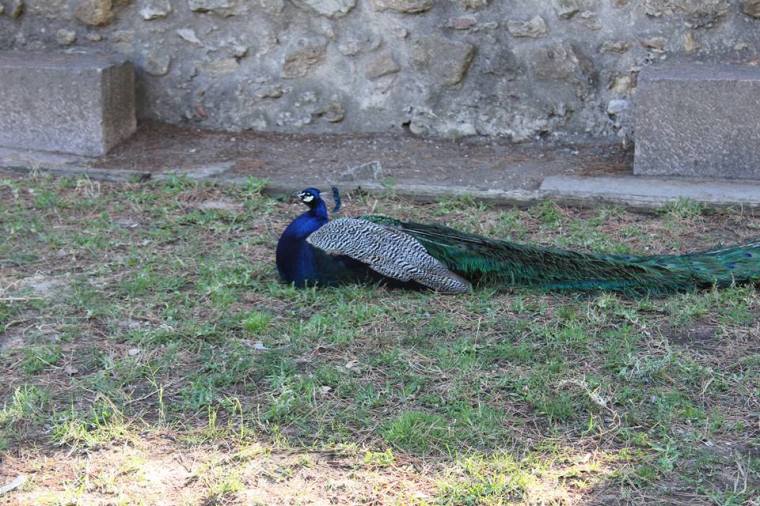
While walking the grounds of the Castela de St. Jorge in Sintra, this peacock stole the show. The castle is huge, and there will be more photos of it in future posts. Stay tuned!
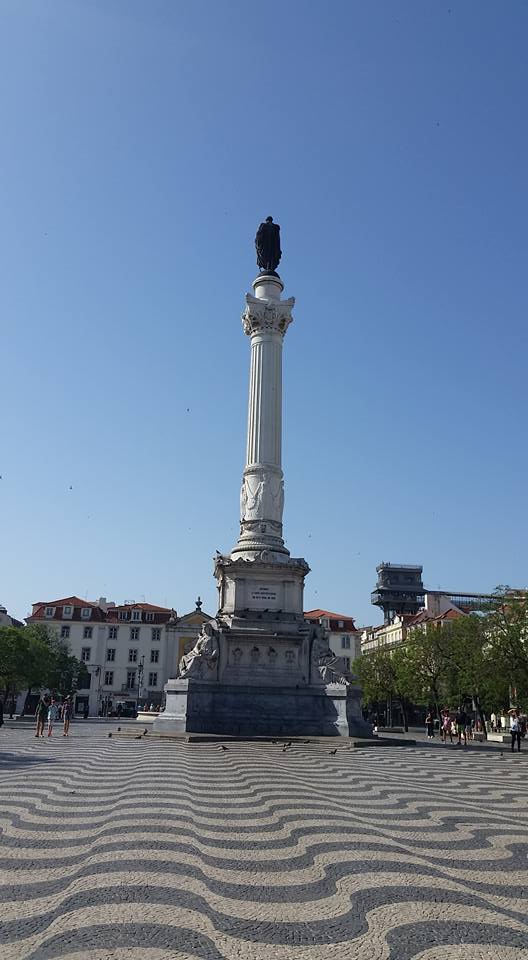
One of the many beautifully tiled plazas here in Lisbon. Statues of artists and writers are everywhere!
Earlier this year, brilliant mathematician and Nobel Prize winner John Nash and his wife Alicia were killed in a car wreck. Nash’s work and life were the subject of the film A Beautiful Mind, directed by Ron Howard in the early 2000s. Like many moviegoers, I too was touched and inspired by Nash’s biography (even if it was “adapted” for film). His humble West Virginia origins, his battle with personal demons, and his eventual rise to academic and economic prominence spoke to audiences everywhere.
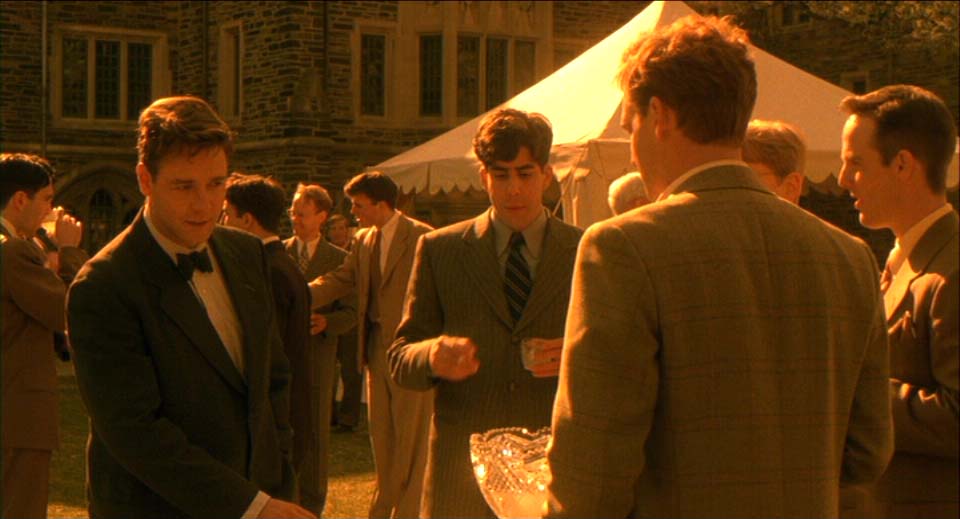
Martin Hansen, played by Josh Lucas in the foreground, engages in some party snobbery toward John Nash (Russell Crowe), at left.
Recently, one scene from Howard’s movie replayed in my head as I encountered a situation similar to one faced by Nash early on in the film: Upon his arrival at Princeton after receiving a substantial scholarship, Nash is confronted by Martin Hansen during a reception. Hansen indicates that he “simply assumed [Nash was] the waiter,” due to his appearance. This barbed condescension is a hallmark of the early Nash-Hansen competitive relationship as portrayed in the film.
People from small towns or rural upbringings often face this kind of slight, even today. I grew up in a town of 3,500 people. Everyone knew everyone else, and the main vocation was agriculture. So, when I eventually moved to a city of 35,000 people (and growing), I felt as though I’d made my home in a more metropolitan area. Even though the culture here is still one of welcoming and warmth (see prior posts), my city has many markers of being a larger, slightly more urban place than many of Florida’s smaller map dots.
While I was serving as a guest lecturer at an area university some months ago, a student I met had the audacity to insinuate that small to mid-sized cities are undeserving of artists in residence or poets laureate. His contention was that only large cities and crowded urban areas should pay attention to literary and arts-related matters, because, after all, creative gifts can only thrive in such a vast and populous setting. There was more “talent” to choose from, he indicated, and more educated people inhabiting the big cities.
So, let me set the record straight, if only to repudiate this student’s erroneous assumptions. Many highly educated and erudite individuals choose to be country-dwellers, suburbanites, and big city expatriates (I’d supply a list, but it would be far too long). Their decision is made not because they desire to be “bigger fish in smaller ponds,” but because they desire a truer sense of community, a safe and clean place to raise a family, or maybe because they hold dear the virtues that modestly populated areas often embrace. In the end, there are several reasons to eschew the hustle and bustle of the sky-scraped city, especially if one is an artist. Certainly, there are benefits to larger metropolises, just as there are drawbacks. And yes, arts and culture do thrive there in most cases.
However, assuming ignorance or lack of refinement exists solely in smaller towns or mid-sized cities is the height of arrogant urban imperialism. I believe that Annie Dillard, Mark Twain, and John Nash would agree, for starters. And for me, smaller places yield bigger ideas. It is not by accident that Richard Hugo encouraged poets to seek out “triggering towns” that seemed to be more tight-knit communities.
I’m not attempting to prescribe small-town living to those accustomed to bigger cities, nor am I advocating one particular mode of residency. But I do know that, for my creative purposes, small and medium places work. Those who denigrate them, somewhat ironically, need only a broader mind.
So here was a first: My interview with local literati member Jane Waters-Thomas: Writers Den
Lessons learned:
When doing an author interview, never resign oneself to a chair that tilts backward, making you push every ounce of your neck flesh out from under your face. The camera already adds 15 pounds; don’t make it worse with posture.
Avoid using verbal fillers like “if you will” and random catch-all adjectives.
Know when to SHUT UP. There’s a fine line between adding details and bloviating.
Keep your eyes on the host, or on one of a few select spots around the set. Too much eye-shifting seems disingenuous.
Read the text that’s in your book, even if you’ve changed it in a later, better draft. Avoid creating cognitive dissonance.
There you have it. If I had it to do over again, I’d probably lose the tie, also. But we all live and learn, I suppose. Hopefully I get another shot at TV sometime — I liked the format, and I truly appreciated the opportunity to get the word out about my writing and teaching. And now that I know what NOT to do, I’d love another shot at speaking to an audience through broadcast. Great conversations are always welcome!
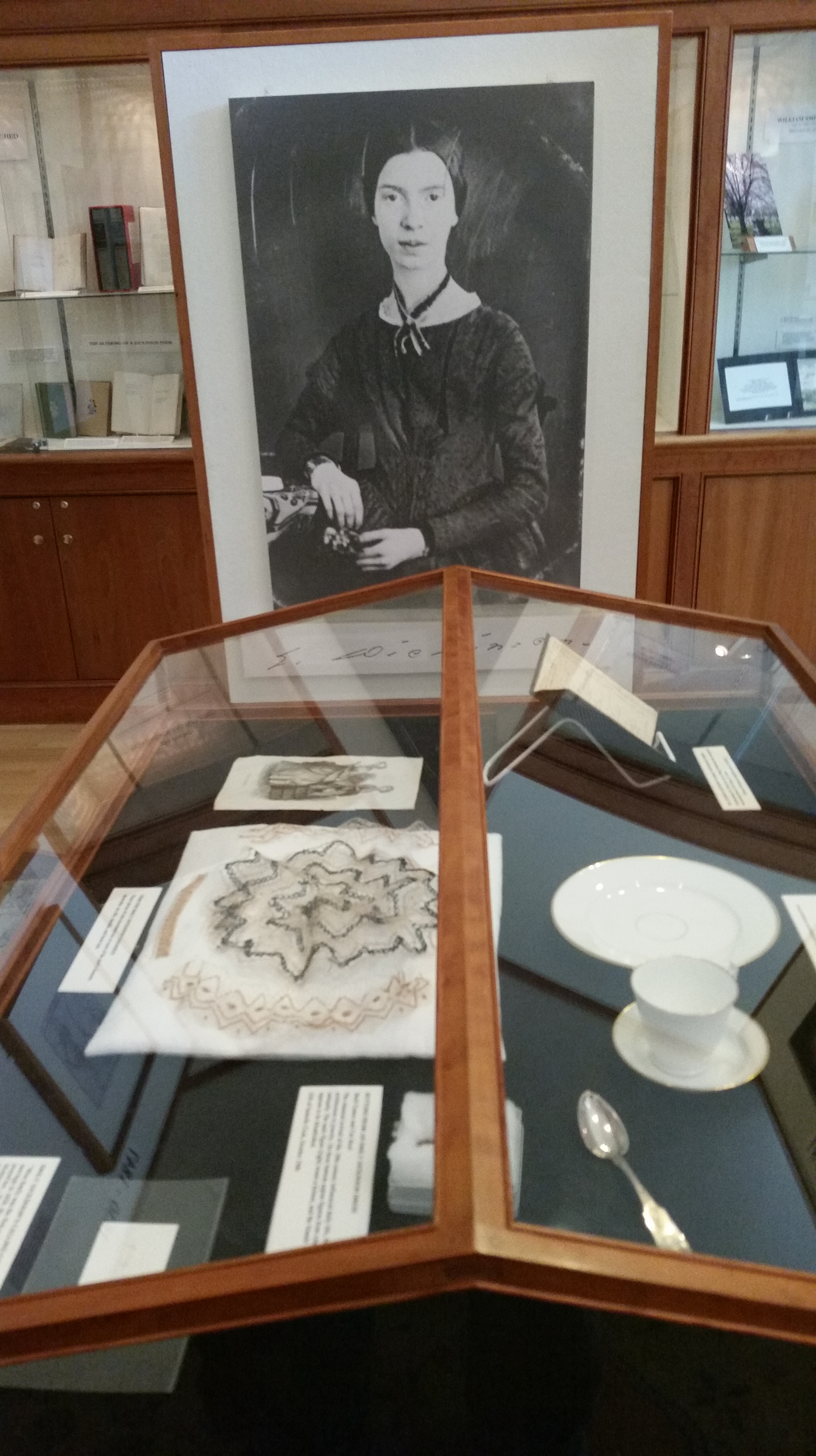
Emily Dickinson’s portrait in the Dickinson/Frost collection of Jones Library, Amherst, Mass.
Recently, I attended the Juniper Writing Institute at University of Massachusetts in Amherst. For the unaware, Amherst is the hometown of one of the canon’s most memorable and memorized poets, Emily Dickinson. Also nearby, one can find the farm of another great American poet, Robert Frost, considered by many to be the landmark poet of the 20th century. Both of these poets have meant a great deal to me as a writer throughout my career, and being in their part of the world was an unforgettable experience.
But my own independent studies of both Frost and Dickinson raised a new question for me — one that awoke me at 3:30 a.m. the first night of the conference. So distracted was I from this recurring question that I arose from my semi-peaceful travel slumber to write by hand in my journal. Here, in its unedited version, is the transcript of my late-night, early-morning writing:
6/21/15, 3:30 a.m.
I am awake because Emily Dickinson will not leave my mind. Having visited her house yesterday, I keep seeing her small corner bedroom over and over: its little sleigh bed, its dresser, its white-knobbed doors.
The Dickinson House in downtown Amherst.
Most of all, though, I think of all its windows. The tour guide kept using phrases like “extraordinary fenestration,” and she did not exaggerate. The natural light in Emily’s room was almost church-like. White and spiritual, it seemed to give life to the broad, thick beams of hardwood flooring there. As old as everything was, the light carried no dust. The air in her quarters was as pristine as the white housecoat she sewed for herself. On that air was the scent of history, a rare mixture of old wood, natural fibers, and unstirred earth.
I glimpsed the Amherst world from her window. Her tiny desk was positioned before it, and for a second, I could visualize her sitting, penning lines of legacy. Some of these lines also awoke me today, mostly her first lines:
Hope is the thing with feathers
I dwell in possibility
My teacher-mind sets to work on these, and I envision exercises for my students:
(Abstraction) is the thing with (concrete object)
What idea or notion do you “dwell in,” and why?
A collection of Emily’s things at the Jones Library in Amherst.
The second of these questions applies to me as well, for once again I find myself too fixated on the idea of leaving my mark as an artist. I dream of a time when others tour my family’s farm or my smaller lake-view house in the city to see where and why and how I worked. Even at this mature age, my boyish whims of literary celebrity return, thanks in part to Emily Dickinson. My pragmatism intervenes, though, and tells me I need to sleep before daylight arrives. [End Journal Entry]
So, I was at my most honest in the middle of the night. But my thoughts of leaving a literary trail for others to follow would not stop with Emily. No, not when the home and writing space of one of my all-time literary heroes was nearby.
Upon my visit to the Frost Farm in Derry, New Hampshire, I was privileged to see his barn, his house (both floors!) and the land surrounding. I stood where the great man stood, walked where he walked, and even trod the staircase his wife descended, prompting the poem “Home Burial.” All these experiences once again raised the concern of posthumous impact.
Would people want to similarly experience the spaces where I have created? Will my own work ever merit that kind of attention, before or after my death? The literary marketplace is full of Frost-wannabes and Dickinson-aspirants, and who am I to even ponder such weighty matters? How does proving oneself a “fanboy” of literature make one any more likely to succeed at literary and scholarly endeavors? And thusly, I tortured myself further.
I visited the Robert Frost Library. I spent hours perusing the Frost-Dickinson collection in the Jones Library of Amherst. I allowed my imagination to run wild with scenarios concocted only from the notion of greatnesses recognized. And once again, I found myself twisting my brain into the same enigma that it has puzzled over like a Rubik’s Cube countless times before: Will I matter? Will my work matter? How do I ensure both? What steps must I next take to be certain that I’m not forgotten, like so many writers of the past?
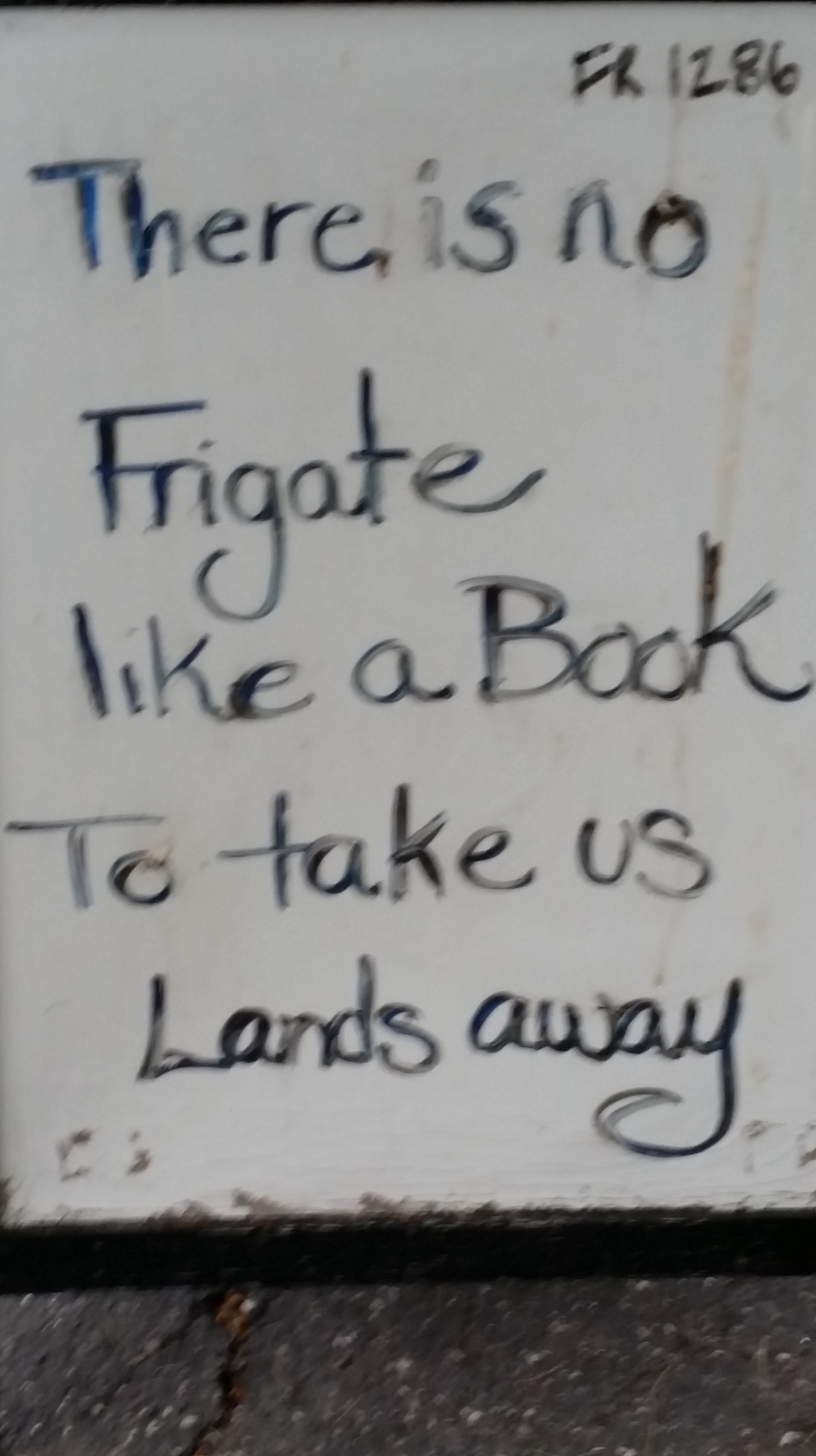
A sign on the grounds of the Dickinson House in Amherst. This passage is directly from Emily’s poetry.A bust of the great man himself inside the Dickinson/Frost collection at Jones Library.
I had hoped by now, at my nearly 40 years of age, that such concerns would really be a thing of the past. After all, I continue to write, and I’m sure that one day I’ll see some wider recognition than my meager efforts have so far produced. Like all writers, I’d like a Pulitzer and maybe some other big awards (see prior posts), but honestly, at the end of the day, what I’m really aiming to do is preserve people, times, and places that have mattered to me the most. If my poetry results in just a few people gaining a broader appreciation of the heritage, values, and experiences I’ve received in this life, then I’ve won. And I don’t mean that all of my poems are totally autobiographical — certainly many are not. But all of them lend themselves toward ideas, visions, and perspectives that, however universal, have arisen somehow from the life I’ve lived.
Will people care about that life? Why should they? Will students sit through laborious documentaries about the different periods in my writing timeline? Will my work be anthologized in textbooks of the future? Such inquiries can drive one mad, if left unchecked. Spending countless hours in the homes of the greats might not make me a better writer, but it did accomplish one thing — it allowed me to see a shared humanity, a common thread of inspiration, motivation, and dedication.
Persistence, diligence, and enormous creativity are shared traits among those we celebrate today, so long after their earthly departures. And perhaps it is these traits that we should take away from memorials and museums commemorating their contributions. More than the vanity of asking, “How can I attain their level of distinction?”, perhaps we (I) should be asking, “What can I do continuously and creatively well to positively affect my world?” Such a question surpasses the superficial desire for remembrance, and enters us into a more philosophical, even theological, realm. May our answers lead us not to fame, not to fortune, and not to solipsism. Rather, may they lead us to be better human beings, produce finer work, and seize the opportunities of the everyday.
Robert Frost’s writing space at Frost Farm in Derry, N.H.A statue of Frost just outside the Robert Frost Library at Amherst College.
It’s that time of year again: Editors and publishers are nominating works from their magazines and bookshelves for a broad range of laurels. Most notably at this time of year, writers receive word of Pushcart Prize nominations. As a younger writer, I used to get all tingly when those nominations arrived by email — kindly journal editors who liked my work sent it on to that mystical committee that views thousands of submissions every year from literary journals all over. I am still honored to have my work nominated for the Pushcart (as it was again this year), but in speaking with mentors and writer-friends of mine, I’ve come to understand something: Poets “worth their salt” are nominated for the Pushcart almost annually. Venerated veterans of poetry take such nominations for granted, apparently, even though those of us who are still “emerging” think them a big deal. So, I’ve learned to cool my jets a little. Once my work is actually included in the honorable Pushcart anthology, I’ll certainly add that detail to my author’s bio. But for now, I suppose I should join the ranks of my fellow authors who see nominations as a nice thought, a kind gesture, but ultimately, little more than a tip of the hat toward one’s work.
I’ve learned also that the awards one reads about in other writers’ portfolios aren’t always as glamorous as they seem (take note, young writers). Certain awards may open some doors, they may add something to one’s CV, but outside the literary community, they don’t amount to a hill of beans. Robert Frost was a fan of the old saw “Fine words butter no parsnips,” and I suppose in the world of literary awards, a similar thought exists — shiny trophies, parchment certificates, and faux-wood plaques don’t make you a writer any more than a fancy hat does.
Recently a publisher friend of mine let me know that my book has been nominated for a couple of other awards, as well. If I win, it will be a wonderful experience, and I’m trying hard not to get my hopes up too much prior to the announcements. These awards are entered by many of my most respected fellow writers and their publishers, as well. To even enter the field is an honor unto itself. The danger, of course, in winning awards is the temptation toward stasis — many a great writer, after earning the Pulitzer or the National Book Award, has lain down his pen. The award was an end rather than a milepost on the journey. Writers, as awards season enters full swing, the temptation is great to see pinnacles where only plateaus exist. Gilded honors are stations on the path, not summits to be conquered. Let us be grateful and humbled, but let’s not be complacent. There’s writing yet to do. Stick that award on the shelf or on your book cover, and let’s keep going.
 FLteacherpoet555

 In one week, I will be launching my latest collection,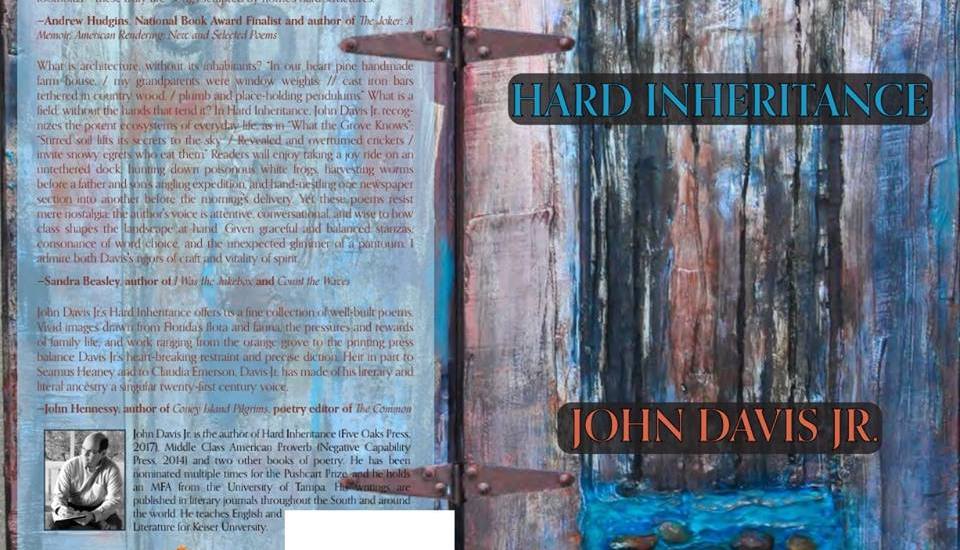






 John Davis Jr. -- Author