As a kid growing up in the 80s, my television family was the Seavers, not the Cleavers. Every boy my age wanted to be Kirk Cameron (Mike Seaver of Growing Pains), or maybe Michael J. Fox, who played Alex P. Keaton in Family Ties. Shows like these made it seem cool to be like those families and their kids, for certain.
In today’s literary community, aspiring toward a more traditional type of success has been replaced by a phobia about being “too mainstream.” I was reading an article just the other day by a respected author who lamented that her life was “becoming too mainstream,” which she defined by tasks like going to the grocery store, washing dishes, and tending to the relationships beneath her roof.
Sadly, being responsible and attempting to live a reasonable, self-sufficient life are both ideas that have been denigrated by various media in recent years. The notions that we should work ethically, raise a family, seek advancement in a single field, and aspire toward something greater than self-satisfaction are frowned upon by a vocal minority. There are those, after all, who believe such ideas to be too old-fashioned, too whitebread, or too puritanical for the twenty-first century.
But this isn’t a political post. I’m here to defend the value of the mainstream in our literature, specifically. There is beauty in the common, after all, and while socio-cultural activists may be trying their hardest to redefine what constitutes “the norm,” Joe and Jane Average still know that their lives — complete with light bills, plumbing repairs, and runny noses — have wonder, merit, and poetry in their seemingly mundane routines. Eschewing the everyday limits the scope and reach of our literature.
What’s more, by omitting mainstream details, artists portray a fallacious picture of what our world is really like: Rather than giving readers honest visions of life, many are seeking shock value, or perhaps some abstract, inauthentic version of their environment. In the end, both of these motives generate lies — creative, occasionally beautiful lies, perhaps, but lies nonetheless. While I’m no Realist (artistically speaking), I also don’t believe that writers should fear the mainstream. Give us the sidewalk cracks, the wasps and overdue notices in the mailbox, the wiffle ball stuck in the backyard oak tree. There is poetry in all these things, and there is life.
Being mainstream, by the way, isn’t all that bad, you’ll find. Parenthood and the obligations of marriage, career, and family life remain sources of great inspiration, just as they did in prior generations. Maybe it’s not new, it’s not avant-garde, and it’s not the “artist thing to do.” But I’ll take it any day over the exotic or the crazy. To be clear, I’m not saying “mainstreaming” is for everyone. However, I am saying that in going about the business of writing, we as authors should not be scared of that which seems standard. For it is the run-of-the-mill that yields the exceptional, the original, and the special. And that, writers, is what we’re after — the diamond in the rough, the pearl inside the oyster, and the rainbow out of the gray. Without the ordinary, there can be no extraordinary.
So here was a first: My interview with local literati member Jane Waters-Thomas: Writers Den
Lessons learned:
When doing an author interview, never resign oneself to a chair that tilts backward, making you push every ounce of your neck flesh out from under your face. The camera already adds 15 pounds; don’t make it worse with posture.
Avoid using verbal fillers like “if you will” and random catch-all adjectives.
Know when to SHUT UP. There’s a fine line between adding details and bloviating.
Keep your eyes on the host, or on one of a few select spots around the set. Too much eye-shifting seems disingenuous.
Read the text that’s in your book, even if you’ve changed it in a later, better draft. Avoid creating cognitive dissonance.
There you have it. If I had it to do over again, I’d probably lose the tie, also. But we all live and learn, I suppose. Hopefully I get another shot at TV sometime — I liked the format, and I truly appreciated the opportunity to get the word out about my writing and teaching. And now that I know what NOT to do, I’d love another shot at speaking to an audience through broadcast. Great conversations are always welcome!
I’m not usually one to post one negative thing after another, but recently, circumstances in my literary life have been causing me to offer a few “no-nos” to the general public. In today’s edition: How to know when you should never submit to a magazine/journal/publisher again.
Without naming names, I’ll tell you that I’ve recently scrawled a list of literary venues that I will never offer my work to again, and posted them to my bulletin board as a reminder. As a younger writer, I did this after a single rejection (or even two or three), which was hot-headed and foolish on my part. However, the places that I’ve listed and “sworn off” recently have committed editorial faux pas that I consider frankly unforgivable in the 21st century. And so, without further adieu (punny, yes?), here’s why I said goodbye and good riddance to a few literary outlets lately:
1. No response unless accepted. One journal is on my list because the editors cling to a policy that states, “We will communicate with you only in case of acceptance.” Hogwash. There is absolutely no reason that a magazine of any size should refuse sending a simple “no” to a waiting and hopeful writer. Their exclusive practice is rude, and rudeness doesn’t fly, even today.
2. Hostile, condescending, or insulting rejections. Another place is on my list because the editor could have sent a simple form rejection letter or a polite “This doesn’t fit our current needs,” but decided instead to engage in blatant snobbery and offer a few ad hominem cutting remarks. Where “no thanks” will suffice, subtle or obvious condescension has no place. Farewell, editorial ugliness. You have no home here.
3. Rampant inefficiency or gross incompetence. My third blacklisted venue accepted my work more than two years ago, and published it about a week ago. No, I haven’t mentioned them by name here or on social media. I thought the place had gone belly-up, honestly, as my attempts at communication were never returned, and I had already submitted the pieces they accepted to other venues. This could have created a major legal snafu, among other issues. Also, my author’s bio was grossly outdated in this publication due to lax oversight and poor management. Never again, (name withheld) Review. Yes, I know publishing is tough and time-consuming, but not to the extent that it should cause literary malpractice.
4. Emotional/personal affairs affecting editorial discernment. The final place to which I will no longer submit is operated by a novice publisher who sees every “no thank you” as a personal attack, or as an affront to the integrity of her/his operation. This same publisher overshares his/her personal problems when deadlines are missed or when quality is questionable. When the boss has problems, everybody has problems, much like the old adage “When momma ain’t happy, ain’t nobody happy.” I’ll steer clear, thanks.
So there you have them: my reasons for “blacklisting” certain publishers. Some of these may seem hasty or even unfair, but in every case, my personal experience has been such that I felt compelled to write them off. I would be interested to know why you, the reader, have stopped submitting to various places, as well. Feel free to posit your experiences in the comments section (please keep it clean and non-libelous). We’ve all been there. Keep writing!
If you read this blog with regularity, you know I recently returned from Amherst, Massachusetts, where I attended a writing conference and explored literary landmarks around New England. I am also a student of municipalities that encourage and invite tourism, however, and Amherst, despite being small and comparatively out of the way, was doing a number of things to make their town tourist-friendly to folks like me:
1.) The public library celebrates renowned local authors and artists. In fact, the whole third floor of Jones Library is devoted to historical artifacts and volumes regarding Emily Dickinson and Robert Frost. Also, local landmarks have significance to the artistic and literary history of Amherst.
2.) The area’s history is celebrated with events, as well, and there appears to be good community involvement which has been stimulated through the use of various media.
3.) Churches and civic groups are partners in the arts.
4.) Colleges in Amherst offer their space as venues for arts-related and literary events, even if the organizers are unrelated to the colleges.
I was favorably impressed by all these details, and thought I would bring them back to my city as suggestions for implementation. After all, Winter Haven is a city on the grow, and with a renewed focus on the arts and tourism, all of these Amherst traits seemed worthy of emulation.
Why, then, don’t I plan to return to Amherst anytime soon? The answer lies in people. Everywhere I went, from the Stop N Shop and Big Y grocery stores to the corner diner, people were complaining. Conversation in the diner was dominated by older men bemoaning a new red light that had been installed. Younger women in the grocery store aisles were whining about their toddlers’ behaviors. Cashiers never smiled, and transacted business without pleasantries. It seemed to me, an outsider, like Amherst was a miserable place to be a local. I stopped in at Friendly’s, New England’s version of Steak N Shake, and nobody, not even the servers, made the restaurant live up to its name. Maybe the city was just having a bad week, but it was enough to sour my perception as a visitor.
Granted, I’m a little spoiled on hospitality. Here in my part of the country, “service with a smile” isn’t just a catchphrase, it’s an overall attitude. Some days, that smile might be forced, but there never seems to be a time when merchants aren’t glad to see you. Publix serves as a national example of what grocery stores should emulate, mostly because of their kind and responsive customer service. Likewise, local chatter at our diners and coffee shops usually consists of a healthy mixture of politics, business, family life, and current events — and most of the time, those conversations, even contentious ones, are cordial.
There are those who would accuse my people of being disingenuous. They might claim that we hide our anger, frustration, or dismay behind stereotypical southern “sunnyness.” But the truth is, no matter how bad the world might be, whether a new red light, an unruly child, or a hard day at work has flustered us, most of us can still muster up kindness for others. It’s what people here do, and it’s one reason why I stay.
The great irony of this post, perhaps, is that it falls into the category of “complaining about complaining.” I get that. But perhaps this post is also demonstrative of attitude infectiousness: pessimism yields more pessimism, yes, but the opposite is also true. Come to Winter Haven sometime and find out for yourself. I’m off to Richard’s Fine Coffees.
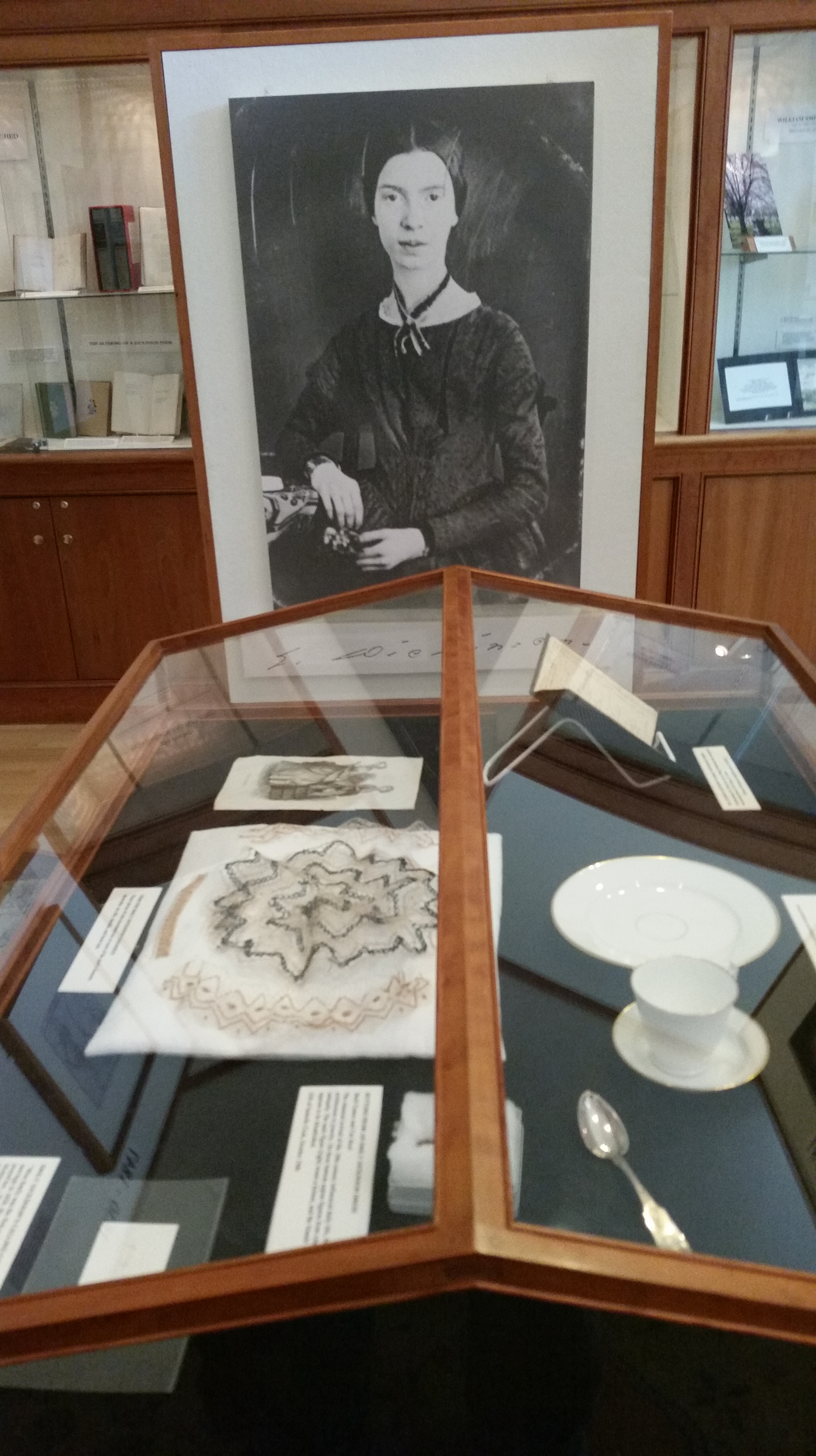
Emily Dickinson’s portrait in the Dickinson/Frost collection of Jones Library, Amherst, Mass.
Recently, I attended the Juniper Writing Institute at University of Massachusetts in Amherst. For the unaware, Amherst is the hometown of one of the canon’s most memorable and memorized poets, Emily Dickinson. Also nearby, one can find the farm of another great American poet, Robert Frost, considered by many to be the landmark poet of the 20th century. Both of these poets have meant a great deal to me as a writer throughout my career, and being in their part of the world was an unforgettable experience.
But my own independent studies of both Frost and Dickinson raised a new question for me — one that awoke me at 3:30 a.m. the first night of the conference. So distracted was I from this recurring question that I arose from my semi-peaceful travel slumber to write by hand in my journal. Here, in its unedited version, is the transcript of my late-night, early-morning writing:
6/21/15, 3:30 a.m.
I am awake because Emily Dickinson will not leave my mind. Having visited her house yesterday, I keep seeing her small corner bedroom over and over: its little sleigh bed, its dresser, its white-knobbed doors.
The Dickinson House in downtown Amherst.
Most of all, though, I think of all its windows. The tour guide kept using phrases like “extraordinary fenestration,” and she did not exaggerate. The natural light in Emily’s room was almost church-like. White and spiritual, it seemed to give life to the broad, thick beams of hardwood flooring there. As old as everything was, the light carried no dust. The air in her quarters was as pristine as the white housecoat she sewed for herself. On that air was the scent of history, a rare mixture of old wood, natural fibers, and unstirred earth.
I glimpsed the Amherst world from her window. Her tiny desk was positioned before it, and for a second, I could visualize her sitting, penning lines of legacy. Some of these lines also awoke me today, mostly her first lines:
Hope is the thing with feathers
I dwell in possibility
My teacher-mind sets to work on these, and I envision exercises for my students:
(Abstraction) is the thing with (concrete object)
What idea or notion do you “dwell in,” and why?
A collection of Emily’s things at the Jones Library in Amherst.
The second of these questions applies to me as well, for once again I find myself too fixated on the idea of leaving my mark as an artist. I dream of a time when others tour my family’s farm or my smaller lake-view house in the city to see where and why and how I worked. Even at this mature age, my boyish whims of literary celebrity return, thanks in part to Emily Dickinson. My pragmatism intervenes, though, and tells me I need to sleep before daylight arrives. [End Journal Entry]
So, I was at my most honest in the middle of the night. But my thoughts of leaving a literary trail for others to follow would not stop with Emily. No, not when the home and writing space of one of my all-time literary heroes was nearby.
Upon my visit to the Frost Farm in Derry, New Hampshire, I was privileged to see his barn, his house (both floors!) and the land surrounding. I stood where the great man stood, walked where he walked, and even trod the staircase his wife descended, prompting the poem “Home Burial.” All these experiences once again raised the concern of posthumous impact.
Would people want to similarly experience the spaces where I have created? Will my own work ever merit that kind of attention, before or after my death? The literary marketplace is full of Frost-wannabes and Dickinson-aspirants, and who am I to even ponder such weighty matters? How does proving oneself a “fanboy” of literature make one any more likely to succeed at literary and scholarly endeavors? And thusly, I tortured myself further.
I visited the Robert Frost Library. I spent hours perusing the Frost-Dickinson collection in the Jones Library of Amherst. I allowed my imagination to run wild with scenarios concocted only from the notion of greatnesses recognized. And once again, I found myself twisting my brain into the same enigma that it has puzzled over like a Rubik’s Cube countless times before: Will I matter? Will my work matter? How do I ensure both? What steps must I next take to be certain that I’m not forgotten, like so many writers of the past?
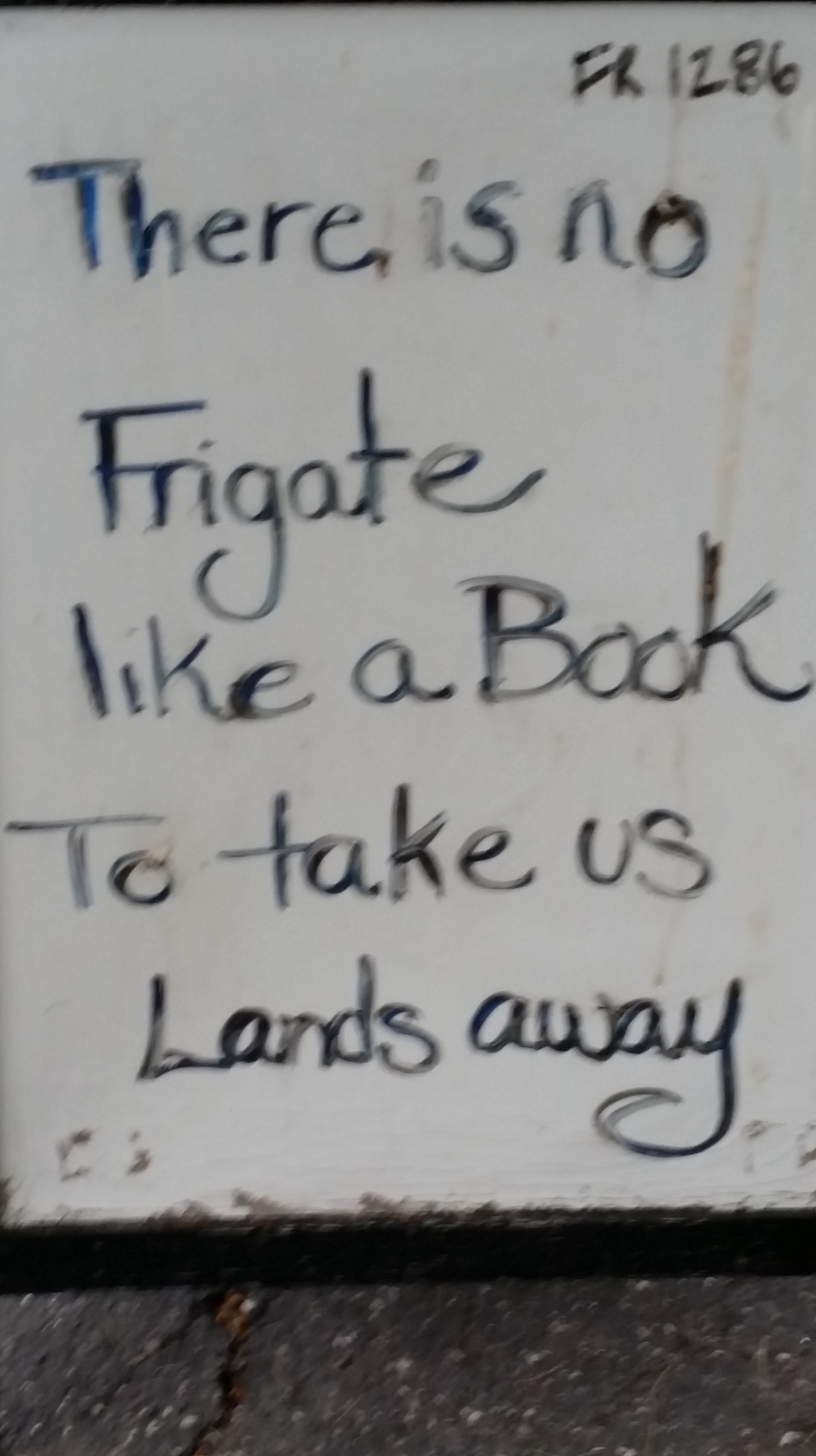
A sign on the grounds of the Dickinson House in Amherst. This passage is directly from Emily’s poetry.A bust of the great man himself inside the Dickinson/Frost collection at Jones Library.
I had hoped by now, at my nearly 40 years of age, that such concerns would really be a thing of the past. After all, I continue to write, and I’m sure that one day I’ll see some wider recognition than my meager efforts have so far produced. Like all writers, I’d like a Pulitzer and maybe some other big awards (see prior posts), but honestly, at the end of the day, what I’m really aiming to do is preserve people, times, and places that have mattered to me the most. If my poetry results in just a few people gaining a broader appreciation of the heritage, values, and experiences I’ve received in this life, then I’ve won. And I don’t mean that all of my poems are totally autobiographical — certainly many are not. But all of them lend themselves toward ideas, visions, and perspectives that, however universal, have arisen somehow from the life I’ve lived.
Will people care about that life? Why should they? Will students sit through laborious documentaries about the different periods in my writing timeline? Will my work be anthologized in textbooks of the future? Such inquiries can drive one mad, if left unchecked. Spending countless hours in the homes of the greats might not make me a better writer, but it did accomplish one thing — it allowed me to see a shared humanity, a common thread of inspiration, motivation, and dedication.
Persistence, diligence, and enormous creativity are shared traits among those we celebrate today, so long after their earthly departures. And perhaps it is these traits that we should take away from memorials and museums commemorating their contributions. More than the vanity of asking, “How can I attain their level of distinction?”, perhaps we (I) should be asking, “What can I do continuously and creatively well to positively affect my world?” Such a question surpasses the superficial desire for remembrance, and enters us into a more philosophical, even theological, realm. May our answers lead us not to fame, not to fortune, and not to solipsism. Rather, may they lead us to be better human beings, produce finer work, and seize the opportunities of the everyday.
Robert Frost’s writing space at Frost Farm in Derry, N.H.A statue of Frost just outside the Robert Frost Library at Amherst College.
This morning, for the first time in a year, I had my first cup of real, honest-to-God coffee. You see, last summer I had an encounter with caffeine that totally reformed my whole perception of it: While on a writing binge, I consumed three large cups of coffee one after the other after the other. Something then happened that had never happened before — my heart rate shot through the roof (like say, 130 bpm), my blood pressure spiked to a dangerously high number, and I thought I was going to die. Yes, really. I even wound up going to the hospital to get checked out, having never encountered anything like that before. Once the effects of the caffeine subsided about an hour or so later, I was fine. In the twenty-some-odd years I’d been drinking coffee, it had never turned against me with such hostility. After this bright red warning sign, when I consumed even a little caffeine, I noticed that some of my previous symptoms began to return. Maybe it was psychosomatic, maybe not. Either way, I didn’t like the feeling.
So, I was turned off of caffeine for a good long while. For the past year, I’ve been a devotee of caffeine-free everything, from sodas to foods (bummer: chocolate has caffeine), and it has been a purification by fire. Admittedly, my mind has been clearer, my body has been more responsive, and my teeth have been noticeably whiter. This fast of sorts has had its advantages. Still, though, something was missing.
At family events, I declined the southern house wine (Sweet Tea) in favor of water. At writing events, I opted for beverages clear and flat while others around me were delighting in the carefree enjoyment of lattes and mochas. Yes, I missed it. But I didn’t miss the near-death sensation from my prior encounter. Better safe than sorry, I told myself.
So this morning, when I found I was totally out of decaf (which, by the way, still has trace amounts of caffeine), I took a risk and made a cup of the hard stuff. I prepared it as I would have pre-fast, two sugars no cream, and partook slowly and cautiously. Thus far, as I’m writing this, I’m feeling no ill effects. A little physiological charge, perhaps, but nothing devastating.
World religions of all sorts preach moderation, and perhaps this account is one that reinforces that idea. “Sucking the marrow out of life doesn’t mean choking on the bone,” teacher John Keating advises his charges in the classic movie Dead Poets Society. Sometimes we have to nearly choke on the bone to appreciate the marrow, however. I don’t plan to caffeinate myself like I used to, but I am hopeful that I can have an occasional indulgence without frightening repercussions. I’ve missed being a coffeehouse regular, I’ve missed the ritual of preparing a single cup before writing, and I’ve missed being a part of the rich history that “real” coffee embodies.
Today, as ten ounces of Nantucket Blend wind their way through my system, I’m reminded of a Simon and Garfunkel tune: Hello darkness my old friend/ I’ve come to talk to you again. The trick is not to be consumed by the darkness. As sunrise peeps over the lake beyond my writing window, I’m grateful that a new day has begun.
My dealer of choice — a fine little coffeehouse here in Winter Haven.
In just a few short weeks, I’ll be speaking to the graduating class of my alma mater’s MFA program. I’m supposed to be addressing “Life after the MFA,” a subject that I’ve become intimately familiar with over the last year and a half. In preparation for this talk, I’ve been looking over some of the notes I once took in MFA workshops, seminars, and synthesis sessions, and I’ve found that, while apart from the academic structure of the program, I’ve developed a discerning sensibility about some of the issues presented by professors in grad school.
One subject is that of using the abstract vs. using the concrete. Not one, not two, but three different professors in the MFA program at different times encouraged students to eschew abstraction in favor of concrete images. This is a good idea for beginning writers like the ones I teach, as their poetry is often littered with pathos in the form of notions like love, jealousy, rage, and abandonment.
But to lay down as a rule the idea that anything abstract or intangible must be omitted is incorrect, or at the very least, in need of refinement. The truth that I’ve found is this — using the abstract in poetry is much like using anything else in art: too much, and the work will become imbalanced; too little, and the work will lack relatability. This is especially true in the use of one of my favorite literary devices, the zeugma. For the unfamiliar, a zeugma is a combination of something concrete with something abstract in a line of poetry (or literature): “She spoiled her honor and her Sunday dress,” for example. Using too many zeugmas cheapens a poem and casts the image that the author must prevail upon parlor tricks to wow the audience rather than solid content.
But the right zeugma in the right place can make a piece sing. Just like similes, metaphors, oxymorons, and the whole array of other literary devices, the zeugma too carries its weight. And without abstraction, the zeugma is relegated to the status of a single image, a single item. Abstraction is necessary for this device and so many others to work.
“Everything in moderation,” the old saying goes, and in poetry as in life, this cliche actually holds true. Plenty of concrete imagery mixed with the right amount of abstract language can produce beauty, truth. Will I, like my former professors, prescribe my advice to near-graduates? Probably not. I’ll probably discuss the pragmatics of literary life — the necessity of staying in touch with fellow writers and readers, the merits of continuing to submit work, and possibly the necessity of overcoming rejections.
As for using the abstract, my students and I will continue to ply the often-holistic, qualitative language in our everyday writings. Rather than removing a tool from the writer’s toolbox, we will use it as a carpenter uses a plane — the write tool for the right job at the right time.
I’ve written before about awards and prizes in the literary realm — some good, some bad. But today I’d like to talk about a very special kind of award; one that recognizes not only quality or quantity of work, but devotion to one’s community. Having recently been named poet laureate of Winter Haven, Florida, I feel a need to examine what such a title means, and what it means to others.
I first heard of poets laureate when I was in college; about that time, two Roberts, Robert Hass and then Robert Pinsky, were poets laureate of our country. And even though I wasn’t an English major, I knew that the title was something significant. I had dabbled in poetry myself even though I was pursuing a misguided career in journalism, and thought that anyone who received such a title must have an exceptional affinity for the written word. The office intrigued me.
The next poet laureate I knew, this time more personally, was Peter Meinke. As a student of Peter’s both in workshops and in my MFA program, I was privileged to see and learn what it took to become the poet laureate of a city. In Peter’s case, his city is St. Petersburg, and all one has to do is pay a visit there to see how St. Pete appreciates him and his work. While the “man on the street” might be unfamiliar with Meinke’s decades-long canon of literature, those who read widely and have been around the Tampa Bay area for a while know that, when it comes to poetry, Peter is king in Florida. In fact, he is currently under consideration to become the poet laureate of our state, a position that I hope he occupies soon. Peter knows what it means to love an area and portray its beauty, its scars, and its people in poetry.
After Billy Collins served the US as poet laureate in the early 2000s, bringing with him the Poetry 180 program to American high schools, I was equally excited when Natasha Trethewey, Southern poet extraordinaire, was named to the office. Her work, while examining issues like civil rights and racial hardships, drips with the resonance and the harmony of America’s southland. She can render an oxymoron so skillfully that it can rip your heart out, and in the next line she’ll have you laughing hysterically. Certainly our national poets laureate give up-and-comers something to aim for as a goal.
Meanwhile, here in Winter Haven, I am humbled by the title of local poet laureate. As my city’s first, I also hope to set the bar for those who may come after me. Whether it’s celebrating a groundbreaking, honoring fallen heroes, or inspiring the bright young minds of tomorrow, my poems are intended to be a positive addition to our city’s growing understanding of and emphasis upon the arts. I love this city that has served as my home for the last 14 years — a time span that has allowed me to evolve from a young photojournalist into an educator, a writer, a husband, a father, and now, a poet laureate. During my time in Winter Haven, I’ve earned two graduate level degrees, taught at two colleges and spoken at many others, and I’ve been allowed the freedom to pursue my craft in a natural setting comparable to none. May my words serve this community well and with the greatest of gratitude.
Here, for my readers, is the short piece I read to the city commission at their meeting Monday night after the poet laureate pronouncement was made:
End Weekend
Our lake is silver
on the cusp of evening
as it is waiting
for sunset, nightfall,
a thousand blind mosquitoes
making black blacker.
Here we are, a lone
boat trolling toward our dock
where God’s finger trails
and our wake both stop.
The surface cools to midnight
blue – that good-bye hue
preceding the stars
that navigate our earthbound
vessels to Monday.
This poem was first published in Saw Palm magazine (USF); included in my latest book Middle Class American Proverb (published by Negative Capability Press).
It’s that time of year again: Editors and publishers are nominating works from their magazines and bookshelves for a broad range of laurels. Most notably at this time of year, writers receive word of Pushcart Prize nominations. As a younger writer, I used to get all tingly when those nominations arrived by email — kindly journal editors who liked my work sent it on to that mystical committee that views thousands of submissions every year from literary journals all over. I am still honored to have my work nominated for the Pushcart (as it was again this year), but in speaking with mentors and writer-friends of mine, I’ve come to understand something: Poets “worth their salt” are nominated for the Pushcart almost annually. Venerated veterans of poetry take such nominations for granted, apparently, even though those of us who are still “emerging” think them a big deal. So, I’ve learned to cool my jets a little. Once my work is actually included in the honorable Pushcart anthology, I’ll certainly add that detail to my author’s bio. But for now, I suppose I should join the ranks of my fellow authors who see nominations as a nice thought, a kind gesture, but ultimately, little more than a tip of the hat toward one’s work.
I’ve learned also that the awards one reads about in other writers’ portfolios aren’t always as glamorous as they seem (take note, young writers). Certain awards may open some doors, they may add something to one’s CV, but outside the literary community, they don’t amount to a hill of beans. Robert Frost was a fan of the old saw “Fine words butter no parsnips,” and I suppose in the world of literary awards, a similar thought exists — shiny trophies, parchment certificates, and faux-wood plaques don’t make you a writer any more than a fancy hat does.
Recently a publisher friend of mine let me know that my book has been nominated for a couple of other awards, as well. If I win, it will be a wonderful experience, and I’m trying hard not to get my hopes up too much prior to the announcements. These awards are entered by many of my most respected fellow writers and their publishers, as well. To even enter the field is an honor unto itself. The danger, of course, in winning awards is the temptation toward stasis — many a great writer, after earning the Pulitzer or the National Book Award, has lain down his pen. The award was an end rather than a milepost on the journey. Writers, as awards season enters full swing, the temptation is great to see pinnacles where only plateaus exist. Gilded honors are stations on the path, not summits to be conquered. Let us be grateful and humbled, but let’s not be complacent. There’s writing yet to do. Stick that award on the shelf or on your book cover, and let’s keep going.
The question above isn’t new. Literary magazines and writing guides have been debating it forever, it seems, and the general consensus among writers groups, workshop participants, and seminar-givers is this: people gets to call themselves writers when each individual decides it’s time. What a horribly unspecific and wishy-washy answer. That being said, all I can provide is my own experience in an attempt to help elucidate some sort of solution to this continuing conundrum.
For some people, becoming a full-time writer gives them the license to wear the title. For others, attaining a degree in writing allows them to introduce themselves with the phrase “I’m a writer.” Many novices don’t consider bringing up their writing unless they’ve published extensively. So, let’s be clear — going full-time, earning educational laurels and publishing are all nice components to a writer’s personal history. Yet none of those (by itself or in concert with the other factors) will magically bestow the name of “writer” upon anyone. What, then, does it?
An oversimplified answer would be to say, “Well, writers write.” That unfortunate phrase has become a cliche (if not a trope) that writing magazines and workshop providers have been uttering like a forged instrument for too many years. We know writers write; hence the name. But if writing is our only criteria for calling someone a “writer,” we’re losing something along the way.
Allow me to provide an example: Last night, my six-year-old son received a new art table from the store. He drew pictures of rockets and dragons and all sorts of things, and then put some words under them. Some of the words were correctly spelled, others were more phonetic. Does he then qualify for what we would call a “writer?” I’d like to say yes, but by societal and cultural standards, I’m afraid that the answer is a resounding negative.
Stephen King is a writer. Billy Collins is a writer. Even Danielle Steele (yeesh) is a writer. Why? Because they have been advertised, marketed, promoted and published as writers, and therefore the public has dubbed them “authors.” Does that mean that our names must be up in lights or on the front of Barnes and Noble before we can lay claim to such a noteworthy nomination? Not exactly.
Here’s what did it for me: Yes, I earned an MFA. Yes, I’ve published three books now. And yes, I’ve seen my name in a pretty good number of literary magazines over the years (gratefully). But honestly, it wasn’t until I finished this most recent book that other people began calling me a writer, and I suppose the reality sank in at last. You see, my first book was self-published (fodder for another post entirely), and my second was a shorter volume (chapbook). This third book was published by a respected and professional publisher, and it has been better received than either of my previous two. It has been advertised in newspapers, online, and in magazines, and friends of mine from various lit journals have promoted it fiercely. I have not one but two different launch events planned. Many of these efforts were self-initiated, and mostly because I have greater respect for this book than I’ve had for my others. That’s not to say the others were bad; it’s just that this volume kicks their cumulative butts.
So I suppose you could say that this most recent book, Middle Class American Proverb, was the magic ingredient that finally allowed me to admit to myself that I’m more than a schoolteacher. Because I’ve given it the respect, the time, and the investment that it truly deserves, it has allowed me to finally say to others, “Yes, I’m a writer.”
The lesson here: When we give our endeavors serious treatment, we will then be treated seriously by others, and more importantly, by our selves.
 FLteacherpoet555




 John Davis Jr. -- Author