poetry, Uncategorized

Poets: Keeping the “human” in humanities

One thing I really like about being in the world of poetry is this: Even though a lot of poets are very well-known and have celebrity-like status in the literary realm, most of the time they remain very approachable on a personal level. Take, for instance, C.K. Williams. Now here’s a guy who has won major awards, published well-received books, seen his name in major magazines, and taught in prestigious locations all over the world. And yet, when encounters a fan of his work (like yours truly), he’s not so stuffy and pretentious that he won’t add you on Facebook. Little things like that are huge, especially to up-and-comers like me — the fact that “big name poets” (see previous entries) would associate themselves with rank newbies is a testament to their humanity and humility.

Certainly, there exist those writers who perceive themselves as so high and mighty that they would not dare set foot off of their cloud of condescencion, but from my experience, those individuals are few and far between, and most poets have a pretty fair assessment of their own status: Their limited fame that comes from the academic and erudite set is a nice commodity, but it’s not like the National Enquirer is going to send paparazzi after a poet laureate anytime soon.

I suppose the lesson in all this is one in the basic tenets of courtesy: Even when you have achieved Pulitzers and Pushcarts, even when the Atlantic Monthly and the New Yorker simultaneously publish your work, and even when your book sells its first million copies, you, poet, still have the obligation to remain personable. The example set by our predecessors is a positive one, and we have the obligation to uphold it.

poetry, Uncategorized

The Poet as Father

OK, I admit it. I’d like to have a writing room. Ever since I heard novelist Michael Connelly talk about his during the last residency of my MFA in Creative Writing program at University of Tampa, I’ve been somewhat envious. It seems that Connelly has blackout blinds, soundproof walls, acoustic “dead zones” and other cool features in the room where he does all his writing. His family understands that when he goes into the special room, he is “at work,” and is not to be disturbed.

Even as I write this, my wife is asking me, “Honey, where did you put the boys’ gummies (those fruit-flavored gummy treat things)?” Granted, I wish I could focus on blogging in peace, but excluding myself from family life seems selfish, even irresponsible to a degree. “They’re in that narrow cabinet beside the stove,” I respond, and keep tappity-tap-tapping away at this keyboard.

In my house, we have a place called “The Quiet Room.” It serves as a library/study/creative workspace, and its view is fantastic. I’ll have to post a photo sometime. Through our large front window, I look out over our neighboring lake and beyond to the dotted houses, palm trees, and other charming features along the opposite shore’s landscape. The view changes based on wind, weather, season, and other factors, but its constancy is reassuring simultaneously. I guess you could say it has sort of a dynamic stability about it. Back in the seventies when this place was built, this room was considered the “formal living room,” that stuffy, pretentious room where you took guests that you considered high-class so you could impress them with your earth-tone hardwood furniture and extensive, gilt-edged encyclopedia sets. Today, that idea is outmoded (to say the least), and thus, the creation of a re-purposed space for reading, writing, and creative endeavors.

I know that The Quiet Room is the closest I’m going to come to a writing room anytime soon, and I’m good with that. It has no real doors to speak of, so my sons come and visit once in a while, usually just to see what I’m up to, and that’s okay with me. In the grand scheme of things, if I have to trade a Pulitzer Prize for attention given to my boys, I’ll gladly do so. My family, after all, is the greater priority. Flights of fancy and creative sparks come and go, but the value of these bonds forged in our home far surpasses any fleeting glory I may attain as a poet. The last thing I want is to be one of those authors who, when PBS makes their documentary, is described as a literary genius but a lousy dad. There are plenty of others out there who have made that mistake, and I’d prefer so stay out of their league. I’d love to write some more about this, but it’s playtime, readers. I have a plastic swordfight to go lose against two keen opponents. En garde!

Uncategorized

Using Your Writing History

“Those who don’t learn from history are doomed to repeat it,” our teachers always told us. There is truth in that maxim, and most especially for writers. By looking back at where we’ve been, we have a better idea of where we’re going.

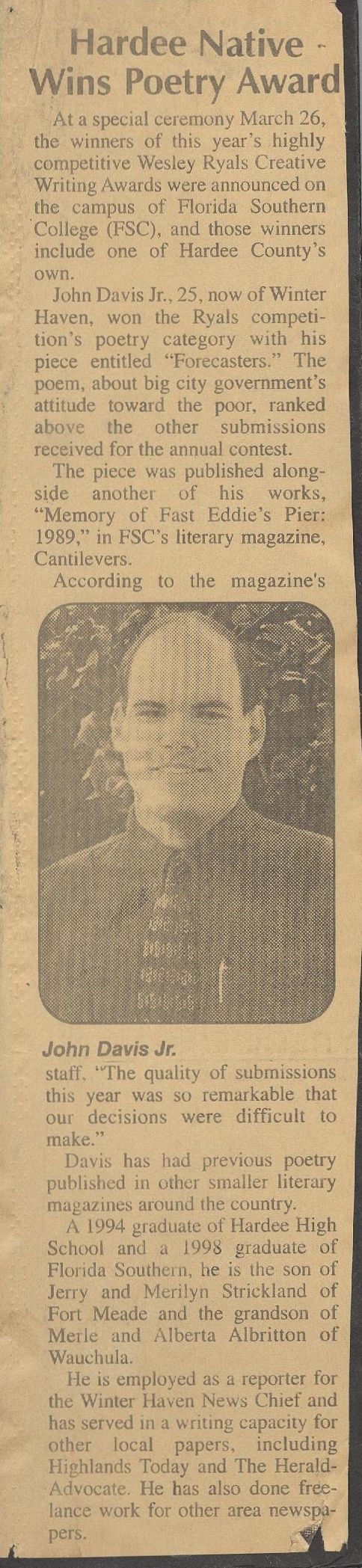
For instance, recently I was digging through some old press clippings from my hometown paper. These clippings heralded my appearance at venues like Florida Authors Day (many, many years ago) and chronicled awards I had won. At the time these pieces were written, I was a young man in my twenties, just poking my nose into the literary world.

But by looking back on them and gaining a sense of my own writing history, I was able to more clearly visualize the road before me as a more mature writer today: Completing my MFA, finishing my next book (this time, it WILL NOT be self-published), and gaining more impressive publication credits from esteemed literary journals are all goals I now possess. I have been better equipped to achieve these objectives by making some wrong turns along the writing path, and I’ve also gained some knowledge and and experience that have prepared me to hone my craft and perfect my unique writing voice.

An occasional walk down memory lane can be just the thing to motivate you as a writer, and perhaps it is indeed necessary to align one’s vision to the road ahead. I have no regrets about the moves I made as a younger man — they’ve been the impetuses that have pushed me toward greater things in the present, and hopefully, the future.

poetry, Uncategorized

Why “Florida Poetry?”

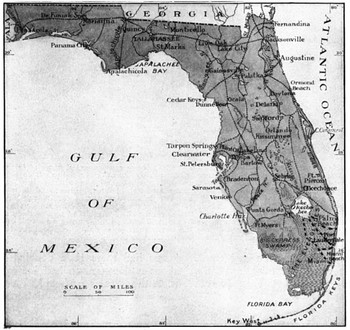
Once in a while, I have people ask about the title I have chosen to wear as a writer. “Why limit yourself to being considered a ‘Florida Poet?'” they inquire, certain that I have made a horrible marketing mistake. The simple fact is, I believe in truth in advertising. My work, while not totally Florida-driven, is largely based here in my home state. Sure, I may write once in a while about exotic, even fictional, locales, but for the most part, the nature, the people, the settings, and the themes of my work are uniquely Floridian.

I don’t write “Florida Poetry” so that I have a better shot at cornering one select niche of readers, nor do I use the term to make my work seem any more “Floridian” than that of my peers or colleagues. When I advertise myself as a “Florida Poet,” I do so because I want people to understand what they’re getting when they pick up one of my books, or when they see my pieces in journals and on websites all over. My perspective is one influenced by “Floridana,” and all that term encompasses.

So, to those of you thinking I’ve eliminated myself from “serious literary consideration” and such, my hope is that you now have a better understanding of my position — I am Florida through and through, and no state is more universal.

poetry, Uncategorized

Of networking, socializing, and writerly introversion

Here’s how you know you’re surrounded by a bunch of people more comfortable at their desks than at a party: When there’s a reception or a gala of some sort, these people act like the grown-up versions of that poor reject by the punch bowl at a junior high dance. They flock to their comfort zone partners (friends, acquaintances, etc.) and stay there until the last possible moment they can leech off that person’s quietly generic conversation (“How about this weather we’ve been having?”). Then, they quickly rush over to the food/drink/other provisions and get something to occupy their hands. Next, the “I’m terribly important” brisk walking begins. Not schmoozing, not gracefully pirouetting from group to group dropping casual bits of dialogue, none of that. Just hastily traversing the entire room as if the earth’s precise gravitational orbit hinges upon their hip sockets’ speed.
OK, so they’ve made the inadequate conversation, they’ve made merry with food and drink, they’ve marched about visibly as if official, so now it must be time for the wallflower slow fade. This is the part where the people in question position themselves along an exterior wall, gradually inching toward the exit so as not to have make the uncomfortable announcement that they’re leaving early. This is handiest if there is a large trash receptacle near the aforementioned exit. They toss the cup/plate away, and WHOOSH! disappear through the nearby door like Zorro jumping for his legendary black horse.
Such is the party life of the introverted writer with unresolved social anxiety disorder. How do I know? I am one of these people. I posit this reflection only to judge myself, mostly, and provide myself with the impetus to change. Perhaps this year, during my MFA opening and closing receptions, I’ll try, just TRY, to be more Gatsby and less Mort Rainey. But it’s a process, guys and girls. Bear with me.

Uncategorized

Thoughts on “Becoming a Name”

Within literary circles, there is constant talk about authors who are “names” — that is, they’ve done so much and accomplished things so notable that their names are immediately recognizable in print or elsewhere: Billy Collins, Rita Dove, C.K. Williams, and others could be considered “names” within the field of poetry, for example.
This observation, then, drives a question: How do amateur poets become “names” also? Certainly winning prizes and earning publication credits help, but without a big-name publisher, well-attended reading events, and a certain splash of eccentric personality, young or fledgling poets can seemingly forget about the idea of “becoming a name.”
Perhaps a deeper philosophical question is this: Should fame really be the end goal of poets, novice or experienced? Certainly recognition helps when making appearance arrangements and other accommodations, but if that sort of “brand awareness” becomes all we’re shooting for as writers, something’s wrong. We write, primarily, because we love to write, and feel deprived if we don’t. When that love becomes something other, some strong impetus for our faces to grace the cover of Poets and Writers perhaps, then it’s time to step back and re-examine.

Uncategorized

Welcome and Introduction

Hello, and thank you for stopping by my site. Here, you’ll find information about me, John Davis Jr., and my poetry and writing. Primarily, I write poetry that reflects my Florida background and lifestyle. Most of my pieces deal with “The Real Florida,” not the postcard-picture stereotypes that most people conjure up mentally when they hear my home state’s name in passing. My people have been here for the last six generations. We fought in the Civil War, farmed our own land, and even today, we continue many of the proud traditions of our agrarian forebears. To learn a little more about me, please choose a link from the menu above: “About” or “Publication and Awards History” should do just fine. Occasionally, I’ll post a little something here inspired by the writing life. As my bio states, I am currently a student in the MFA program at University of Tampa. Some posts may be motivated by specific assignments, but mostly, this is a place to reflect and express my thoughts on writing and poetry in particular. Stay tuned, folks. The best is yet to come.