poetry, Uncategorized

Bookstores, Amazon, and Other Such Things

So, I went to my local bookstore today to purchase one of the texts I need for my MFA readings. This book happens to be by our newest poet laureate, Natasha Trethewey. I perused the one measly section of poetry books tucked into a single section of a poorly lit aisle, only to discover that, not only was Trethewey’s work unavailable, but so was work by other established and well-known poets. This lackluster selection inspired me to visit the “customer service” desk of the establishment in question.

“May I help you sir?” the somewhat bothered clerk asked.

“I believe you can. I’m looking for a volume by Natasha Trethewey, the poet laureate.”

“Who?” she hooted, blinking repeatedly from behind extra-large lensed glasses. “Oh, let me look it up.”

Her fingers dashed across the keyboard, entering letters then backspacing furiously in frustration.

“Can you spell that?” she finally requested.

“T-R-E…” I went on, giving her the name in its entirety, letter by carefully pronounced letter.

“Oh, Natasha!” she said, as if the two of them had been classmates in another life.

Here came the kicker: “We had two copies by her, but they’ve both been sold.”

SERIOUSLY??? The woman is the poet laureate of the United States, and you have TWO copies of her work in inventory? Now, mind you, this so-called bookstore can boast countless aisles of Twilight toys and fairy princess bookmarks, but GOD FORBID they actually carry work of literary value. I maintained a poker face, took a deep breath, and then administered some kind advice:

“You may want to think about getting some more. She’s very popular right now,” I said.

“Oh, well uh, would you like to order one?” she offered, still rapid-fire blinking.

“No, that’s okay. Just thought I’d check,” I answered. “Thanks anyway.”

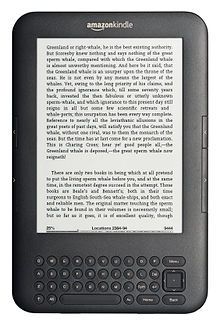
As brick-and-mortar bookstores bemoan the loss of business to megalithic online entities (Amazon, etc.), encounters like these only encourage consumers to seek out alternatives that are less inconvenient, i.e. internet buying. Listen up, literature vendors: If you want to sell books, stop sitting around sipping lattes and whining about how the big, bad capitalist machine is eating up your sales. Stock your shelves, know your stuff, and offer service with a smile. For today, I’m ordering the Kindle version of the book I needed — cheaper, faster, and easier.
Uncategorized

Birthdays and self-imposed deadlines

Interesting thing about inching closer to the big 4-0: It really makes you put on the afterburners as a writer. After all, when that magic number arrives, one is no longer considered a “young” writer anymore — you’re supposed to know your chops, demonstrate proficiency, and be well on your way to bigger and better things. As it is, I have not fulfilled the goals I set out for myself back in my early 30s, and so now especially, I’m feeling the tug and pull of age beckoning me to “Carpe Diem.” Many of the men and women who are finding success in the literary world are younger than I am now, and if I’m going to do this thing, then it’s time to do it right and truly. As this birthday arrives, I pledge myself to devotion to my craft and its ambitions. No longer will I passively go about the business of writing. It is time to seize the horns of destiny and lead it where I want it to take me. 40 draws near, and so, it is time to stand up and be counted. Get ready, readers — my time to shine is on its way.

Uncategorized

Of Book Covers and Photographs

Soon, I will be doing a photo shoot for potential shots to grace the cover of my upcoming book. I have a dilemma in this area: I’ve never been the most photogenic person, at least in my opinion. I have, as the old-timers would say, “a face for radio.” This is not some statement of false modesty — I’ve honestly just never looked that great in photos (see my “about” page for evidence). So, as I prepare for this shoot, needless to say I’m somewhat hesitant.

My main concern is concealing my incessant double-chin, which, no matter how little I weigh, always seems to push itself outward in photos, making me look like a modern-day Boss Hogg. In addition, my eyes always seem to disappear in photographs, morphing into black lines that are almost indiscernable from the eyebrows above them. I’ve always been a little vain about my eyes, as I believe they’re better features of mine. And yet, pictures always seem to minimize them. Alas.

Finally, there’s the glasses vs. no-glasses issue: I wear glasses irregularly because I have only slight astigmatism in one eye. When I really want to concentrate or focus intensely, out come the glasses. But if I’m doing everyday tasks, the glasses are nowhere to be found. I suppose that if I want to look “writerly,” I should really wear them, but then, I’d be playing to a stereotype that I’ve worked hard to avoid. (Deep sigh).

I suppose the answer in the end is just to do what the photographer says and hope for the best. I have a lot of confidence in the abilities of this camera-artist, so I guess I’ll just sit back and let her do the work. Expect photos posted here in the next week or so, and wish me luck, good readers…

poetry, Uncategorized

MFA residency overview

So, in case my readers haven’t noticed, I’ve been out of commission for a couple of weeks. I just completed the second residency in my MFA program, and I must say, the organizers are really starting to get things figured out. During the last residency, it seemed like we spent a great deal of time “spinning our wheels;” that is, we were in sessions and seminars that were remotely connected to our literary lives, but in some ways, felt distant or disconnected. Not this time. I can honestly say that each day was filled with relevant, rigorous, real events and activities that helped everyone there, whether they wrote fiction, nonfiction, or poetry. Some sessions were universal: They offered writing advice that spanned across all genres, and every writer walked away feeling inspired and refreshed by the voices of experience presented.

As our new batch of students arrived, old acquaintances and MFA novices got to share in several worthwhile excursions, from the literary history of the Don CeSar hotel to the surreal imaginings of Salvador Dali at the museum bearing his name in St. Pete. Readings given by guest authors varied in quality, as is usually the case. Some poets and writers brought a unique voice and a dynamic presence to the program, while others simply showed up to hear themselves talk.

All in all, however, the agenda this time was filled with worthwhile material — I walked away inspired to ply my craft in new and more refined ways, and am anxious to get going on another semester’s body of poetry. January waits!

poetry, Uncategorized

Preparing the MFA Mind

As I spend my last day at home before the big Master of Fine Arts (MFA) in Creative Writing residency, I’m taking a few last minutes to brush up on all the reading I’ve done before this point. Everything from Aristotle to Billy Collins has been thrown at me in preparation for this upcoming session, and I’m proud to say that I’m ready.

Which leads me to a bit of history: Prior to adulthood, I was not always the exemplary student. In junior high, high school, and even as an undergraduate, my performance was, shall we say, lackluster. It wasn’t that I couldn’t do the work; it was that I lacked motivation. If I didn’t see the need for learning something, then frankly, I didn’t learn it. Daniel Pink talks a great deal about motivation in his book Drive, and in many ways, I am the poster child for his theories: If I like it, if I want it, if I enjoy it, I’ll do it. Likewise, if I am given autonomy to perform tasks (academic or otherwise), then I am largely happy, and I will produce. However, the flip side of this coin also holds true. I’ve spent the better part of my life trying to overcome my own resistance to math, in particular. My mind simply does not operate in mathematical ways, even though I can be very logical and reasonable at times. Also as an adult, I have had to face the truth of maxims that my parents constantly threw at me: “You might not LIKE it, but you still have to do it,” and “We do what we HAVE to do so we can do what we WANT to do.” So, when an unpleasant task comes my way, I have learned to discipline myself, break chores into pieces, and do all those things that my mom and dad (for years) tried to persuade me to do. For me, changing required firsthand experience — all the idioms in the world don’t replace real-world encounters for learning purposes.

In my first graduate program, which was in education, I earned a 4.0 grade point average. Here again, it was subject matter that I enjoyed, and which I decided to pursue. In addition, I was paying for the education myself. Straight A’s were my own personal expectation and goal (not anyone else’s), and therefore, I fulfilled that aim. Now I find myself having to persist in this MFA reading, as well. While many of these reading selections are interesting, I notice that I have to force myself to stay aware and absorbent to the ideas presented on the written page (especially Aristotle). By steeling my mind to assimilate the learning that I personally want, I am preparing to reap the benefits of an education that I have tailored to my own interests and needs. My eventual goal is to teach at the college level, but to get there, I have to pay the piper first. I suppose now would be a good time to stop procrasti-blogging and hit the books. Brain, don’t fail me now!


poetry, Uncategorized

One writer’s addiction

It isn’t alcohol. It isn’t drugs. It isn’t even something more abstract like attention or recognition. No, it’s office supplies. That’s right — stores like Staples, Office Depot, OfficeMax, and the wealth of other such outlets are my Achilles’ Heel.
As I’m beginning to prepare for my next residency in the UT MFA program, I have now the perfect excuse for going on huge buying sprees at my local office supply stores. “I just know I’m going to need these (whatever they are that is usually unnecessary).” My wife, bless her heart, has endured my office supply addiction now for the last eleven years. She’s very understanding about the whole thing.
I think there’s a combination of factors working against me in stores like Staples: 1. I’m a very sensory person (see “poet”). The smell of fresh paper, pencils, pens, notebooks, and other such items brings back a range of pleasant memories, and for me, those happy recollections are absolute kryponite.
Next, there’s the happily-colored environment that makes you feel like you will have such great fun if you just buy one more ballpoint pen. Of course, you get the thing you bought home and inevitably, it isn’t the party that was promised, but you still have something tangible and enjoyable.
Finally, there’s genetics. My family line, consisting of professors, teachers, and writers, has always been one drawn to office supplies. My father collects fine writing instruments, and my mother will buy almost anything in “cute” packaging. So, from a hereditary standpoint, I guess I’m disadvantaged also.
This time around, I’m avoiding the big office supply warehouses. I have accumulated everything I need to be the student and writer I have envisioned myself becoming, and I know that, should I need another index card/binder clip/printer cartridge, those things will be available. Hopefully, my budget and my brain can begin to heal from this endorphin-crazed pattern of behavior. Pardon me while I go sharpen a fresh box of No. 2 pencils. More to follow…

poetry, Uncategorized

Poets: Keeping the “human” in humanities

One thing I really like about being in the world of poetry is this: Even though a lot of poets are very well-known and have celebrity-like status in the literary realm, most of the time they remain very approachable on a personal level. Take, for instance, C.K. Williams. Now here’s a guy who has won major awards, published well-received books, seen his name in major magazines, and taught in prestigious locations all over the world. And yet, when encounters a fan of his work (like yours truly), he’s not so stuffy and pretentious that he won’t add you on Facebook. Little things like that are huge, especially to up-and-comers like me — the fact that “big name poets” (see previous entries) would associate themselves with rank newbies is a testament to their humanity and humility.

Certainly, there exist those writers who perceive themselves as so high and mighty that they would not dare set foot off of their cloud of condescencion, but from my experience, those individuals are few and far between, and most poets have a pretty fair assessment of their own status: Their limited fame that comes from the academic and erudite set is a nice commodity, but it’s not like the National Enquirer is going to send paparazzi after a poet laureate anytime soon.

I suppose the lesson in all this is one in the basic tenets of courtesy: Even when you have achieved Pulitzers and Pushcarts, even when the Atlantic Monthly and the New Yorker simultaneously publish your work, and even when your book sells its first million copies, you, poet, still have the obligation to remain personable. The example set by our predecessors is a positive one, and we have the obligation to uphold it.

poetry, Uncategorized

The Poet as Father

OK, I admit it. I’d like to have a writing room. Ever since I heard novelist Michael Connelly talk about his during the last residency of my MFA in Creative Writing program at University of Tampa, I’ve been somewhat envious. It seems that Connelly has blackout blinds, soundproof walls, acoustic “dead zones” and other cool features in the room where he does all his writing. His family understands that when he goes into the special room, he is “at work,” and is not to be disturbed.

Even as I write this, my wife is asking me, “Honey, where did you put the boys’ gummies (those fruit-flavored gummy treat things)?” Granted, I wish I could focus on blogging in peace, but excluding myself from family life seems selfish, even irresponsible to a degree. “They’re in that narrow cabinet beside the stove,” I respond, and keep tappity-tap-tapping away at this keyboard.

In my house, we have a place called “The Quiet Room.” It serves as a library/study/creative workspace, and its view is fantastic. I’ll have to post a photo sometime. Through our large front window, I look out over our neighboring lake and beyond to the dotted houses, palm trees, and other charming features along the opposite shore’s landscape. The view changes based on wind, weather, season, and other factors, but its constancy is reassuring simultaneously. I guess you could say it has sort of a dynamic stability about it. Back in the seventies when this place was built, this room was considered the “formal living room,” that stuffy, pretentious room where you took guests that you considered high-class so you could impress them with your earth-tone hardwood furniture and extensive, gilt-edged encyclopedia sets. Today, that idea is outmoded (to say the least), and thus, the creation of a re-purposed space for reading, writing, and creative endeavors.

I know that The Quiet Room is the closest I’m going to come to a writing room anytime soon, and I’m good with that. It has no real doors to speak of, so my sons come and visit once in a while, usually just to see what I’m up to, and that’s okay with me. In the grand scheme of things, if I have to trade a Pulitzer Prize for attention given to my boys, I’ll gladly do so. My family, after all, is the greater priority. Flights of fancy and creative sparks come and go, but the value of these bonds forged in our home far surpasses any fleeting glory I may attain as a poet. The last thing I want is to be one of those authors who, when PBS makes their documentary, is described as a literary genius but a lousy dad. There are plenty of others out there who have made that mistake, and I’d prefer so stay out of their league. I’d love to write some more about this, but it’s playtime, readers. I have a plastic swordfight to go lose against two keen opponents. En garde!

Uncategorized

Using Your Writing History

“Those who don’t learn from history are doomed to repeat it,” our teachers always told us. There is truth in that maxim, and most especially for writers. By looking back at where we’ve been, we have a better idea of where we’re going.

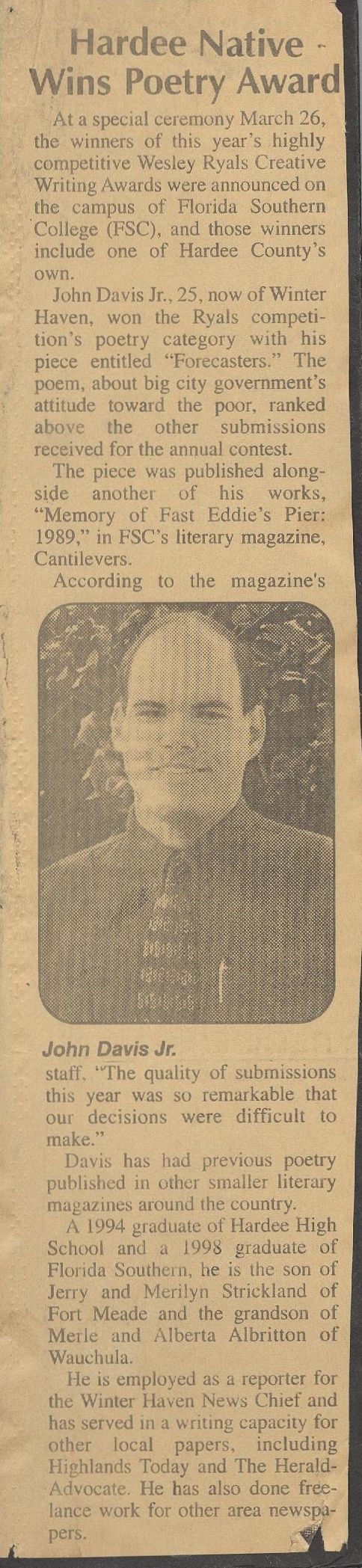
For instance, recently I was digging through some old press clippings from my hometown paper. These clippings heralded my appearance at venues like Florida Authors Day (many, many years ago) and chronicled awards I had won. At the time these pieces were written, I was a young man in my twenties, just poking my nose into the literary world.

But by looking back on them and gaining a sense of my own writing history, I was able to more clearly visualize the road before me as a more mature writer today: Completing my MFA, finishing my next book (this time, it WILL NOT be self-published), and gaining more impressive publication credits from esteemed literary journals are all goals I now possess. I have been better equipped to achieve these objectives by making some wrong turns along the writing path, and I’ve also gained some knowledge and and experience that have prepared me to hone my craft and perfect my unique writing voice.

An occasional walk down memory lane can be just the thing to motivate you as a writer, and perhaps it is indeed necessary to align one’s vision to the road ahead. I have no regrets about the moves I made as a younger man — they’ve been the impetuses that have pushed me toward greater things in the present, and hopefully, the future.

poetry, Uncategorized

Why “Florida Poetry?”

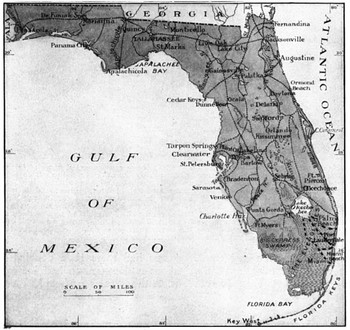
Once in a while, I have people ask about the title I have chosen to wear as a writer. “Why limit yourself to being considered a ‘Florida Poet?'” they inquire, certain that I have made a horrible marketing mistake. The simple fact is, I believe in truth in advertising. My work, while not totally Florida-driven, is largely based here in my home state. Sure, I may write once in a while about exotic, even fictional, locales, but for the most part, the nature, the people, the settings, and the themes of my work are uniquely Floridian.

I don’t write “Florida Poetry” so that I have a better shot at cornering one select niche of readers, nor do I use the term to make my work seem any more “Floridian” than that of my peers or colleagues. When I advertise myself as a “Florida Poet,” I do so because I want people to understand what they’re getting when they pick up one of my books, or when they see my pieces in journals and on websites all over. My perspective is one influenced by “Floridana,” and all that term encompasses.

So, to those of you thinking I’ve eliminated myself from “serious literary consideration” and such, my hope is that you now have a better understanding of my position — I am Florida through and through, and no state is more universal.