poetry, publishing, Uncategorized, writing

Embracing the Idiosyncratic

WIN_20171228_15_08_04_ProWriting is full of superstitions. There are accounts of authors who only use a certain brand of typewriter, who write only at one certain time of day, who sip only one certain brand of coffee or tea with one certain number of creams/sugars/whatevers in it.

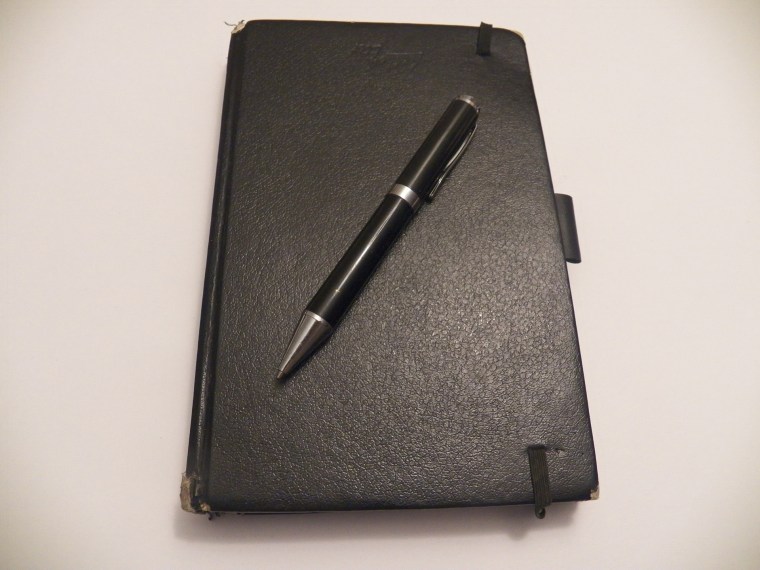
Our rituals become nearly religious in their practice. For instance, I prefer to write the first several drafts of a poem with a fountain pen, specifically a Waterman Phileas. I like to fill its charger with ink from a bottle — the color doesn’t really matter so long as it’s not red — and then feel the flow of that ink through a golden nib onto the page of a legal pad (canary or white is of little consequence to me).

But these kinds of minute habits, while important, are more innocuous than the habits we can sometimes abuse in our actual writing. I know I have a few idiosyncrasies in my poetry, and over the years, I’ve had a love-hate relationship with each of them. The excessive alliteration, the internal rhyme for no good reason other than the enjoyment of its sound, the Dickinsonian love of dashes — all these and more have been stylistic markers of my work, for better or worse.

And while my MFA program did its best to make me aware of them to the point of eschewing them, I’ve come to another understanding: All the greats have certain idiosyncrasies that critics scolded them for, but in the long run, we find those little habits endearing. Who could  imagine the work of e.e. cummings with capital letters, for instance? Or who could recall the work of Ogden Nash without its insistent whimsy and child-like wordplay? The list goes on, and the remainder of this post could be comprised of famous poets’ strange diction-predilections, but there’s only so much space, and I value your time.

The point is just this — Maybe I’ll stop using those devices that I’ve loved so much and so long, fearing I may “wear them out.” Or maybe, like a comfortable sweatshirt or an old pair of jeans, I’ll keep using them. Maybe I will own them proudly. Being mindful of delicious syllables doesn’t necessarily mean obviating them. In the diet of language, our guilty pleasures can still be consumed (or employed) occasionally, so long as we know not to eat the whole metaphorical pizza. Like everything, diction is a balancing act. Too much or too little of anything can throw things into disorder or disarray. But sometimes, that kind of creative chaos is just what we need. Our little indulgences and idiosyncrasies can lead us to greater authenticity. And as literary history proves, the authentic writers survive long after they’ve passed. Here’s to a great 2018, complete with all the oddities our creative minds return to again and again.

life, teaching, Uncategorized

The Value and Relevance of Home

EmilyHouseIf you have been following this blog for the last few days (or longer), you know about my campaign to help save one of my brightest students and her mom from the homeless shelter this holiday season. In running this one-man show, I have had to give a lot of thought to the psychology and meaning that the word “home” generates.
After all, we are in the midst of a holiday season rife with songs about the joys and pleasures of being at home, whether it’s “I’ll be Home for Christmas” or “There’s No Place Like Home for the Holidays.” In our greatest literature, home is portrayed as that point of both psychological and physical relief: When a character is at home, he or she is at rest, completely at ease, and ideally, right with the world.

Of course, there are plenty of homes in literature where the above is not true, whether it’s in short stories like Aryn Kyle’s “Allegiance,” or Faulkner’s “A Rose for Emily,” or whether it’s in longer novels (see multiple works by Stephen King or any other author who capitalizes on family dysfunction).

But even when an author or character comes from a home with “chronic angers” (Hayden) or faults and fissures (Poe), home as a concept still resonates with the expectation of peace. When that expectation is unfulfilled, conflict results.

But what about the nomad? The archetypal wanderer may fill our minds with romantic notions, but in reality, the soul without a home is oppressed. Such is the case with my student and her mother. Life at the shelter is not so different from jail: No visitors beyond the lobby, curfew is 6 p.m., and countless other restrictions give families the impression that they are not so much being housed as confined. That’s no way to spend Christmas.

As our minds fill with warm images and remembrances of home, may we all realize in this season that there are many wonderful, intelligent, and moral people without such a place. Let us give so that others may know the comfort and joy that our seasonal carols promise. Once again, here’s the link to donate:

https://www.gofundme.com/save-my-student-from-homelessness


life, poetry, publishing, teaching, Uncategorized, writers, writing

Calling All Writers: HELP


cover-for-ad

Buy a book, save a life: Between now and Christmas, 100 percent of every sale of each of my books will go toward getting one of my poet-students and her mother out of the homeless shelter. You get good poems, and a family that desperately deserves a Merry Christmas is given a hand up. There are no losers here — If you don’t want to buy one of the books below, you may donate directly to the Save my Student from Homelessness fund:

https://www.gofundme.com/save-my-student-from-homelessness

If you would like to go the literary route and receive some poetry in exchange for your generosity, please consider purchasing any one of the books below (click the title):

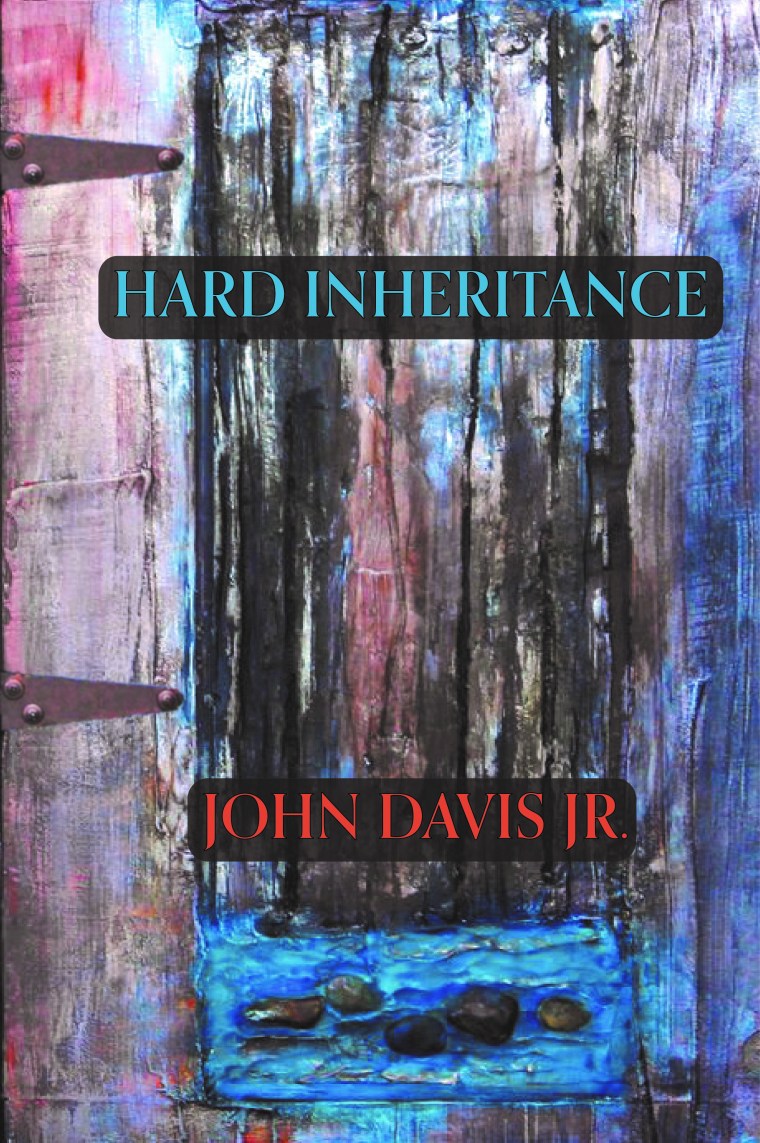
Hard Inheritance

Middle Class American Proverb

The Boys of Men

Your purchase or donation is deeply appreciated. I can’t say enough good things about this student, and she and her mother are grateful for any help you can offer. Please join this effort to save a budding writer from the horrible conditions at the homeless shelter. THANK YOU!

life, Uncategorized

A Plea for a Deserving Student

homeless.jpg

Dear Follower:

One of my brightest and best students is homeless. I am working as hard as I can to get her out of the homeless shelter by Christmas. She and her family are earnestly good people who have simply faced a series of unfortunate coincidences that left them without a roof over their head.

At this time of year when finances are tighter than usual, I hesitate to ask anyone for money. But this wonderful young lady is very deserving of a good home, a hot meal, and the comforts of this holy season. Please give to the GoFundMe that I have set up for this family:  https://www.gofundme.com/save-my-student-from-homelessness

I thank you in advance, and certainly, this family is deeply grateful for any generosity you can show them. These people are responsible, ethical, hard-working, and resourceful individuals who have unfortunately faced an unusually hard time in their life. Please assist — I thank you for anything you can spare.

In return for your donation, I’d like to send you a signed copy of any of my three books you’d like: Hard Inheritance, Middle Class American Proverb, The Boys of Men, or Growing Moon, Growing Soil: Poems of my Native Land. This is the least I can do in return for your much-needed assistance. Thank you again for your generosity.

life, poetry, publishing, Uncategorized, writers, writing

Well, That Didn’t Take Long

journalRegular readers may recall in mid-November that I was lamenting copious recent rejections and doubting my own ability as a poet. I feared I had “lost my touch,” in essence, and I was also seeking solace in other genres, among other things. Not too long thereafter, I was contacted by a prestigious literary journal whose reading period is ongoing. I was complimented by the editor on a fine poem, and I was asked not to say anything about the acceptance until their reading period ended (which it has not). Hence, the mystery and ambiguity at this point: I’d love to tell you where and when the poem will be published, but I’ve made promises, and for now, I’m keeping them.

The lesson in all this, of course, is one I learned long ago but still occasionally forget: One’s poetic victories and losses wax and wane, and there is usually a fair balance among the wins and defeats. Inspiration doesn’t just suddenly die, and experimentation can make one’s voice more authentic, more robust. If nothing else, dabbling with other choices can help reinforce the resonance of a poet’s authentic voice — it certainly did for me.

When I stopped “messing around” with subjects, ideas, and forms that were unnatural and inorganic to my sensibilities, I was able to return to the true, the genuine, and the productive. Like Dickinson, Frost, and countless others before me, I have certain friendly forms and techniques that have served me well over the years, and while breaking from them for a time can serve as a kind of oasis, sooner or later, the trek must continue more earnestly than ever before.

My journey has been (and continues to be) one marked by the regional, the rural, and the real. These descriptors, however I may wish to alter or even abandon them, continue to define my work, as they are the sources I return to again and again, and they rarely fail me.

Place is inextricable from my diction. Every Dickinson needs her Amherst, every Frost needs his Vermont (or New Hampshire), and every Hughes, Cullen, or Toomer needs his Harlem. I need central Florida and its rhythms, its landmarks, and its people as much as I need oxygen. This land and its characteristics are infinite in their inspiration.

As the publication of this newer piece arrives, I’ll be sure to follow up here. For now, may I politely suggest a few stocking stuffers:

Hard Inheritance — My latest (2016) collection filled with the wonders and truths of agrarian life.

Middle Class American Proverb — My 2014 book that was a finalist for the Lascaux Book Prize, and which includes multiple Pushcart-nominated poems. It is also my largest collection to date, and was hailed by poets from Peter Meinke (poet laureate of Florida) to Erica Dawson (2016 Poets Prize winner, among other accolades).

The Boys of Men — A chapbook (meaning little/short collection) of poems about fatherhood, mentorship, and the bonds that link generations to one another. A good gift for the teacher, dad, or son on your list. And cheap!

Thank you, readers and lovers of poetry, for your continued support. This literary life might not be an easy road at times, but it certainly remains valuable. Onward to Christmas!

life, poetry, publishing, teaching, Uncategorized, writing

On Losing One’s Touch

howtoholdapen1Recently I’ve been rejected. A lot. As in, even the Armpit of Nowhere Review won’t publish my work.
I’m a veteran writer, and as such, I’m used to getting my fair share of rejections. In looking over my Submittable queue recently, it was revealed to me that roughly 10 percent of my poetry submissions have been accepted over the years that I’ve been using the service. So, it stands to reason I’ve got a pretty thick skin — that kind of pathetically slim acceptance rate necessitates one.

But here’s the part that has me concerned: This latest round of rejections comes after a sort of evolution in my poetic style. Such diction alterations happen every once in a while — a poet decides that the old way or the old materials have grown stale, and so a few shiny new features begin to assert themselves in his or her work. Sometimes these changes can be good; other times, they denote the death-knell of the artist’s career.

My suspicions about this latest round of rejections have me speculating about possible causes. The poems themselves, by all measures of quality and integrity, are fine pieces. They are well put-together, and would receive workshop table praise from people whose voices I respect. And I understand that often, rejections are not so much a comment on one’s work as they are a byproduct of space constraints and other factors. Still, I sense the culprit must be something abstract, something subterranean.

My first suspect: Disingenuous fervor. I have written about things that I should care about (and deeply), but on a more subconscious level, I am distantly apathetic. That apathy could translate into an energy vacuum in the poems. Much like the snake-oil salesmen of old, I may be trying to muster interest in ideas about which I am (earnestly) less than enthralled. To quote Frost, “No passion in the writer, no passion in the reader.”

Suspect number two: Divergent interests. I have been spending much of my time recently pursuing excellence in other areas of my life. I’ve dabbled in nonfiction, I’ve made my teaching more robust, and I’ve even started doing a young adult novel podcast with my oldest son. More on that later. These other pursuits, while valuable, could easily be sapping the creative juice from my poetry, however, and I’m wondering about the effects of laurels from other non-poetic enterprises — are the rewards from these endeavors silencing my usual muses?

Third and final suspect: Age. I’ve found myself becoming more curmudgeonly toward the opinions of “experts” in the literary realm, and more disparaging of modern poetry. Maybe I’m becoming that weird old guy in the poetry world who yells “Get off my lawn!” to the avant-garde. I’m over 40, and let’s face it, that’s the age when a lot of poets have made their greatest contributions. I know, I know: There’s a whole cadre of people who didn’t really come onto “the scene” until their twilight years. Good for them. There’s also a vast wealth of people who were bright and shining stars in their youth, though, and for yours truly, that ship has sailed. My only “over the hill” option is to stick around and hope that perseverance pays off, as my mentors have often assured me it will.

In the meantime, I fear that one or more of the above-mentioned factors has resulted in some loss of my stylistic “touch:” the intangible characteristic that sets apart the work of memorable authors. I’d like to try reverting to my MFA-minded self — that individual who sees inspiration everywhere and burns to make people feel the pleasant vertigo of poetic rapture. I’m not sure I can find him again, or that it would be at all appropriate to do so. Perhaps these latest rejections signal that it’s time to call in the dogs and turn out the lights, as the old saying goes. The first part of Marianne Moore’s “Poetry” could have been right: “…there are things that are important beyond/ all this fiddle.” I recall how the rest goes, and I draw inspiration from her conclusion, but maybe a respite of sorts is in order. Stepping back from the page could be just the thing that my writing needs; call it a brain break from heartbreak. Farewell for now, poetry. I’ll be back when I just can’t possibly stay away any longer.


life, poetry, publishing, Uncategorized, writers, writing

The End of “Published Alongside”

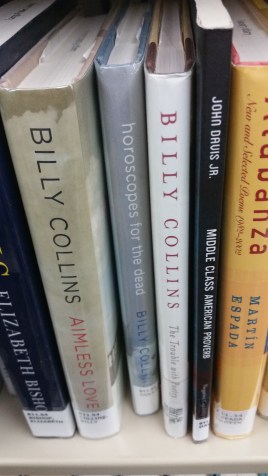
20161017_142111.jpgWhile browsing the local library nearest my university the other day, I stumbled across one of my books neatly tucked between other collections of poetry by some very well-known names in the literary realm. I’ve always been honored to see my work juxtaposed with that of “name-brand” poets, and I’ve even caught myself saying in those brief author’s bios that lit mags make you write: “His work has been published alongside that of [well-known literary icon] in [equally well-known literary journal].” I’m going to stop doing that, and here’s why:
I’ve been around the poetry game long enough. I don’t have to “prop my work up” by saying it appeared with the poetry of somebody who receives hefty advances or well-publicized appearances. Maybe that sounds a little arrogant, even bitter, but it’s time to let my words and my craft stand on their own two feet.

Comparisons will always be inevitable — some critics have said my work reminds them of The Fugitives, while others have drawn lines to other various modernists or formalists, and that’s okay. I don’t mind being called “The Southern Robert Frost,” for example. That’s high praise.

But I feel compelled to stop invoking the names of people who have already had their turn at bat (and in most cases, hit it out of the park).  It smacks of pretension and literary snobbery at its worst, and truthfully, if I saw someone else do it, I’d be very critical. “Well LA-DEE-DA, so-and-so…Your work has ‘appeared’ beside someone else important. Big frickin’ deal.” It diminishes the credibility of the writer rather than scaffolding it. So it needs to stop, no matter how much I may admire other poet(s).

Not too terribly long ago, I stopped mentioning (in my author’s bio) my multiple Pushcart Prize nominations for this same reason. Stick around poetry long enough and write decent poems, and sooner or later, you’re bound to get a few. It’s a big deal the first time it happens — I remember the great celebration at our home when the first journal to nominate me, Deep South magazine, spread the news. But unless and until I actually win one, it’s kind of like telling people that my next-door neighbor is a movie star. I’ve had enough of hedging greatness.

My poems need to live on their own merits and be judged by their own characteristics, positive or negative. Not everybody is going to enjoy my style, but at least they won’t be conflating it with that of someone who has long since paid their dues. It’s time to stop trespassing on others’ good names. Let it begin today.


life, Uncategorized

A new house, a hurricane, and a normal sunrise

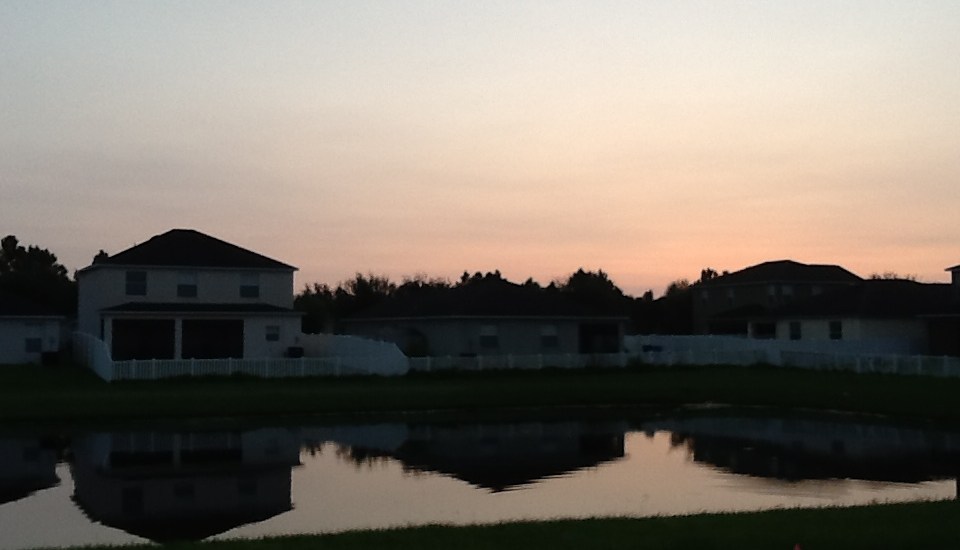
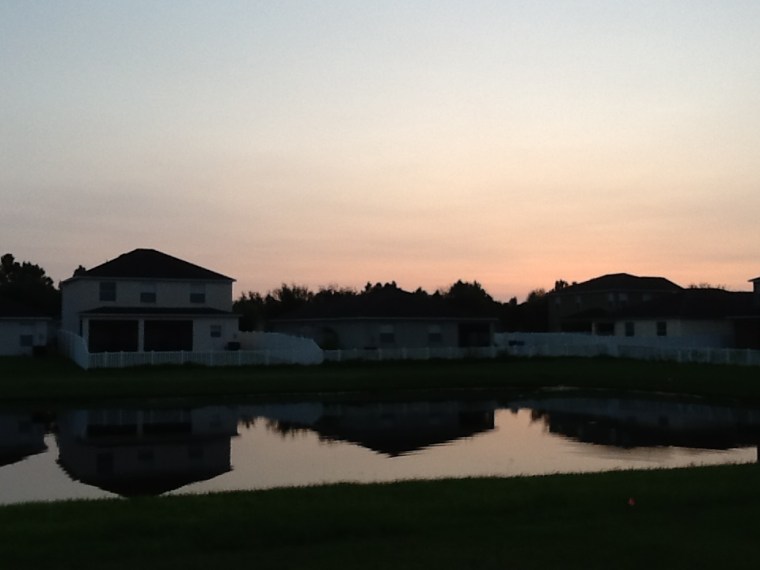
image As I sit here with my French-pressed morning coffee, I look across our little neighborhood pond and I’m thankful for an ordinary dawn. My wife, my sons, and I have now been in our new home roughly a month, and during that month, we have had the unique opportunity to survive Hurricane Irma.

Predictions were all over the place, but as it turned out, our new home near Tampa was spared the brunt of the storm. Instead, it turned east, striking my former city of residence with an angry ferocity not seen since Hurricane Donna. My previous home was undamaged as well, fortunately, and all my central Florida family members weathered the event without much ado: a few branches were downed, foliage was blown all over the place, but their homes and their lives were spared. We are grateful.

Our new home lost power for about two days, and we all became reintroduced to such preservative-laden delicacies as Vienna sausage, which, for the uninitiated, is essentially the leftover parts of varying animals rolled into a slick, flesh-colored casing and stuffed into a tiny can. It is, perhaps, the closest thing to Soylent Green that I’ll ever eat.

Without power, the grill became our friend as well, barbecuing the wholesale-club sleeves of burgers we had frozen for a large family dinner. No freezer meant that all that cow was going to go bad, so it was charcoal to the rescue. I felt sort of bad grilling all that delicious ground beef because I have Hindu neighbors. There they were: no electricity, and having to smell the meaty (offensive?) aroma of medium-well survival patties. What’s an old country boy to do?

At last, power has been restored, life has returned to normal, and I’m once again able to enjoy the first-world luxuries of air conditioning, hot water, and a civilized kitchen. Our little foray into apocalyptic living is over, for now. But as Jose churns in the Atlantic, I think I’ll see if Sam’s has mega-packs of veggie burgers, just in case.

life, poetry, publishing, teaching, Uncategorized, writing

A Farewell Book Launch

cover-for-adIn one week, I will be launching my latest collection, Hard Inheritance, at one of our city’s nicest art galleries. It is bittersweet, as this will be both the first and last book launch I hold here. I’ve loved my current city for 17 years, but this summer, my family and I will be moving to the west coast of Florida. My newest university teaching gig is a 70-mile drive from my present home, and making a 140-mile round trip daily is simply infeasible. By spring break, we plan to put our house on the market, and hopefully by summer, we will be in a new house in the Tampa Bay area. Timing, the market, and other factors will determine how quickly all this occurs, of course.

In the meantime, I’m excited to offer this new book, much of which has been inspired by our city, to the people of Winter Haven. My cover artist, a Winter Haven native herself, will be on hand to sign copies of the book with me, and invitees include people who have been supportive of my craft over the years that I’ve resided here. In many ways, this book launch is a fond goodbye to a place that has been kind to me and my family. The time I’ve spent here hasn’t been perfect — the same is true anywhere called home — but it has been inspirational.

Winter Haven’s people, its lakes, its nature, and its history have all woven themselves into my poems at different points along my artistic journey. I’ll miss all that over on the west coast, but there will be fertile material for writing there, as well. I’ve enjoyed seeing the vast salt water every day as I cross the Courtney Campbell Causeway or the Howard Frankland Bridge, and I feel certain that soon enough, my writing will take on a flavor that is more beach-driven. My hope is not to become one of those poets who creates trite rhymes about the sea, but rather, one who allows the environment to speak in its own way. Certainly that has happened here among the lakes of Winter Haven.

My wife’s family lives in Winter Haven, and doubtless we will be returning to visit often, especially during the summers. And yes, it will be a while yet before we’re out of the area. But this book launch allows me to reflect upon and salute a place that has been meaningful. The future is uncertain but hopeful, and it wouldn’t be possible without history. So, Winter Haven, a place of history, beauty, and opportunity, this book launch is for you. Best wishes.

life, poetry, publishing, Uncategorized, writing

How 5 became my life’s official number

handfiveAllow me to begin by saying I’m no numerologist. I do believe, however, that one day, we will all understand why the numbers in our lives intermingle and coordinate the way they do. I also believe that this overlap of figures is more than just mathematical. There is a purpose to the numbers, and it’s not just coincidental.

Here’s a good example: I was born on July 5. As a kid, I lived on Fifth Street. My stepdad was born March 5. My oldest son was born January 5. My best friend growing up had a birthday 25 days later than mine. Many of my other family members have birthdays, anniversaries, and other important dates that are influenced by the number five — maybe they’re multiples or maybe the dates add up to something five-related. Perhaps that last bit is stretching the significance a little, but you get the picture.

So I suppose it shouldn’t have surprised me when, the other day, my publisher emailed to tell me that my latest book, Hard Inheritance, had been published on the date of my grandfather’s death 12 years prior — December 5th.

To really grasp the importance of this chronological lineup, you have to know the kind of influence my grandfather had in my life. As a young child, I grew up on his citrus farm in Hardee County, a very rural community in southern central Florida. My grandfather loved me more deeply than almost any other person in my life, save my mother. He invested his time, his resources, and his wisdom in preparing me to become a hard working, honest, and thinking man.

He had flown 51 missions in World War II, and his American devotion carried well beyond his military service. He served his church as a deacon (a model I would later follow myself). He faithfully worked for the Coca-Cola Foods Division as a groves manager for decades before retiring to volunteer with my scout troop. I became an Eagle Scout because he taught me the value of persistence and perseverance; seeing a thing through to its successful end.

It only made sense to me when Hard Inheritance came out on the fifth. Of course it would, I thought, following the five-laden trail of bread crumbs throughout my life. It’s both fitting and bittersweet that this book, my best and most earnest to date, would become available to the public on a day with such meaning.

My hope now is that this volume would please him, were he still here. It celebrates the beautiful and the natural, but it also shows the events in life that leave our scars and calluses, both of which he was intensely familiar with. It celebrates Our Florida — that place that he, six generations of our ancestors, and now my children call home.

I think he’d like the history, the honesty, and the geography of this book. He’d probably laugh at the pieces he’s featured in, having forgotten an episode that seemed relatively unimportant to him, but one in which I find deeper relevance. He, too, was a “five” man, after all — born in the month of May, living to the age of 83 (subtract the two digits), and being great-grandfather to five children (3 girls by my sister, 2 boys that are mine).

Being connected to one particular number in such a vital way can sometimes be a Hard Inheritance  of its own. Rarely a day goes by when some important connection to the number 5 doesn’t crop up in my day-to-day life. Were I one to play the lottery, I sometimes think I’d buy one of those “Pick 5” tickets and just play all fives to see what happens. My statistician friends would discourage this, of course, knowing the wild improbability of winning from such a choice.

But if it’s one thing that my life has taught me, it’s that all the cold, sterile math in the world can’t explain the way that numbers work. There is no algebra, no geometry, no trigonometry or physics formula to rationalize how the figures align. And in that same logically inexplicable space, poetry lives.

Tomorrow will mark five days since my book was published. I will celebrate by watching my oldest son, number 35 on his basketball team, play his final game of the season. I will think of how proud my grandfather would be — both of my writing and my boys’ achievements. I will hope for more fives in the future. And I know that I will surely receive them.