I’m not usually one to post one negative thing after another, but recently, circumstances in my literary life have been causing me to offer a few “no-nos” to the general public. In today’s edition: How to know when you should never submit to a magazine/journal/publisher again.
Without naming names, I’ll tell you that I’ve recently scrawled a list of literary venues that I will never offer my work to again, and posted them to my bulletin board as a reminder. As a younger writer, I did this after a single rejection (or even two or three), which was hot-headed and foolish on my part. However, the places that I’ve listed and “sworn off” recently have committed editorial faux pas that I consider frankly unforgivable in the 21st century. And so, without further adieu (punny, yes?), here’s why I said goodbye and good riddance to a few literary outlets lately:
1. No response unless accepted. One journal is on my list because the editors cling to a policy that states, “We will communicate with you only in case of acceptance.” Hogwash. There is absolutely no reason that a magazine of any size should refuse sending a simple “no” to a waiting and hopeful writer. Their exclusive practice is rude, and rudeness doesn’t fly, even today.
2. Hostile, condescending, or insulting rejections. Another place is on my list because the editor could have sent a simple form rejection letter or a polite “This doesn’t fit our current needs,” but decided instead to engage in blatant snobbery and offer a few ad hominem cutting remarks. Where “no thanks” will suffice, subtle or obvious condescension has no place. Farewell, editorial ugliness. You have no home here.
3. Rampant inefficiency or gross incompetence. My third blacklisted venue accepted my work more than two years ago, and published it about a week ago. No, I haven’t mentioned them by name here or on social media. I thought the place had gone belly-up, honestly, as my attempts at communication were never returned, and I had already submitted the pieces they accepted to other venues. This could have created a major legal snafu, among other issues. Also, my author’s bio was grossly outdated in this publication due to lax oversight and poor management. Never again, (name withheld) Review. Yes, I know publishing is tough and time-consuming, but not to the extent that it should cause literary malpractice.
4. Emotional/personal affairs affecting editorial discernment. The final place to which I will no longer submit is operated by a novice publisher who sees every “no thank you” as a personal attack, or as an affront to the integrity of her/his operation. This same publisher overshares his/her personal problems when deadlines are missed or when quality is questionable. When the boss has problems, everybody has problems, much like the old adage “When momma ain’t happy, ain’t nobody happy.” I’ll steer clear, thanks.
So there you have them: my reasons for “blacklisting” certain publishers. Some of these may seem hasty or even unfair, but in every case, my personal experience has been such that I felt compelled to write them off. I would be interested to know why you, the reader, have stopped submitting to various places, as well. Feel free to posit your experiences in the comments section (please keep it clean and non-libelous). We’ve all been there. Keep writing!
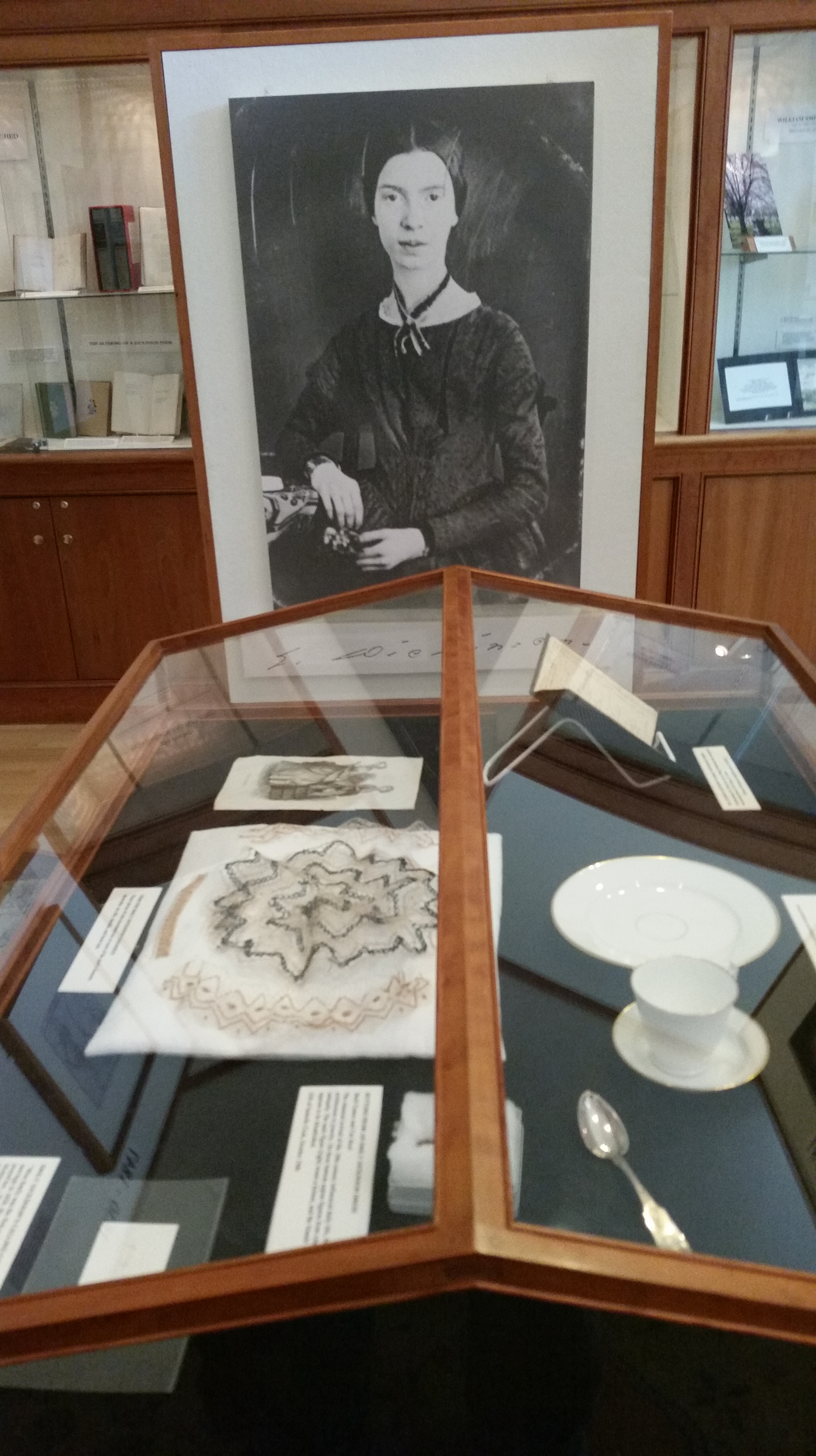
Emily Dickinson’s portrait in the Dickinson/Frost collection of Jones Library, Amherst, Mass.
Recently, I attended the Juniper Writing Institute at University of Massachusetts in Amherst. For the unaware, Amherst is the hometown of one of the canon’s most memorable and memorized poets, Emily Dickinson. Also nearby, one can find the farm of another great American poet, Robert Frost, considered by many to be the landmark poet of the 20th century. Both of these poets have meant a great deal to me as a writer throughout my career, and being in their part of the world was an unforgettable experience.
But my own independent studies of both Frost and Dickinson raised a new question for me — one that awoke me at 3:30 a.m. the first night of the conference. So distracted was I from this recurring question that I arose from my semi-peaceful travel slumber to write by hand in my journal. Here, in its unedited version, is the transcript of my late-night, early-morning writing:
6/21/15, 3:30 a.m.
I am awake because Emily Dickinson will not leave my mind. Having visited her house yesterday, I keep seeing her small corner bedroom over and over: its little sleigh bed, its dresser, its white-knobbed doors.
The Dickinson House in downtown Amherst.
Most of all, though, I think of all its windows. The tour guide kept using phrases like “extraordinary fenestration,” and she did not exaggerate. The natural light in Emily’s room was almost church-like. White and spiritual, it seemed to give life to the broad, thick beams of hardwood flooring there. As old as everything was, the light carried no dust. The air in her quarters was as pristine as the white housecoat she sewed for herself. On that air was the scent of history, a rare mixture of old wood, natural fibers, and unstirred earth.
I glimpsed the Amherst world from her window. Her tiny desk was positioned before it, and for a second, I could visualize her sitting, penning lines of legacy. Some of these lines also awoke me today, mostly her first lines:
Hope is the thing with feathers
I dwell in possibility
My teacher-mind sets to work on these, and I envision exercises for my students:
(Abstraction) is the thing with (concrete object)
What idea or notion do you “dwell in,” and why?
A collection of Emily’s things at the Jones Library in Amherst.
The second of these questions applies to me as well, for once again I find myself too fixated on the idea of leaving my mark as an artist. I dream of a time when others tour my family’s farm or my smaller lake-view house in the city to see where and why and how I worked. Even at this mature age, my boyish whims of literary celebrity return, thanks in part to Emily Dickinson. My pragmatism intervenes, though, and tells me I need to sleep before daylight arrives. [End Journal Entry]
So, I was at my most honest in the middle of the night. But my thoughts of leaving a literary trail for others to follow would not stop with Emily. No, not when the home and writing space of one of my all-time literary heroes was nearby.
Upon my visit to the Frost Farm in Derry, New Hampshire, I was privileged to see his barn, his house (both floors!) and the land surrounding. I stood where the great man stood, walked where he walked, and even trod the staircase his wife descended, prompting the poem “Home Burial.” All these experiences once again raised the concern of posthumous impact.
Would people want to similarly experience the spaces where I have created? Will my own work ever merit that kind of attention, before or after my death? The literary marketplace is full of Frost-wannabes and Dickinson-aspirants, and who am I to even ponder such weighty matters? How does proving oneself a “fanboy” of literature make one any more likely to succeed at literary and scholarly endeavors? And thusly, I tortured myself further.
I visited the Robert Frost Library. I spent hours perusing the Frost-Dickinson collection in the Jones Library of Amherst. I allowed my imagination to run wild with scenarios concocted only from the notion of greatnesses recognized. And once again, I found myself twisting my brain into the same enigma that it has puzzled over like a Rubik’s Cube countless times before: Will I matter? Will my work matter? How do I ensure both? What steps must I next take to be certain that I’m not forgotten, like so many writers of the past?
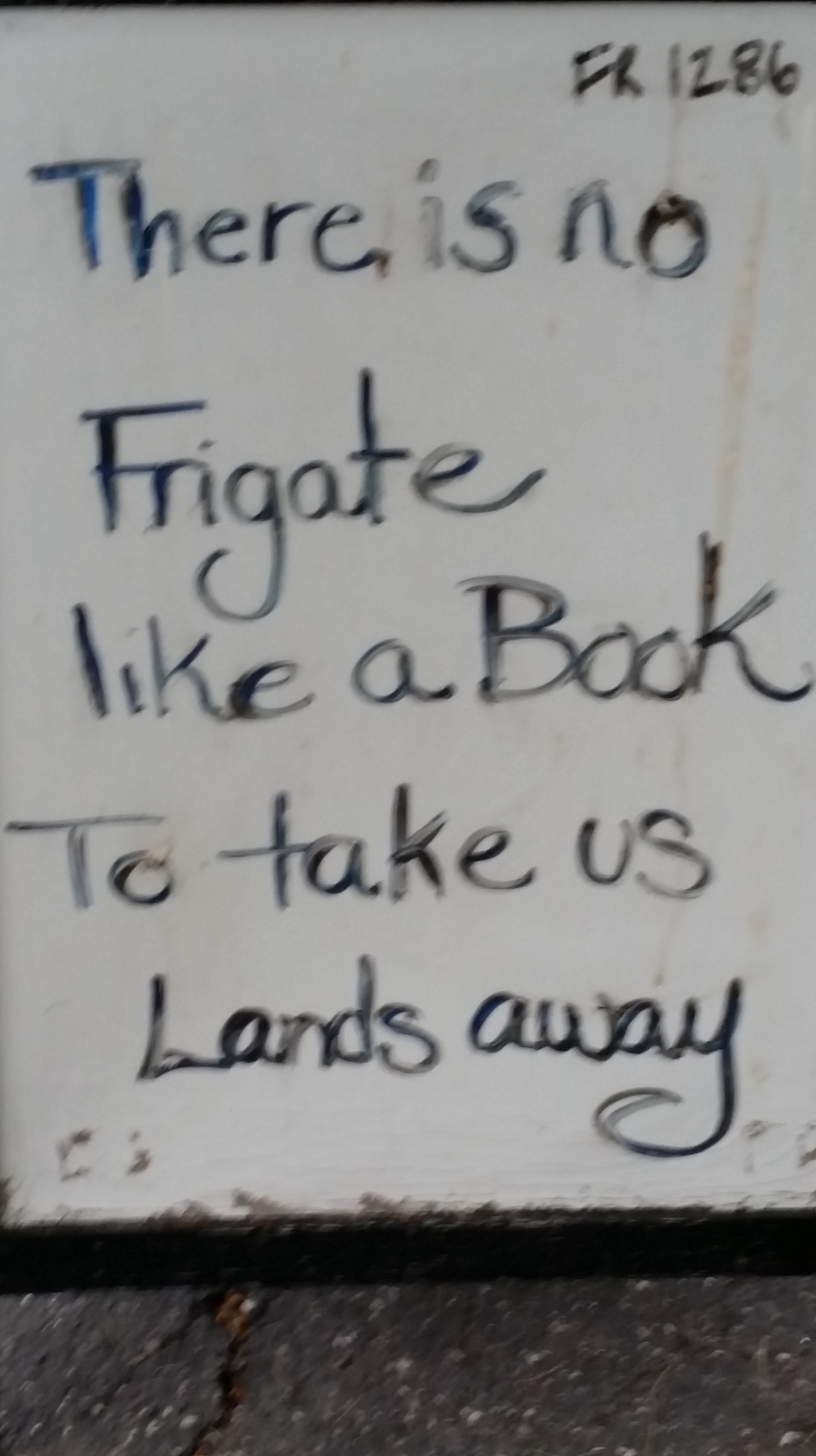
A sign on the grounds of the Dickinson House in Amherst. This passage is directly from Emily’s poetry.A bust of the great man himself inside the Dickinson/Frost collection at Jones Library.
I had hoped by now, at my nearly 40 years of age, that such concerns would really be a thing of the past. After all, I continue to write, and I’m sure that one day I’ll see some wider recognition than my meager efforts have so far produced. Like all writers, I’d like a Pulitzer and maybe some other big awards (see prior posts), but honestly, at the end of the day, what I’m really aiming to do is preserve people, times, and places that have mattered to me the most. If my poetry results in just a few people gaining a broader appreciation of the heritage, values, and experiences I’ve received in this life, then I’ve won. And I don’t mean that all of my poems are totally autobiographical — certainly many are not. But all of them lend themselves toward ideas, visions, and perspectives that, however universal, have arisen somehow from the life I’ve lived.
Will people care about that life? Why should they? Will students sit through laborious documentaries about the different periods in my writing timeline? Will my work be anthologized in textbooks of the future? Such inquiries can drive one mad, if left unchecked. Spending countless hours in the homes of the greats might not make me a better writer, but it did accomplish one thing — it allowed me to see a shared humanity, a common thread of inspiration, motivation, and dedication.
Persistence, diligence, and enormous creativity are shared traits among those we celebrate today, so long after their earthly departures. And perhaps it is these traits that we should take away from memorials and museums commemorating their contributions. More than the vanity of asking, “How can I attain their level of distinction?”, perhaps we (I) should be asking, “What can I do continuously and creatively well to positively affect my world?” Such a question surpasses the superficial desire for remembrance, and enters us into a more philosophical, even theological, realm. May our answers lead us not to fame, not to fortune, and not to solipsism. Rather, may they lead us to be better human beings, produce finer work, and seize the opportunities of the everyday.
Robert Frost’s writing space at Frost Farm in Derry, N.H.A statue of Frost just outside the Robert Frost Library at Amherst College.
This morning, for the first time in a year, I had my first cup of real, honest-to-God coffee. You see, last summer I had an encounter with caffeine that totally reformed my whole perception of it: While on a writing binge, I consumed three large cups of coffee one after the other after the other. Something then happened that had never happened before — my heart rate shot through the roof (like say, 130 bpm), my blood pressure spiked to a dangerously high number, and I thought I was going to die. Yes, really. I even wound up going to the hospital to get checked out, having never encountered anything like that before. Once the effects of the caffeine subsided about an hour or so later, I was fine. In the twenty-some-odd years I’d been drinking coffee, it had never turned against me with such hostility. After this bright red warning sign, when I consumed even a little caffeine, I noticed that some of my previous symptoms began to return. Maybe it was psychosomatic, maybe not. Either way, I didn’t like the feeling.
So, I was turned off of caffeine for a good long while. For the past year, I’ve been a devotee of caffeine-free everything, from sodas to foods (bummer: chocolate has caffeine), and it has been a purification by fire. Admittedly, my mind has been clearer, my body has been more responsive, and my teeth have been noticeably whiter. This fast of sorts has had its advantages. Still, though, something was missing.
At family events, I declined the southern house wine (Sweet Tea) in favor of water. At writing events, I opted for beverages clear and flat while others around me were delighting in the carefree enjoyment of lattes and mochas. Yes, I missed it. But I didn’t miss the near-death sensation from my prior encounter. Better safe than sorry, I told myself.
So this morning, when I found I was totally out of decaf (which, by the way, still has trace amounts of caffeine), I took a risk and made a cup of the hard stuff. I prepared it as I would have pre-fast, two sugars no cream, and partook slowly and cautiously. Thus far, as I’m writing this, I’m feeling no ill effects. A little physiological charge, perhaps, but nothing devastating.
World religions of all sorts preach moderation, and perhaps this account is one that reinforces that idea. “Sucking the marrow out of life doesn’t mean choking on the bone,” teacher John Keating advises his charges in the classic movie Dead Poets Society. Sometimes we have to nearly choke on the bone to appreciate the marrow, however. I don’t plan to caffeinate myself like I used to, but I am hopeful that I can have an occasional indulgence without frightening repercussions. I’ve missed being a coffeehouse regular, I’ve missed the ritual of preparing a single cup before writing, and I’ve missed being a part of the rich history that “real” coffee embodies.
Today, as ten ounces of Nantucket Blend wind their way through my system, I’m reminded of a Simon and Garfunkel tune: Hello darkness my old friend/ I’ve come to talk to you again. The trick is not to be consumed by the darkness. As sunrise peeps over the lake beyond my writing window, I’m grateful that a new day has begun.
My dealer of choice — a fine little coffeehouse here in Winter Haven.
In just a few short weeks, I’ll be speaking to the graduating class of my alma mater’s MFA program. I’m supposed to be addressing “Life after the MFA,” a subject that I’ve become intimately familiar with over the last year and a half. In preparation for this talk, I’ve been looking over some of the notes I once took in MFA workshops, seminars, and synthesis sessions, and I’ve found that, while apart from the academic structure of the program, I’ve developed a discerning sensibility about some of the issues presented by professors in grad school.
One subject is that of using the abstract vs. using the concrete. Not one, not two, but three different professors in the MFA program at different times encouraged students to eschew abstraction in favor of concrete images. This is a good idea for beginning writers like the ones I teach, as their poetry is often littered with pathos in the form of notions like love, jealousy, rage, and abandonment.
But to lay down as a rule the idea that anything abstract or intangible must be omitted is incorrect, or at the very least, in need of refinement. The truth that I’ve found is this — using the abstract in poetry is much like using anything else in art: too much, and the work will become imbalanced; too little, and the work will lack relatability. This is especially true in the use of one of my favorite literary devices, the zeugma. For the unfamiliar, a zeugma is a combination of something concrete with something abstract in a line of poetry (or literature): “She spoiled her honor and her Sunday dress,” for example. Using too many zeugmas cheapens a poem and casts the image that the author must prevail upon parlor tricks to wow the audience rather than solid content.
But the right zeugma in the right place can make a piece sing. Just like similes, metaphors, oxymorons, and the whole array of other literary devices, the zeugma too carries its weight. And without abstraction, the zeugma is relegated to the status of a single image, a single item. Abstraction is necessary for this device and so many others to work.
“Everything in moderation,” the old saying goes, and in poetry as in life, this cliche actually holds true. Plenty of concrete imagery mixed with the right amount of abstract language can produce beauty, truth. Will I, like my former professors, prescribe my advice to near-graduates? Probably not. I’ll probably discuss the pragmatics of literary life — the necessity of staying in touch with fellow writers and readers, the merits of continuing to submit work, and possibly the necessity of overcoming rejections.
As for using the abstract, my students and I will continue to ply the often-holistic, qualitative language in our everyday writings. Rather than removing a tool from the writer’s toolbox, we will use it as a carpenter uses a plane — the write tool for the right job at the right time.
I’ve written before about awards and prizes in the literary realm — some good, some bad. But today I’d like to talk about a very special kind of award; one that recognizes not only quality or quantity of work, but devotion to one’s community. Having recently been named poet laureate of Winter Haven, Florida, I feel a need to examine what such a title means, and what it means to others.
I first heard of poets laureate when I was in college; about that time, two Roberts, Robert Hass and then Robert Pinsky, were poets laureate of our country. And even though I wasn’t an English major, I knew that the title was something significant. I had dabbled in poetry myself even though I was pursuing a misguided career in journalism, and thought that anyone who received such a title must have an exceptional affinity for the written word. The office intrigued me.
The next poet laureate I knew, this time more personally, was Peter Meinke. As a student of Peter’s both in workshops and in my MFA program, I was privileged to see and learn what it took to become the poet laureate of a city. In Peter’s case, his city is St. Petersburg, and all one has to do is pay a visit there to see how St. Pete appreciates him and his work. While the “man on the street” might be unfamiliar with Meinke’s decades-long canon of literature, those who read widely and have been around the Tampa Bay area for a while know that, when it comes to poetry, Peter is king in Florida. In fact, he is currently under consideration to become the poet laureate of our state, a position that I hope he occupies soon. Peter knows what it means to love an area and portray its beauty, its scars, and its people in poetry.
After Billy Collins served the US as poet laureate in the early 2000s, bringing with him the Poetry 180 program to American high schools, I was equally excited when Natasha Trethewey, Southern poet extraordinaire, was named to the office. Her work, while examining issues like civil rights and racial hardships, drips with the resonance and the harmony of America’s southland. She can render an oxymoron so skillfully that it can rip your heart out, and in the next line she’ll have you laughing hysterically. Certainly our national poets laureate give up-and-comers something to aim for as a goal.
Meanwhile, here in Winter Haven, I am humbled by the title of local poet laureate. As my city’s first, I also hope to set the bar for those who may come after me. Whether it’s celebrating a groundbreaking, honoring fallen heroes, or inspiring the bright young minds of tomorrow, my poems are intended to be a positive addition to our city’s growing understanding of and emphasis upon the arts. I love this city that has served as my home for the last 14 years — a time span that has allowed me to evolve from a young photojournalist into an educator, a writer, a husband, a father, and now, a poet laureate. During my time in Winter Haven, I’ve earned two graduate level degrees, taught at two colleges and spoken at many others, and I’ve been allowed the freedom to pursue my craft in a natural setting comparable to none. May my words serve this community well and with the greatest of gratitude.
Here, for my readers, is the short piece I read to the city commission at their meeting Monday night after the poet laureate pronouncement was made:
End Weekend
Our lake is silver
on the cusp of evening
as it is waiting
for sunset, nightfall,
a thousand blind mosquitoes
making black blacker.
Here we are, a lone
boat trolling toward our dock
where God’s finger trails
and our wake both stop.
The surface cools to midnight
blue – that good-bye hue
preceding the stars
that navigate our earthbound
vessels to Monday.
This poem was first published in Saw Palm magazine (USF); included in my latest book Middle Class American Proverb (published by Negative Capability Press).
It’s that time of year again: Editors and publishers are nominating works from their magazines and bookshelves for a broad range of laurels. Most notably at this time of year, writers receive word of Pushcart Prize nominations. As a younger writer, I used to get all tingly when those nominations arrived by email — kindly journal editors who liked my work sent it on to that mystical committee that views thousands of submissions every year from literary journals all over. I am still honored to have my work nominated for the Pushcart (as it was again this year), but in speaking with mentors and writer-friends of mine, I’ve come to understand something: Poets “worth their salt” are nominated for the Pushcart almost annually. Venerated veterans of poetry take such nominations for granted, apparently, even though those of us who are still “emerging” think them a big deal. So, I’ve learned to cool my jets a little. Once my work is actually included in the honorable Pushcart anthology, I’ll certainly add that detail to my author’s bio. But for now, I suppose I should join the ranks of my fellow authors who see nominations as a nice thought, a kind gesture, but ultimately, little more than a tip of the hat toward one’s work.
I’ve learned also that the awards one reads about in other writers’ portfolios aren’t always as glamorous as they seem (take note, young writers). Certain awards may open some doors, they may add something to one’s CV, but outside the literary community, they don’t amount to a hill of beans. Robert Frost was a fan of the old saw “Fine words butter no parsnips,” and I suppose in the world of literary awards, a similar thought exists — shiny trophies, parchment certificates, and faux-wood plaques don’t make you a writer any more than a fancy hat does.
Recently a publisher friend of mine let me know that my book has been nominated for a couple of other awards, as well. If I win, it will be a wonderful experience, and I’m trying hard not to get my hopes up too much prior to the announcements. These awards are entered by many of my most respected fellow writers and their publishers, as well. To even enter the field is an honor unto itself. The danger, of course, in winning awards is the temptation toward stasis — many a great writer, after earning the Pulitzer or the National Book Award, has lain down his pen. The award was an end rather than a milepost on the journey. Writers, as awards season enters full swing, the temptation is great to see pinnacles where only plateaus exist. Gilded honors are stations on the path, not summits to be conquered. Let us be grateful and humbled, but let’s not be complacent. There’s writing yet to do. Stick that award on the shelf or on your book cover, and let’s keep going.
Loyal blog subscribers, I have a secret for you: Today you can order your pre-release copy of my newest book, Middle Class American Proverb. Here’s the link:
This is the definitive Florida poetry collection I’ve been writing about. Get your copy today!
A word of warning before I begin here: This post is probably going to upset a number of my creative and socially inclined readers. But what you see below must be said.
I will not be holding a “cover reveal” for my upcoming book. If you want to know what the cover looks like, here it is:
There. It’s revealed. And as happy as I am with this cover (isn’t it COOL?), I don’t feel anything further is warranted. After all, the real meat of this work lies between the covers, and that’s where I’m hoping you’ll look when this volume hits the bookstore shelves soon.
“Why the snarky attitude about cover reveals?” you might ask. Well, here’s the thing: I am a husband, a father, a teacher, and a writer. I serve as a community volunteer and as an active member of my church. My weekends are most often consumed with birthday parties for other people’s kids, lawn maintenance, and the peripheral tasks of education — grading papers, preparing lesson plans, and so forth. My time is valuable, and honestly, unnecessary and entangling social engagements are nothing more than a gigantic time-suck.
Now before my readers accuse me of being some selfish, antisocial hermit, allow me to say that I love a good get-together as much as the next person. Just recently (as you may have read here), I hosted my own chapbook launch for “The Boys of Men,” and it was thankfully well-attended. The food was delicious, the company was wonderful, and the reading was fun and interactive. I sold lots of copies, and was able to make a modest donation to one of my favorite charities who helped host the event.
Why, then, am I against the notion of a cover reveal, in particular? I oppose cover reveals for the same reason that I oppose “gender reveal” events for babies that have not yet arrived: It’s one more thing. That’s right — one more space on the calendar filled with pointless banter and oddly colored punch. We’re all very happy you’re having a boy/girl, but isn’t your fourth baby shower (also inappropriate, might I add) enough? Must you subject us to yet another inane occasion to stand about, idly discussing the weather until you drop a curtain or pop a balloon? Seriously, stop. No more, please.
Authors: Please don’t consume the valuable time of those you know with the literary equivalent of the gender reveal. We know your book has a cover. We’re ecstatic for you, and proud to call you our friend. But to hold people hostage while you unveil a placard is both ludicrous and disrespectful, even if you provide finger sandwiches and fruity beverages. By all means, launch your book. Hold readings. Give lectures and seminars. I’ll be there. It’s an opportunity to learn something, hear something new, and culturally engage. Reveal something more than a shiny piece of plastic, some crackers and a “TA-DA!” Give us your words, give us your work, give us your heart.
It was the end of the first week of school. Students in my creative writing classes had been pounded all week with Strunk & White, William Zinsser, and the thousand and one unofficial “rules” of good writing. It was time for expression. It was time to put the “creative” back in creative writing.
I thumped a load of TIME magazines down on the table at the front of the classroom along with scissors, glue sticks, tape, and construction paper. Then I began explaining found poetry: that crazy-but-sometimes-deep hodgepodge of discovered, connected everyday language. My challenge to this group: “Take seemingly disparate words and phrases from these publications and bring them together in a way that appeals to your mind.” No limitations other than that. Just cut and paste. Form something that makes a semblance of sense to you — that’s it.
Then something magical happened. Students began to string together words and phrases in unexpected ways, forming verses about topics ranging from racial prejudice to missing class because of nature’s call. Some were expectedly cliche, but others struck a nerve, both in their authors and in me as their teacher. It was splendid. It was creative. It was (pardon the triteness) inspiring.
This was not the first time I’d seen the “cut and paste” exercise used — teachers have known about newspaper poetry and similar tricks for years. And of course, I’d been fortunate enough to have a grad school professor who encouraged us to use this exercise to loosen up our own creative muscles before. But when these high schoolers were set loose on the project, there was an unusual fervor in the air — it was as though they were finding treasures that would help display their souls. After a long week of reading the advice of the old, the dead, and the mundane, found poetry was just what the doctor ordered.
For us as writers, the occasional dabble into arts and crafts can likewise be a refresher. When faced with being stuck, the switch to tactile-kinesthetic arranging of words like refrigerator magnet poetry or word tiles can allow another part of the brain to do the work for a while. And sometimes, when monotony brings us down, colorful paper and scissors and paste can also remind us of a simpler time — one that perhaps inspired us to undertake the writer’s journey in the first place.
Photo: University of Buffalo’s Robert Frost Collection
As a middle schooler, I was fortunate to have one English teacher throughout those tumultuous years who encouraged my interest in poetry. Mr. Pace knew I was a rare breed: a perceptive and sensitive farm boy interested in writing and things literary, though not the greatest scholar. My profile, he felt, matched up with a certain northeastern poet whose canonized tomes of work combined the rhythmic labors of agriculture with the delicate intricacies of poetic diction. Hence, my introduction to the works of Robert Frost began.
I would sit atop our barn roof overlooking our orange grove, and read everything from “Out, Out –” to “Stopping by Woods on a Snowy Evening.” I’d never seen snow. This was central Florida, after all. It didn’t matter — Frost brought it to life with his vintage imagery and steady, clopping-horse meter. And then, of course, there were the apple orchard pieces. From “After Apple-Picking” to “Mending Wall,” I knew well the lifestyle he described, even though our farm and its accompanying ladders and fences were more than a thousand miles away from New England. Like Frost, I knew the press of a rung into flesh and the whisper and sway of fruit trees. Here was a man who “got” me, I felt, even though he was long since dead.
My love for Frost’s work continued into high school and college, and I wrote bad pastiches of his work, thinking I was being totally original all the while. After all, my “citrus farm” poems were completely disparate from anything New Englandish. Yeah, right. As I look over my older pieces, I hear familiar iambs and rustic rhymes that mark a younger poet’s perception of excellent verse. How brilliant I believed my rhyme schemes and wordplay to be! If only the rest of the world could see this marvelous talent, I thought, refusing to admit that every syllable was a tribute to America’s godfather of poetry — Frost.
Even my first book, Growing Moon, Growing Soil, contains blatant influence from “Frosty Bob.” As I matured, my reading tastes expanded to include contemporary voices and a vast array of styles. But as a writer, I kept coming back to those paradoxical poems — so seemingly simple, yet profound. Frost’s work occupied a space on my mental bookshelf alongside Bible verses and the Scout Oath and Law — it was ingrained among the ridges and folds of my brain’s landscape as surely as cut weeds turned under by a grove disc.
Today, my work is influenced differently — I no longer strive to “sound like” this poet or that one, but my poetry (I like to think) has come into its own. One of the greatest compliments of my more recent work came from poet Erica Dawson: “John is accomplished. He knows his voice. He knows his subject matter. He knows his style.” Those words, like Mr. Pace’s initial encouragement, gave me not only assurance, but a goal. If my work is to reach the level of greats like Frost, it must be identifiable as uniquely mine. The thumbprints of many poets may be found within my writing, no doubt, but when the final draft is finished, my hope is that it surges with a different pulse; one as recognizable as Frost’s, but unique — oranges to everyone else’s apples.
 FLteacherpoet555
 I’m not usually one to post one negative thing after another, but recently, circumstances in my literary life have been causing me to offer a few “no-nos” to the general public. In today’s edition: How to know when you should never submit to a magazine/journal/publisher again.



 John Davis Jr. -- Author