life, poetry, teaching, Uncategorized, writing

What Robots and AI Can’t Replace

Everywhere we look, there are mentions of artificial intelligence (AI), robotics, and their implications for the future. News stories and social media feeds predict a heyday of ease and comfort as we assign more and more mundane tasks to technology (the art that accompanies this post was created by AI). In contrast, we’re also given the dark prophecies of Asimov and Bradbury come to life: When our computerized creations become so sentient that they can resent us, how will we control them?

More realistically, however, people are rightfully concerned about their jobs: Cashiers are already becoming obsolete, data entry by remote workers is becoming a relic, and countless other positions previously filled by people are slated to go extinct in the next few years. How, then, do we reckon with this revolution?

As the father of two older boys, one in college and one about to go there, I’m relieved that both of them have chosen irreplaceably human endeavors for their futures: One is in theatre, and the other plans to pursue architecture. These are professions that AI will never be able to fully usurp. After all, theatre is among the humanities, a select group of art forms and practices marked by their innate reliance upon authentic emotion and genuine experience. Our hamartia, the human condition, is ironically our greatest strength when it comes to livelihoods that are AI-proof. Architecture will be helped by AI, certainly, but to design and create livable spaces that consider the needs of complex people, we need human minds and hearts. Ask AI to design a mid-20th Century ranch house like the one on The Brady Bunch, and you’ll probably get a reasonable facsimile. But ask AI for a blueprint of a home that considers the individual needs of 21st Century family members, and confusion results — the blinking cursor begins to smoke.

As a teacher, I’ve already encountered the challenge of getting students to write rather than use ChatGPT or some similar product. For now, AI-generated writing is fairly easy to spot: Its reliance upon certain words and phrases, its preference for sterile-sounding language, and its occasional errors about obvious matters all make it detectable, even without running an essay or paper through an online checker or two. Combine those facts with a vast divergence from a student’s in-class writings, and AI use becomes obvious. But we know that technology consistently advances, and as time elapses, the fakes will become harder to spot, especially as classrooms become more tech-dependent. This is why some teachers and professors have gone back to old-school blue books, those lined-paper pamphlets of an earlier era, for class writing. And while I see the nostalgic appeal and hard-nosed devotion to justice driving such a practice, I also see its inherent temporary nature. Returning to number two pencils and canary yellow legal pads may get us by for a while, but students, parents, and clients of the new age won’t tolerate this Luddite approach for long. We need to find the middle ground between total AI reliance and achieved, owned learning quickly. Compromises like “You may use an AI editor for the writing you have authored independently in class” serve as a good start. This technique prepares students for the world to come without damaging their acquisition of knowledge. Further, they learn by seeing the corrections made by QuillBot, Grammarly, and other language-fixers. And if these products make a mistake as they sometimes do, so much the better. That’s where the real learning begins — technology has never been and will never be infallible, and the sooner students grasp this truth by experience, the better off they will be.

As a poet, I’m not worried about AI. I’ve seen the replica-poems it produces, and while some sound good on the surface, a closer look reveals that same artificial shimmer visible in the art that I’ve used above. Something’s missing; there’s a bad aftertaste like that of saccharine diet sodas from the seventies. An astute reader can tell that the cane sugar of the human touch is missing from this thing’s formula, whatever it may be. The “experiential resonance” — the sense that an event or product is organic — just isn’t there. Call it instinct if you will, but a reasonable human being can tell the difference between the things we do and make and the contrived, data-driven simulacra of thought-approximating algorithms. An initial, superficial “Oh, that’s lovely!” soon becomes an “Oh, this isn’t what I thought it was.” And that kind of deflating disappointment will toll the end of our infatuation with AI. Like any other once-novel discovery, this, too, will lose its luster.

So, what’s the big picture? The AI “scare” is similar to that of Y2K: Yes, we should consider it, but no, it isn’t Armageddon. As we prepare and adapt, we will add it to our toolboxes, become indifferent to it, and move on. Just as we healed the hole in the ozone layer, just as we eliminated acid rain, and just as we defeated diseases of long ago, we will coexist with this latest change until it no longer seems intriguing or threatening. We could easily theorize a future dystopia like those seen in science fiction, but it’s more likely that balance will prevail as it always has. For parents, teachers, and creators, AI is nothing to obsess over. Put simply, it’s just another thing. And if history has taught us anything, it’s that things are perishable.

life, teaching, writing

The Literary Scoutmaster

Photo by Bryce Carithers on Pexels.com

When I was the age of my current students, I was busy finishing up the requirements for Eagle Scout. I genuinely enjoyed scouting, mostly because the things I learned there were hands-on, useful, and seemed to have real-life application. I enjoyed it so much, in fact, that one of my very first jobs was camp counselor, teaching younger boys how to safely and accurately shoot both rifles and shotguns. Scouting was good to me, and it gave me skills I use and teach even now when I take my sons camping, fishing, skeet shooting, hiking, or kayaking, among other activities.

Admittedly, the Boy Scouts of America is not what it used to be. Over the years, the organization has made a series of egregious missteps that have caused me not to place my sons in a troop, and I’ve largely cut all ties with the BSA. But this isn’t a political post, nor is it one intended to defend or prosecute “Scouting USA” as they now prefer to be called. Instead, I’d like to reflect upon how my present teaching experience embodies what was valuable within a former version of scouting: Practical guidance and retainable learning through meaningful relationships and memorable experiences.

I teach at an all-boys high school. Every day, I get to walk into my classroom and impart subject matter I love to young men who are eager to start the first chapters of their “real lives” beyond secondary education. Like tying a square knot or administering first aid, the skills I provide (reading a text more deeply, writing a clear sentence, etc.) are ones that will follow my pupils the rest of their lives if they’re wise enough to grasp this opportunity.

And I do all I can to ensure that my subject matter is imparted in a tangible, relatable way. We don’t just sit in rows and uniformly parrot back the rules of reading and writing; we investigate texts and tear sentences apart to see what makes them work (or not). I choose material that the boys will find engaging so as not to lose their focus. I show them that poetry, an oft-dreaded element of high school English, can be cool. They earn metaphorical “merit badges” in matters like fiction, nonfiction, composition, rhetoric, and critical analysis. And throughout all this, I lean into their experiences.

They write about their lives, their parents, their worries, and their friends. They give presentations about how they share traits with certain characters we’ve encountered. They read paragraphs with highlighters like navigators would read maps with compasses. And they build essays and compositions as a camper might carefully structure his log-cabin fire lay: each piece discerningly placed atop the other until the warmth and light reach optimal climax.

These boys remind me of a better chapter and give me hope for our cultural future. While all around us, young men give in to so many negative influences, I prefer to think that my small part in shaping my students will in some way brighten tomorrow through integrity and knowledge. I know that some of them will make bad choices just as certain scouts in my troop did. But if a small-town poet can reach into the minds of enough youth with lingering lessons about words and ideas, I will have succeeded. When my students enter the world beyond our campus, I know they will have heeded, even adopted, a certain old motto that remains in my heart: Be Prepared.

life, poetry, teaching, writing

Personas I’ve Known, Part Two: The Brooding Academic

If you read my post from earlier this week, you know that my recent writing of persona poetry has caused me to think more closely about some of the identities I’ve adopted over the years. Today I’m taking a look at another one — the stereotypical professor.

Fancy degrees in hand; time to stonily condescend to some college kids.

There was a time in my academic career that I believed I had to fit a certain mold (and a pretty old one at that): the sweater-wearing, overtly studious, and incredibly stodgy pedagogue. You know the type — that old, bald white guy who has breathed too deeply the rarefied air of higher education too long and is now utterly disconnected from average reality. Let’s call him Professor Highenmighty.

A far cry from “Bubba” of last post’s fame, this guy was so deeply impressed by his own credentials that he conducted class as if he were Socrates and Jesus rolled into one. Listen up, mere peons, for the fount of all knowledge is about to spew forth. Have you not noticed my scholarly looking attire? Have you not observed my air of sophisticated erudition? You should.

Granted, I’d done pretty well for myself. Not everyone from my humble beginnings secures two graduate-level degrees, publishes books of poetry, or wins hoity-toity literary awards. Still, I had no real justification for becoming Professor Highenmighty — I had just fulfilled the potential that people nearest me knew I had all along, and what’s more, I had done so later than I should have. Nonetheless, here I was — Mister Intellectual, ready to look indifferently down my nose at lesser mortals, and that meant just about everybody in my usual sphere. What an ass.

What got rid of Professor Highenmighty? As is usually the case, an encounter with someone (or several someones) smarter. Comeuppance is usually the cure for excessive ego, and this time was no different:

My day job was teaching impressively gifted kids in high school the various facets of creative writing. These students were smarter, more talented, and more motivated than I ever could have been at their age. I was stunned by their intelligence, and their regular demonstrations of innovation and originality were a reminder of the shiftless sloth I’d been. When I was their age, I had specialized in invisibility. In contrast, they put their brilliance on display daily, secure in their giftedness and their place as young artists. Some of their poise was certainly artificial, but still, their native ability was undeniable. Outsmarted by teenagers, Professor Highenmighty quickly became a thing of the past. Humility, thy name is youth.

If this were a fable or a folk tale, I suppose a moral or a lesson would go here at the end. Like all accomplishments, degrees gather dust. After a while, they’re taken for granted, and it’s perfectly possible to become an educated idiot. Maya Angelou is quoted as having said, “Nobody cares how much you know until they know how much you care.” I think that’s a good line to take away from this post. As I prepare for the next stage in my career and learning, I’ll do my best to keep Professor Highenmighty extinct. After all, there’s always somebody smarter.

life, poetry, publishing, teaching, Uncategorized, writers, writing

The Joy of Writerly Objects

With all due respect to Marie Kondo and other “organization” experts, I’m not making my space utterly devoid of stuff. Here’s why: Stuff has history. Stuff is full of inspiration, and sometimes it can make us think in ways we ordinarily wouldn’t. And finally, stuff has meaning. If a thing has beauty as well as function, then it ceases to be what some experts would call “clutter.”

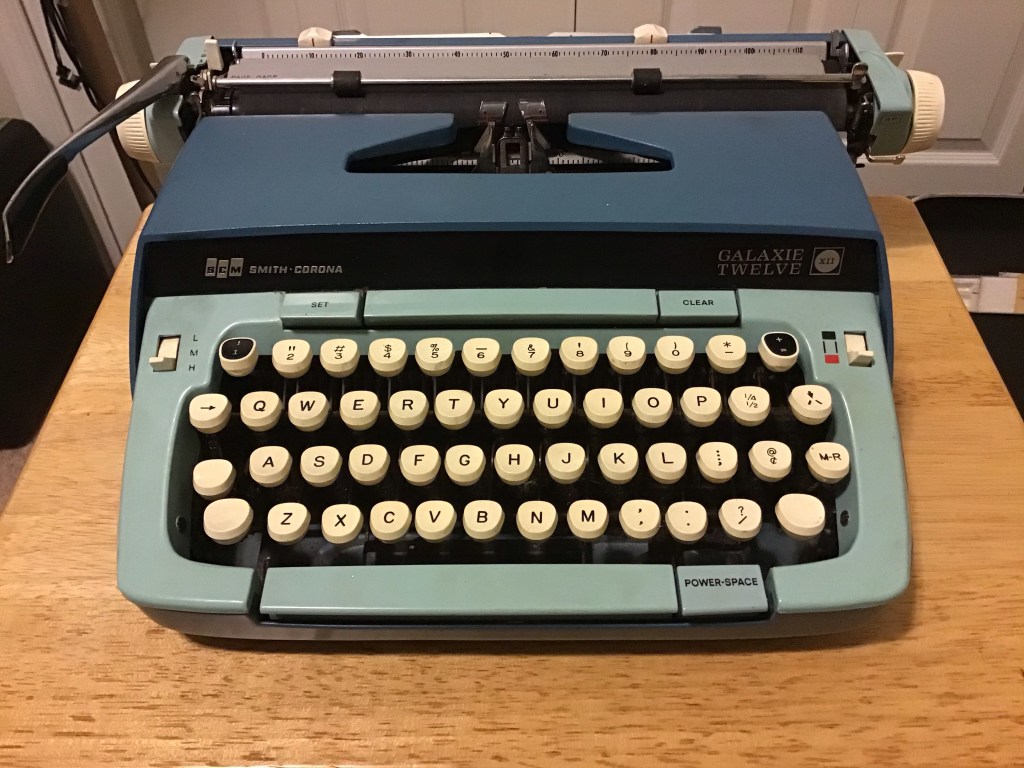
My Smith-Corona Galaxie Twelve typewriter. Molon Labe, home arrangement experts. I dare you.

Now before you call Hoarders and report me, let me say that there’s an extent to everything. My study is not overflowing with so much junk that I can’t even move, let alone think. But I do have a number of objects that I keep because of their inherent aesthetic value. Here, I’d like to talk just a little about the items I hold dear as a writer, and how my practice might suffer without them.

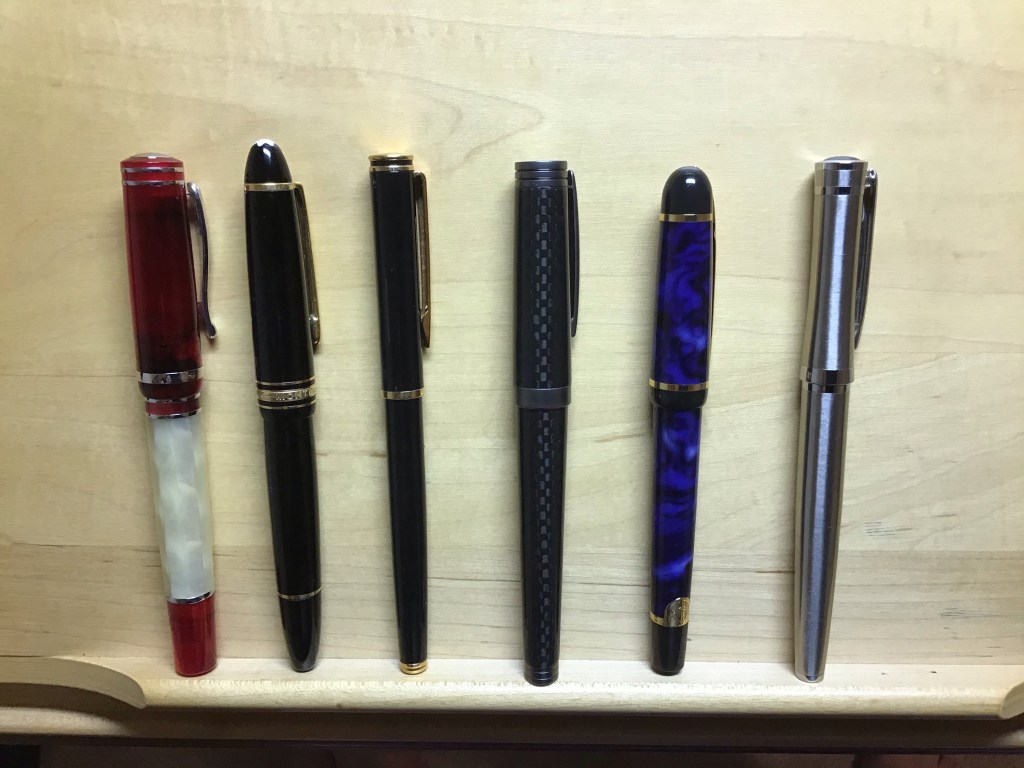
An assortment of fountain pens by Waterman, Montblanc, Levenger, and other makers. Vital to step one of poem creation.

Good pens are the frontline workers of the creative life. When smooth ink is flowing freely, filling good paper with artfully rendered words, the whole experience of writing is improved. I prefer old-school fountain pens because they connect me to generations of great minds well before our all-things-temporary present. Watching a crafted nib do its work motivates a writer to do his work in an equally elegant way. On my podcast, I talk about how connecting to things by touch can result in artistic revelation, thereby generating more output (writing or otherwise). Good fountain pens are probably the prime examples of this idea in action, and they’re good for Socratic Journaling, another idea explored on my podcast.

Uncle Hy’s ashtray — historically used in the evenings, when he’d puff on his pipe after reading the paper.

Some of the stuff I keep has sentimental value. My Great Uncle Hy was a swell guy — he was a businessman through and through, and over his lifetime, he did well for himself. One relic of his that I’ve kept is the translucent heavy green glass ashtray he used when smoking his after-dinner pipe. While I’m not a smoker myself, I use it these days to hold the aforementioned fountain pens and other office sundries. It catches the light the same way it did when I was a boy and became fascinated by its color and brilliance. The memory of Uncle Hy and his industriousness keeps me going when I feel like slacking off.

The compass box — just because it’s cool.

Some things call out to you when you see them. Such was the case when I saw this little faux ivory box at The Oxford Exchange in downtown Tampa. It holds paper clips and thumbtacks mostly, but it also reminds me to stay true in my direction. Its weight is pleasantly permanent, and opening it is always an experience filled with possibility, even though I’m well aware of what’s inside. There’s a kind of Indiana Jones mystique about it, so yes, it stays.

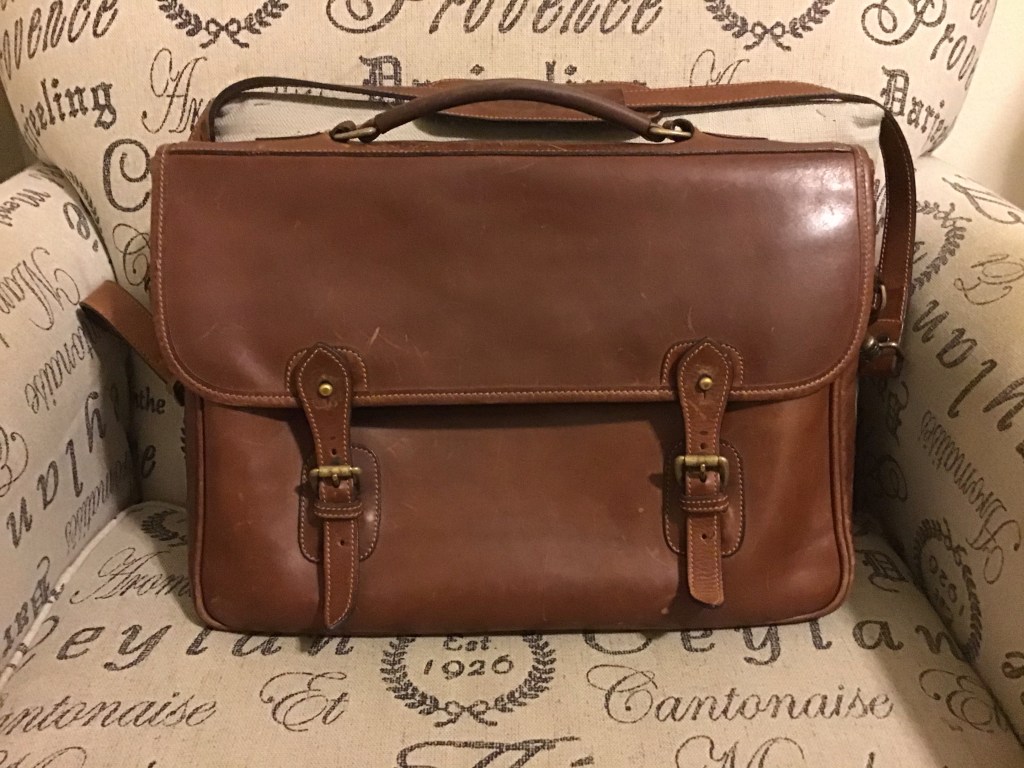
This briefcase has so many stories behind it…

My leather briefcase was given to me by my mother after I received my first master’s degree. Over the years, it has been to Lisbon, Portugal, Santa Fe, New Mexico, and lots of other spots. It holds everything I need, and frankly, it has become an extension of me — rare is the day when I walk onto campus without it. It even smells like literature.

So there you have it — an assortment of objects and keepsakes that make my literary life a little more inspiring. Minimalists and Feng Shui practitioners take note: These items might not be totally utilitarian, but they absolutely influence my creative process. Maybe you’ll say I should be willing to part with some of what I’ve mentioned here — my reasoning is too maudlin or clingy for your taste. Therein lies the beauty of stuff: Shakespeare was right when he said, “Beauty is in the eye of the beholder.” I enjoy beholding everything you’ve seen here. End of story.

Are there things that you can’t part with? Items that you’d feel a little more empty without? Use the comments section below to tell about your most cherished or prized creative possession…

life, poetry, teaching, writers, writing

Where the Liberal Arts Take You

This year, my oldest son is beginning high school. As a freshman, he has begun considering possible college majors that he’d like to aim toward. His big love is theater, especially musical theater (insert pragmatic-dad eye roll here). He is a member of the school band, and he is trying out agriculture, as our family has a long history of farming in addition to teaching and other professions.

As much as I’d like to give him the whole lecture about “getting a degree in something useful,” I’m realize in no position to advise him to be practical about his eventual course of study. I’ve done a pretty unconventional thing, earning a terminal degree in creative writing later in life, and I can’t say it has turned out badly. No matter how many guidance counselors and career advisers may say otherwise, getting a degree (or two!) in the liberal arts can in fact make life more fulfilling.

Readers of this blog know that I recently spent a week in the Wisconsin Northwoods, leading poetry workshops and kayaking the lakes of a beautiful part of the country:

8d775751-fd18-4ad2-bf93-c9752aafa0ad-1

And earlier this summer, I spent a week in Appalachia simply pondering how best to order my latest manuscript of poems:


Then there was the summer of my 40th birthday, where the whole family and I traveled to Lisbon, Portugal because I received a partial scholarship to attend the Disquiet International Literary Program:

And before I became an “international” poet, there was the summer I spent a week at the Juniper Writers Institute (also on a scholarship), where I explored the home of Emily Dickinson:

20150620_155224

And the farm of Robert Frost in Derry, New Hampshire:


Oh, and then there was the time (in the middle of my MFA program) that I was kindly given a full ride to the Glen West Workshop in Santa Fe, New Mexico. This would have been in 2013:

Add to that the workshops, seminars, and conferences that I’ve been able to attend closer to home (The National Graduate Creative Writing Conference in Carrollton, GA; AWP in Tampa; the Other Words conference at Flagler College in Jacksonville, and many, many, more), and you’ve got yourself quite a travel itinerary spread out over 10 or 12 years.

Lest the audience think that I am only measuring meaning by travel, there are plenty of other ways that my liberal arts degrees have enhanced my biography. Before I entered the realm of education, I used my Bachelor of Arts degree in print journalism to report for newspapers — now nearly an extinct species. In the process, I drove through (over!) the flames of brush fires, got shot at twice, had a beer bottle hurled at my head during a riot, and witnessed life in a way that few other people ever experience.

I spoke with flood survivors, celebrities big and small, government officials, and even the occasional inmate. All these experiences expanded my lens and allowed me to view the world from a variety of perspectives. It wasn’t the liberal arts degree that provided breadth and open-mindedness about our human situation; those understandings came along well after I’d received diplomas, in fact. But I never would have had those encounters without the degrees I earned, and I absolutely would not have interpreted those encounters in the same way sans higher education.

“But what about the money?” you may ask. “Is it true that people with liberal arts degrees earn less than those with vocational and technical degrees?” While I can’t speak to the assets held by those in hands-on professions, I can tell you that we’ve always had enough. My two boys, my wife, and I have had sufficiency and surplus in varying frequency, and even during times of struggle, our scenario has been eased by the knowledge that we are not the only ones to have faced difficulty. A thorough education in the humanities provided both fictional and nonfictional examples from which to learn. Some of our Christmases may have looked like the Bob Cratchit family or an O. Henry short story, but along with that sparsity came the closeness that such stories also featured. Enduring with beloved others is its own wealth.

“What about the cost? Not everyone can afford a spiffy degree from a small, private institution, you know…” True enough. I’m well aware of our national student debt crisis, and I also know that liberal arts colleges can be expensive. For me, the payoff has been worth the initial investment. The promises made by my parents and grandparents turned out to be true: Earn a college degree/ start a career/ live the American Dream, etc. Certainly this has not always been the result for others. I’ll leave it at that.

I do know that when someone is willing to work hard and smart, when he or she gives back to the profession, and when relationships are tended with near-agricultural precision, a liberal arts degree can help make life worthwhile. Sure, there’s a Wall Street Journal article that also bears out the truth of what I’m saying, but for today, I’m speaking from personal experience.

What am I going to tell my son about earning a “useless” degree? Go for it. No, I’m not a proponent of “follow your bliss” or “do what makes you happy” exclusively, but we need at least some modest enjoyment from making our livelihood. Work is still going to be work, no matter what, but fulfillment? That can be achieved, and a liberal arts degree can serve as the welcome mat for it.


life, teaching, Uncategorized, writing

Dear Teacher: Thoughts on a New School Year

It’s that time again: Parents prepare to send their kids off to school for the next go-round, hoping that this year will be the best so far. Teachers eagerly decorate classrooms, plan vivid and engaging lessons, check class rosters, and pick apart data.

As someone who spent 15 years in the secondary classroom before moving into higher ed, I distinctly recall all the dreamy potential that this time of year can represent for parents, students, and teachers — it’s a blank slate, a fresh start, and a million other tabla-rasa cliches rolled into one. It is hope and nerves. It is the smell of paper, the satisfaction of checked-off lists, and the promise of a brightly lit, welcoming space away from home. It is its own magic.

But the real work is about to begin. The daydream of clean faces, happy chatter, and new clothes will soon be supplanted by young people facing issues from abuse to homelessness (and more). The shiny technology and glossy posters will matter less than empty stomachs and forgotten texts. Teacher, what will you do then?

I don’t mean to quell the inspiration of a new year. I really don’t. Love those new stickers for your gradebook. Enjoy the cool, smooth plastic of fresh whiteboard markers. But also understand that the highs of August wear off quickly, and if you don’t love teaching and students, endorphins and dopamine will only last so long.

Teacher, I hope you are excited by those learners seated before you. I hope you are just as passionate about your subject as you have ever been and that your passion is virally contagious. I hope you have ideas for activities, strategies, and projects that will make Disney World seem dull. And above all else, I hope that the instructional fire within you burns bright All. Year. Long.

I wish you all this not just because I’m a parent, not just because I’ve been there, but because our profession (and our youth) need you now more than ever. Amid the bickering about pay scales, the ingratitude of an uninformed public, and the ever-increasing demands of governments large and small, remember your calling. Education isn’t just grading worksheets and administering assessments. It truly, truly is touching lives, leaving a legacy, and yes, making the greatest differences.

Maybe you won’t be a movie teacher like Jaime Escalante or Erin Gruwell. Maybe you’ll just be yourself, whatever that means. But you are exactly the person that at least one student is desperately seeking. Be the calm in their storm. Be the high point of their day. Be unforgettable.

America, its children, and its future are relying on you. We know it’s hard. We know there will be days of frustration, tears, and inimitable joy, sometimes all at once. Teaching means poetry. You chose this life, and we so deeply admire you.

Greet this year with greatness, and then nurture it, sustain it. You can do it, our children can do it, and tomorrow will be better because of it. This is your time. Inspire.

poetry, publishing, teaching, writing

The Joy of Literary Volunteerism

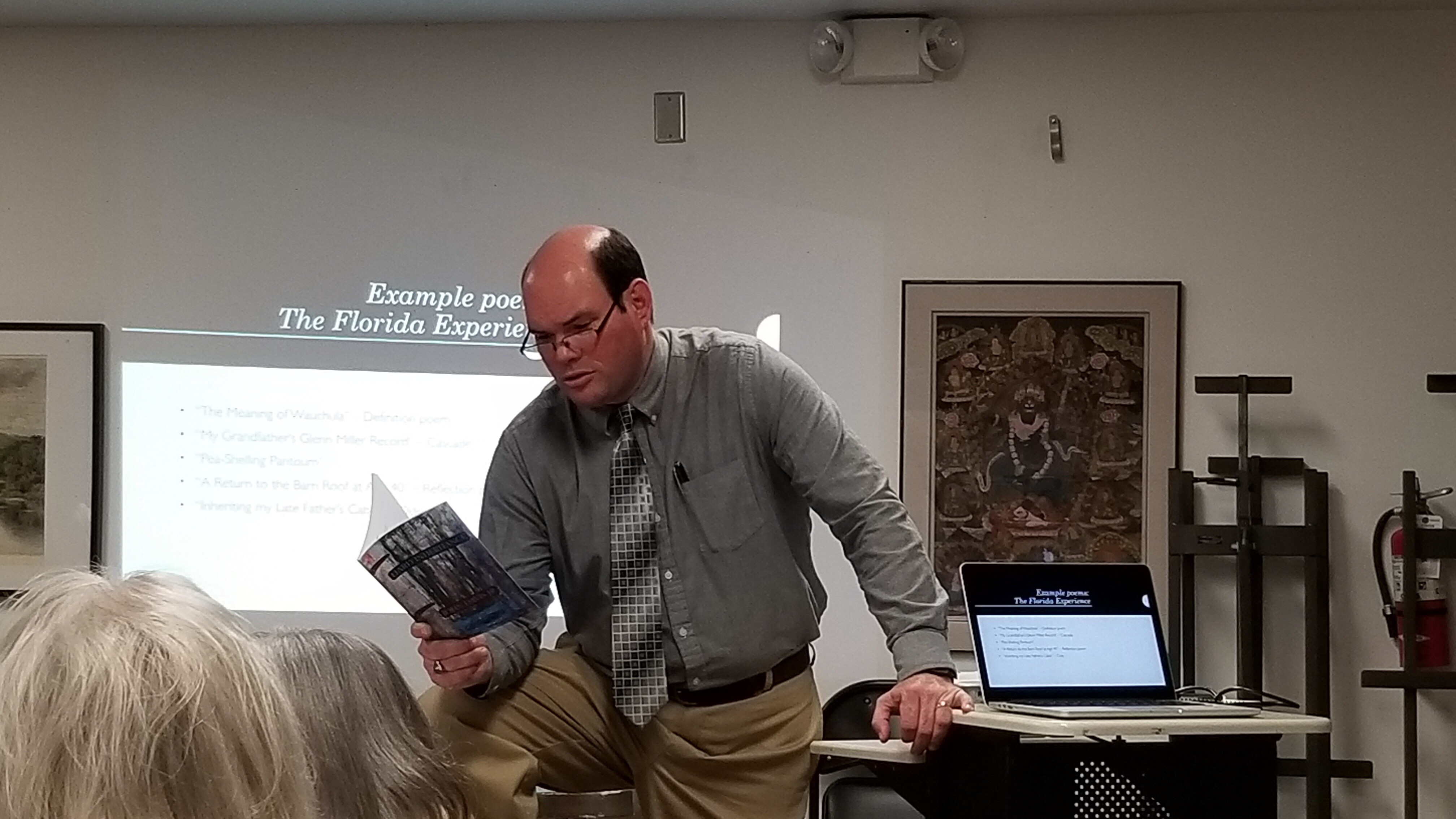
For about six months or so now, I’ve been volunteering for a local arts organization. I’ve provided workshops, seminars, and even the occasional reading. Here’s what I’ve learned: The most rewarding part of being a poet is passing on the joy of writing to others.
Sure, that sounds trite, but it’s true. And it’s not that I hadn’t grasped this notion previously. I mean, I’m a teacher after all. But here’s the thing — teaching adults who truly want to learn the craft is a world apart from teaching English courses for a paycheck.

I get to have a good time discussing poetry and how to make it, and newbies find out a few tricks and techniques that perhaps they hadn’t considered. My favorite is the generative workshop, where we use various prompts to craft the beginnings of new work. That silent hum of concentrated creativity fills the room, and you can tell that vivid things are happening in everyone’s mental theater. It’s almost (cliche warning) magical.

And while I love my day job and all it provides, for sheer joy of teaching, it’s hard to beat the volunteer space. No grades, no homework, just genuine fun with words. I’ve also noticed that giving back a little something to the craft that has meant so much to me restores my passion for the written word. Watching people grasp the potential of poems reminds me why I do this work, and believe me, it is work. But it’s a labor of love, certainly.

life, poetry, publishing, Uncategorized, writers, writing

Poetry Reading is On the Rise! Now What?

closeup photo of assorted title books
Photo by Suzy Hazelwood on Pexels.com

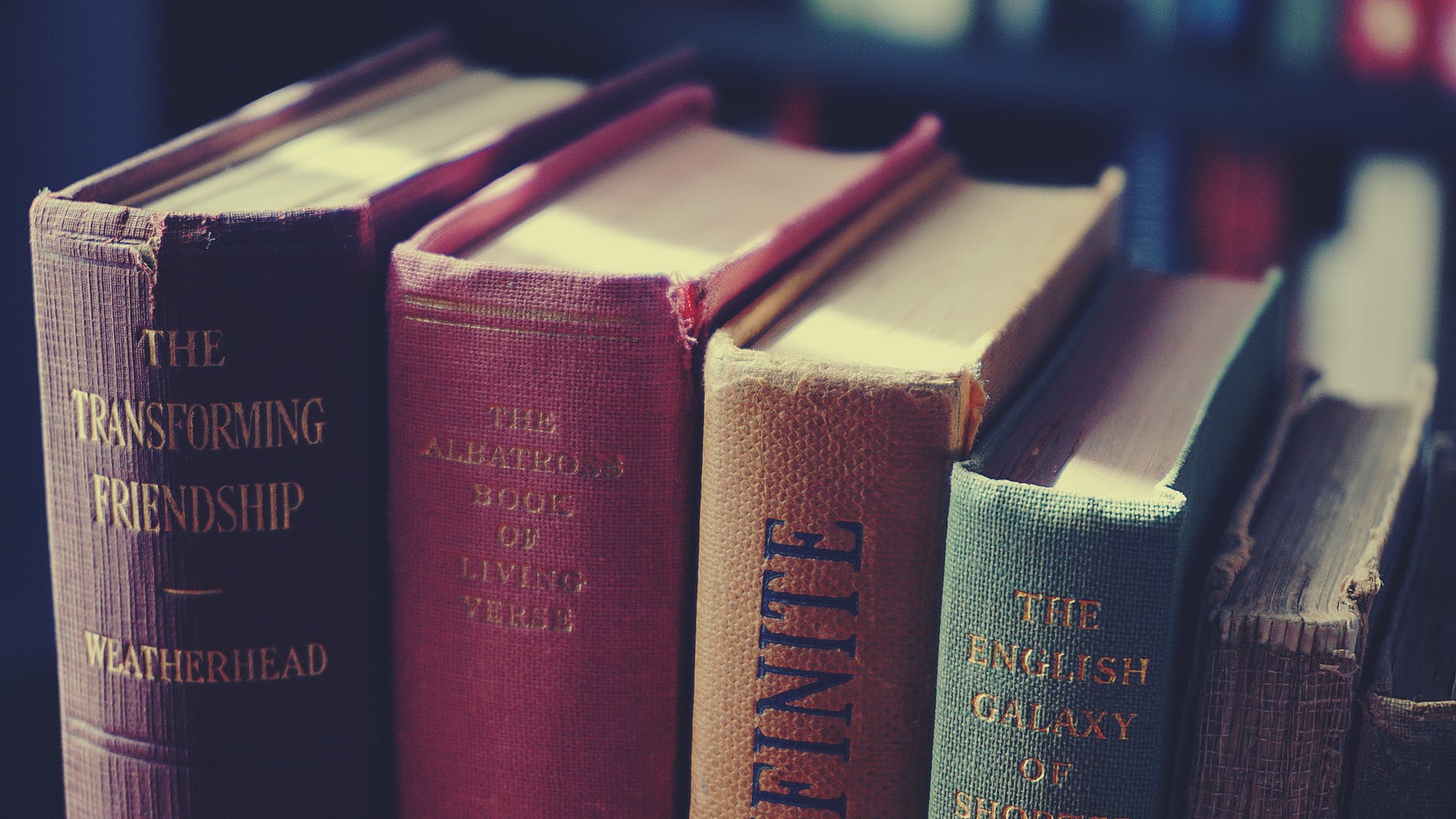
Recently, the literary world became aglow with news confirmed by The Poetry Foundation and the National Endowment for the Arts: Poetry reading has increased over the past several years, giving hopes to aspiring poets everywhere. The questions arising from this news are: 1.) Why are people reading more poetry? and 2.) How do we keep them reading it?

The politically motivated individual will point to the barbarities of our modern age to explain why people are seeking more poetry. Everything is so coarse, so divisive, so insensitive that people are looking into poetry with hopes of solace. They seek some escape from the hard cruelties of our culture’s climate, and think that by slipping into volumes by Mary Oliver or Billy Collins, they will rediscover Keatsian truth-beauty. Maybe they’re right.

But another political explanation goes something like this: People are seeking answers from thinkers, and poets are perceived as philosophers (which we are). Maybe poetry has a secret map laden with metaphors and imagery that can lead us out of whatever misery we may be facing. Historically, poets have been the voices that landmark history. And certainly, our current station in history is one that requires guideposts. Hostilities seep between the teeth of those doing the loudest talking, and some poems provide a quietly artful voice of reason. Other verses scream back irrationally at the megaphone-wielders. Whatever poetry’s response, people are seeking it, and that’s a good thing.

Are we compelled by this encouraging news to produce poems that are merely society-driven? I hope not. For as much value as the adamant political poem has, it often fails to observe the pastoral. Furthermore, the didactic diatribe concerns itself with messaging more than meaning. Clapping back is a limited response, and people will only stick around so long for a sign-waving rally, even if the signs are colorful and easily memorable. Once the adrenaline of activism wanes, everyday life must resume. And it is in the everyday that poetry must make itself seen as vital.

We (poets) must concern ourselves with what endures. Beyond the shouting, beyond the headlines, beyond the temporary controversies, we must strive for the persistent universals that have allowed writers to transcend their respective eras. We still read Shakespeare because we still love, still hate, still aspire, still ponder. We go back to Dickinson because we continue to wrestle with mortality. We return to poetry because we are still human beings, and our lives require assurance, pause, and depth.

I also suspect that people have wearied of hectic, frenetic instantaneity. Text messages, status updates, tweets, and likes are superficial, fleeting things, and even though they produce little bursts of dopamine, we can only tolerate that pleasure-cycle so long. We want something more than emojis and temporary images. It has taken a while, but people’s brains want to do some heavier lifting.

Are you ready to satisfy that craving, poet? Are you prepared to offer language that contributes in a permanent way — not just for the moment, but for eternity? It’s a tall order. With consideration, wonder, and vision, though, we can do it. We can cause people to regularly remember their humanity and continue celebrating it with the greatest of all literature — poems.

life, poetry, publishing, teaching, Uncategorized, writers, writing

Calling All Writers: HELP


cover-for-ad

Buy a book, save a life: Between now and Christmas, 100 percent of every sale of each of my books will go toward getting one of my poet-students and her mother out of the homeless shelter. You get good poems, and a family that desperately deserves a Merry Christmas is given a hand up. There are no losers here — If you don’t want to buy one of the books below, you may donate directly to the Save my Student from Homelessness fund:

https://www.gofundme.com/save-my-student-from-homelessness

If you would like to go the literary route and receive some poetry in exchange for your generosity, please consider purchasing any one of the books below (click the title):

Hard Inheritance

Middle Class American Proverb

The Boys of Men

Your purchase or donation is deeply appreciated. I can’t say enough good things about this student, and she and her mother are grateful for any help you can offer. Please join this effort to save a budding writer from the horrible conditions at the homeless shelter. THANK YOU!