poetry, Uncategorized

Lessons from Santa Fe

Now that some time has passed since my scholarship-funded trip to the Glen West Workshop, I feel that I can reflect on the experience with greater objectivity, and extract some of the bigger ideas from it. Held on the campus of St. John’s College in Santa Fe, New Mexico, the workshop included writers and artists from all walks of life, and from all over the world.
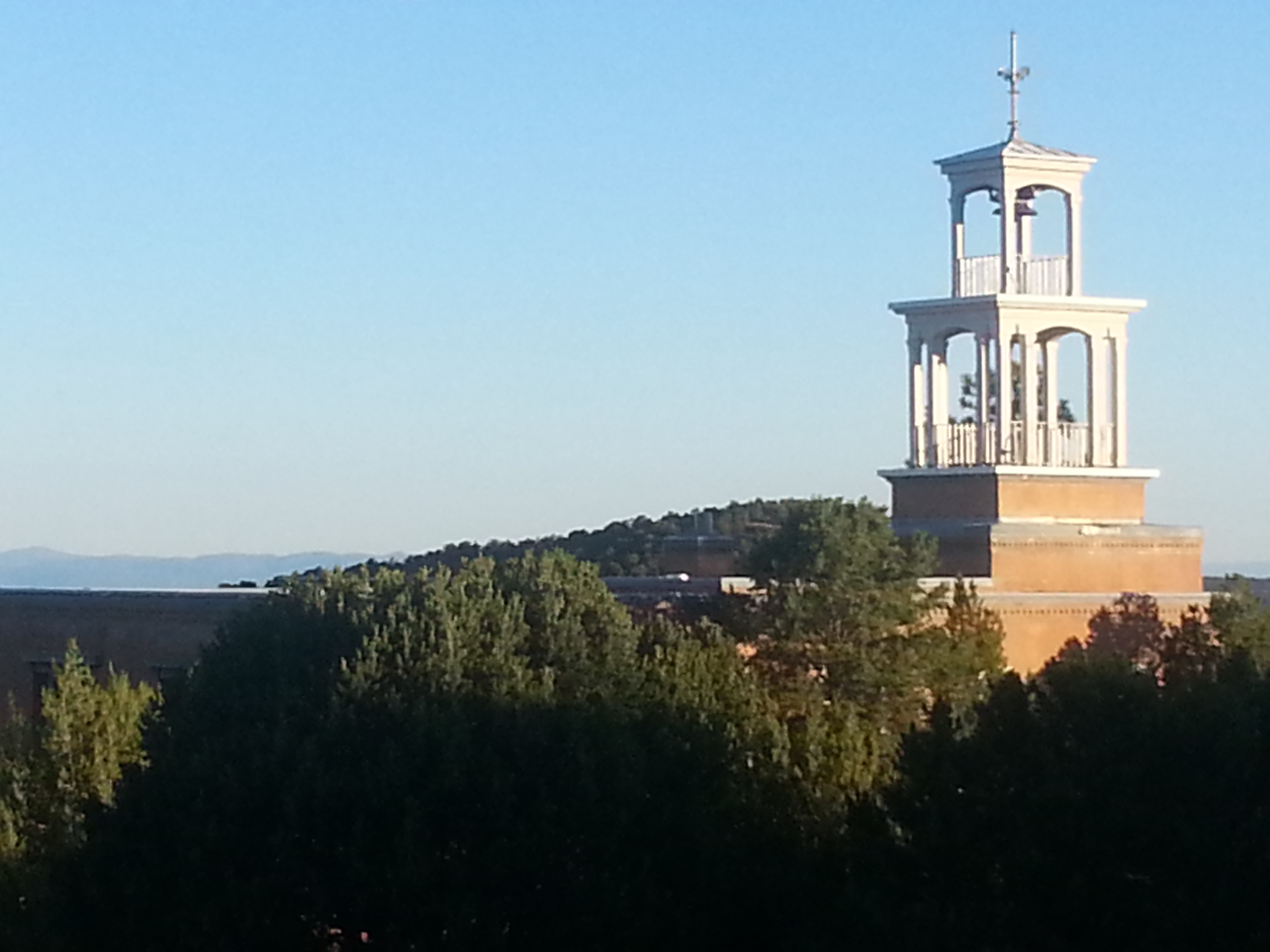
A shot from one of the sloping hills of St. John's College in Santa Fe.
A shot from one of the sloping hills of St. John’s College in Santa Fe.

The scenery was beautiful, the discussions and seminars were engaging, and the faith-based component made me take a much harder look at my own personal theology. Almost nightly, I found myself returning to scripture to examine my own beliefs in response to the claims of others beyond my denomination. What I found was this: The pastors and leaders I have known allow God’s Word to speak to them to inform their perspectives. Their hermeneutics and apologetics are without error when scrutinized from a logical, etymological, and spiritual standpoint. I became grateful for my solid foundation in the greatest of all literature.


Aside from the religious component of the workshop, however, the time spent working out my own poetry was invaluable. Critiques during workshop allowed me to hear from a community that represented a broad cross-section of society, from amateur dabblers, avid readers, and experts who are highly respected in their field. In addition, the artful environment of Santa Fe provided a much-needed break from the summertime doldrums I was previously facing. The art galleries, public displays of sculpture, and a fantastic rendering of C.S. Lewis’s The Screwtape Letters on stage at the Lensic Theatre allowed me the cognitive space I needed to regenerate creativity.

While the accommodations were sparse, the company, the climate, and the conversation made up for any lacking luxuries. I made a few new good friends who are very different from me, and by so doing, received bigger understandings and broader interpretations of life itself. I would recommend The Glen West Workshop to those seeking something different than the typical writing conference. Its effect on your mind and your soul will be worth it.


poetry, Uncategorized

Embracing the Shel Silverstein moment

Shel, looking especially Whitman-esque.

As a child, my mother and grandparents read a good mixture of genres to me. About once a week, usually on Fridays, my mom made a special effort to expose me to poetry. Sometimes it came from the Childcraft series, a collection of gilt-spined hardcover books that were like thin encyclopedias of primary knowledge. Sometimes, it was the inimitable Dr. Seuss, with his nonsensical rhymes and his worlds of whimsy and fantasy. And then, there were the nights before bed that I was privileged enough to be exposed to the great Shel Silverstein, an author whose work had been slammed by public school districts throughout the south because of Shel’s past career choices (artist for Playboy, among them) and his shocking use of words like “butt” and “pee.”

The thing I really liked about Shel’s work is that, often, it would start with a simple premise (having to do the dishes, preparing to clean one’s room, etc.) and by the end, the poem had morphed into something totally unusual and unexpected. I find my own poetry doing this more and more these days. A poem will start with something pretty standard, but by the end, an entire other world or scenario will have emerged on the page.

At first, I was troubled by this occurrence, thinking that structure and form demanded I stick to the original idea and pursue it to its most logical and rational conclusion. I should persist, in other words, to do justice to my work’s inspirations. After letting the “distracted” works rest, though, I came back to them with fresh perspective. It was then I recognized that, even though the poem had taken the road less traveled somewhere along the way, it still held merit. Revision would still be necessary, but the original form — weirdness and all — warranted its own continued existence. Not unlike Shel’s digressions into crazy landscapes, my own poetry is sometimes fueled by what my fiction friends would call “the not-knowing.”

No doubt the Beats would approve of this editorial decision, reiterating their “first thought, best thought” mantra. Not every poem has to show up for work in a starched oxford shirt and presidential-looking tie. Still, I can’t help feeling that words without boundaries are somehow lost. Frost’s misgivings about free verse resonate even today in the minds of poets everywhere, mine included. I feel that certain limits and strictures make poetry stronger, and poems without rules, even self-imposed ones, often fail the test of relevance. Call me a “new formalist” if you will. Many of my peers disagree, asserting the wildness of words renders a poetic experience that is exclusive and unique. Too often such justifications provide fodder for “artists” who want to assign depth to drivel, however. “It’s not that I can’t write; it’s that I find meaning in error and ugliness,” they’ll say, as if ignorance plus garishness equals enlightenment. Rubbish.

Giving in to occasional rabbit-trails along a poem’s path may be acceptable, even artful. But when diversion turns to disruption, it’s time to get out the old poets’ toolbox and get to work. Accepting moments of Seussian whimsy and Silversteinish play can make work more human, and add an element of fun to otherwise serious poetry. It remains up to the poet, however, to know when and where those moments are beneficial. For today, I think I’ll do a few re-writes and see what happens. Wish me luck, respected reader.


poetry, Uncategorized

Latest publication: The Wayfarer

What a beautiful journal! The free e-edition is very nice, but I would encourage my readers to purchase the print edition — it’s worth the price, and small presses can use all the support they can get in these times! Thank you to the editors of The Wayfarer, whose skills and sharp eyes made this edition a visual feast as well as a fulfilling reading experience.The Wayfarer magazine

poetry, Uncategorized

Lessons learned while editing

pencil_redRecently I’ve had the privilege of providing feedback to a budding poet whose work has been compiled into a chapbook. I see a lot of my own history in this poet’s words — as he has been exploring the tools of the trade, there’s the occasional overuse of alliteration (we both love the smart rhythm and happy repetition of consonant sounds), but there’s also this vibrant joy that comes with writing for writing’s sake.

This gentleman’s work has reminded me of my own roots as a fledgling poet. Before any fancy MFA programs, before any acceptance letters or awards, there I was — that beginner who scribbled out potent images and happily entangled words for the sake of seeing and hearing their interplay with one another. At some point along the writing journey, as I learned more of the “rules” and what to expect from diverse audiences and editors, somehow a little bit of that word-joy vanished. Writing poetry became about using literary devices and styles that others dictated were “the right way.” And while others’ perspectives are always helpful (even when they’re hurtful), at some point we as poets must step back from others’ voices and ask ourselves, “Is this really ME?” We would be wise to adhere to the admonition that Polonius gives to his son Laertes in Shakespeare’s Hamlet: “This above all else: to thine own self be true.”

That doesn’t mean that we shouldn’t consider others’ points or feedback; indeed, if we want to excel as writers, listening to credible responses will strengthen our work greatly. But when that advice begins to fly in the face of one’s own vision, then it’s time to gain some distance for the sake of clarity. In a few days, I will be headed over to Tampa for my summer MFA residency. While there, I will be engaged in workshops and seminars, many of which are intended for the critique and strengthening of my poems. As I listen to my peers and hear their thoughts (positive and negative) about my creations, I hope that I can keep that beginning-writer passion alive. When the bliss of writing is gone, nothing remains but sheer mechanics and accumulated letters. And when writing becomes the equivalent of intellectual ditch-digging, it’s time to stop.


poetry, Uncategorized

Pick Five: A Burnout Prevention Strategy

handfiveIt’s that magical time of the academic year when teachers and professors are thoroughly sick and tired of everything school-related, and unfortunately, that also sometimes includes students. I know, I know. Those in the pedagogical arts are supposed to be compassionate souls who never tire of their charges — that doesn’t stop us from being human, however. Every year about this same time, when I feel the negative vibes besetting me daily, I have a little routine that I choose to follow that also serves me well as a writer. I pick five.

Here’s what I mean: I teach juniors and seniors in high school. Among my juniors, I pick out five or so that I know I can and will make a meaningful difference to in the school year yet to come, when they are seniors. My seniors, of course, are graduating, so it becomes my priority to begin thinking ahead for the next go-round. Who among those 11th graders will I impact in a way that makes me their most unforgettable teacher? How will I reach them profoundly, leaving my impression on their future? By “picking five,” I find a reason to stick around for yet another year. Even if I’m only there for those selected few, I know I will have achieved a purpose that is greater than succumbing to my stress and shucking the whole thing in favor of real estate sales or marketing (not that there’s anything wrong with those professions; they’re just the first couple that sprang to mind).

For writers (and poets especially), this strategy requires a little tweaking: Pick five writing goals that you haven’t achieved (realistic ones), or choose five poetic forms that you haven’t yet mastered. I’m still trying to write a reasonably decent villanelle, for example. Don’t try to force words into those forms of course — that never works — but allow those forms to become subconscious targets. When inspiration next strikes, see if one or more of those forms might be fitting for the topic. For writers of other genres, maybe your “five” can be some new narrative devices or dialogue tricks that you haven’t tried out. In any event, identifying five goals can be beneficial for just about anybody.

So, as summer vacations await and beautiful weather beckons beyond your window, don’t quit your day job. Think of five reasons to do what you do best. Maybe those five things, whatever they happen to be, will keep you in the game a little longer and preserve your sanity.

poetry, Uncategorized

Hometown Fellowship — A guide to being inspired where you are

downtown1
A view of Central Avenue from my new short-term writing space.

Recently, I decided to invest in my writing using a different method. Plenty of my writer friends pay some high-priced writing retreat or conference a handsome sum for the sake of privacy and different surroundings. Still others win residencies at noted creative spaces like Yaddo or The Studios of Key West. My objective was to experience this same “getaway” mentality without the hassle of airlines, rental cars, or questionable bathrooms.

I decided, simply, to invest recent prize winnings of mine in a “loft.” Here in my city, we have lots of historic buildings downtown with inexpensive space for rent. My thought was, by providing myself with a different perspective on a usual place, my writing would be renewed. So far, the new view has generated one piece, and I’m hoping, of course, for more.

I also gave myself a deadline and a project: for three months, I will use this office space as a creative venue outside my usual lake-view “writing room.” During that time, my plan is to produce a chapbook-size accumulation of work inspired by this new locale. Notice, I did not say “at least 20 poems,” or “at least 30 pages,” or any other precise measurement. By leaving the project somewhat open-ended, I have allowed myself the luxury of defining my own parameters as time proceeds. After all, I’ve only paid for three months here, and using the space judiciously is imperative.

By giving ourselves, writers and artists, permission to invest in our passions, we are assuring at least some level of productivity. There is also a tradition to be observed here: plenty of poets, novelists, and creatives have similarly allowed themselves the liberty of “lofts” or “studios” over the centuries. The views from these spaces have produced some of our greatest masterpieces. If I can achieve even some small slice of that same motivation, my objective will be achieved.

In the meantime, I would ask my fellow right-brainers to consider something similar if they’re in a funk or need a breath of fresh air.  A small getaway can result in the greatest returns, I’ve found. Hopefully, my little experiment will pay several creative dividends as the months pass. Updates, as usual, will follow.

downtown2
A second view of Central Avenue from the new writing space.
poetry, Uncategorized

Epiphanies, part 4: The Epiphany While Reading

booksA while back, I decided I hadn’t read enough Marcel Proust. To better equip myself with his viewpoints and his genius, I began reading his work with serious, scholarly depth. My intent was not to generate my own writing, but to better understand his so that I would be able to utilize his philosophies in academic endeavors.

The pleasant surprise of this “new” reading material came when I stumbled across the phrase “…kaleidoscope of darkness.” Immediately my mind began to whirl and hum with the possibilities that this contradiction provided. I turned the phrase into a first line, and wrote an entire poem inspired by it. Then, I deleted the first line. I still owe a pretty debt to Proust for his inspiration, despite his words’ disappearance from my work.

Lots of poets have moments like these — they’re reading a happy piece of summertime fiction or an article unrelated to anything literary when one certain phrase or circumstance elicits the poetic response. Maybe a memory is stirred, or perhaps an idea is initiated because a unique turn of phrase strikes the creative core just so. Whatever it is that lights our imaginative fire, those epiphanies had while reading can prove to be some of the strongest, and produce work that is often the most rewarding. No doubt this effect is why generations of poets have told younger ones to read, read, read. The more exposure one has to others’ original diction, the greater the likelihood for inspiration becomes.

Hmmmm…I suddenly feel like I could know a little more about John Stuart Mill — signing off for a while, friends. Until next time, READ.

poetry, Uncategorized

The First Line Epiphany

shakes

Scholars might argue with me, but I would be willing to bet that an awful lot of William Shakespeare’s writing began when he had a sudden realization of a great first line.

We poets know how it is: You’re mowing your yard, taking out the trash, or doing some other mundane chore when suddenly WHAM-O — a great first line just sort of strikes like lightning. You write it down in your pocket notebook, and when you come back to it later, that first line serves as a catalyst for some much bigger piece.

Sometimes these first lines survive in the final draft, sometimes they don’t. No matter why those primary words strike us as they do, they almost always reap great rewards. Even if those initial ideas get culled, the work they produce tends to be refreshing, inspired, and original.

Sometimes the first lines occur because of weird word combinations; things like “nuclear neurology” or “concrete coffee” tickle our fancy. Other times, it may be a random statement from a stranger that rings with a certain poetic something.

One time, a student of mine informed me that “The ice cream trucks in our neighborhood only play Christmas carols.” While the exact iteration of his words didn’t survive in my later poem’s final draft, the concept of a summertime ice cream truck tooling about playing “Jingle Bells” was too irresistible to refuse. It became “Merry Summer,” a sonnet-like piece written from the perspective of a boy waiting to hear the warbled yuletide tunes of the dirty, somewhat questionable ice cream truck.

First line epiphanies are some of my favorites. There’s always such a bright hope and a brilliant promise that comes with an entire line coming into consciousness. When we have a start, we’re obliged to build toward an end. Think I’ll go mow the lawn and see what strikes…

poetry, Uncategorized

Epiphanies: A new blog entry series

brick All of us have them: Those ingenious revelations that visit us in a state of reverie, near-sleep, or near-awake. The problem comes for many of us when we decide to leverage our big revolutionary ideas in an approachable way for others. Epiphanies, elusive and sometimes seemingly divine, can be a source of pleasure or torture, depending on how we use them.

For the next several blog posts, I plan to highlight different types of epiphanies, and then present one way of leveraging them into applicable plans or products, especially from a writing standpoint. To begin, let’s look at one type of epiphany that regularly strikes the poetic mind: the analogy epiphany.

In this revelation, the poet or thinker is suddenly and shockingly aware of a similarity or relationship between two previously alien things. Usually, the two items in question are comprised of one concrete, tangible thing and one abstraction. For instance, when Robert Burns realized his love was a red, red rose, his writing documented that epiphany. Many may say that this thought lacked originality, as poets had been symbolizing love with roses for centuries. Often though, our own epiphanies are far from original as well. When we begin speaking in similes and metaphors about two previously disparate ideas, you can bet that an analogy epiphany is hard at work forming itself. Our “aha” moments need not escape us, however.

When the analogy epiphany strikes me, my first choice is to dissect the relationship between the two things using a plain, ordinary T-chart. You know the kind: Two columns created by one vertical line intersecting a shorter horizontal line toward the top. One topic goes on the left at the top, one topic goes on the right. From there, I’m able to list qualities, characteristics, and descriptors of the two things and see their similarities and differences with parallel acuity. Sure, this may seem elementary — a Venn Diagram or another instrument may work just as well for visual organization. But by having the two ideas side by side, I’m able to begin a larger process. About five or ten minutes into listing qualities, first lines begin to form inside my mind. I write these down. Maybe I’ll use them, maybe not. More often than not, refined versions of these first lines work their way into my poetry somehow.The two items often create a central metaphor around which the larger piece is built.

By examining relationships between tangentially connected things, the wheels and cogs of the mind begin to naturally create points of commonality that were previously unexplored. These connections are the creators of poetry, as well as products and plans in the business world. The more receptive we become to our analogy epiphanies, the better our world will be. Creators and connectors, keep your minds wide open. More epiphanies to follow.


poetry, Uncategorized

Insomnia: The writer’s best frenemy

Plenty has been written about writers and their lack of sleep. But since I’m awake anyway, I thought I might as well tackle the issue also.

Yes, being awake at 3 a.m. has its advantages — the house is quiet, and if I really need to get some writing or editing done, there is no quieter time. Everyone else is “a-snooze in their beds,” as Dr. Seuss would say, and meanwhile, my grey matter is churning and firing more thoughts than its daytime counterpart could ever conceive.

However, the price will come in the sunlit hours — my teaching will be less enthusiastic, or too much coffee will make me jittery/cranky/irascible/jumpy. I’ve heard all the remedies, from herbal supplements (melatonin once broke me out in a rash more severe than chicken pox) to yoga relaxation techniques. And there’s nothing more irritating than a hangover induced by over-the-counter sleep aids, by the way. The plain truth is, my mind wants to be up, and so my body follows.

Insomnia is a bit of a blessing curse — some of my best stuff gets written in the wee hours, and I guess there is an established literary tradition to be followed here. Poets across centuries have endured the same nightly conflict: get up and scrawl out what could be great revelation, or stay in bed, tossing and turning in the torture of some undocumented epiphany. Truthfully, it isn’t always some kind of great inspiration that rouses me. Some nights, it’s just “awakeness.” No pressing thoughts about pieces, deadlines or work-related matters; just the old thinker cycling thousands of disconnected, unrelated images through my mental cinema.

If I were to be perfectly forthright with myself, I suppose I allow insomnia to recur because it has its creative payoff. While other writers are snugly tucked in dreamland, here I am, cranking out poetry and prose. Sure, there are studies and advisory epistles that show how lack of sleep affects performance, thought clarity, and other aspects of life, but in the end, when I have a newly completed piece or an expertly edited work of my craft, I’m willing to endure a few yawns throughout the day. Time to go brew up a pot of the good stuff — have a good morning, friends.