poetry, Uncategorized

A Quick Thank-you and A Longer Thought

notebook2red To those of you who have eagerly taken advantage of my free book weekend offer, I offer my deep gratitude. Your acceptance of my work shows that you believe it has potential. For this vote of faith, I thank you. Other followers who have not yet seized the opportunity to get your free Kindle copy of Growing Moon, Growing Soil: please do so! I’d hate to tell my writer friends that I couldn’t even GIVE AWAY my poems…how embarrassing.

On a separate note, I’ve been reading a lot of advice lately from writers who encourage others  to “write about those things that you would never want to write about.” This near-cliche is usually followed by an admonition to confess fears, secrets, undisclosed parts of one’s past, etc. in the name of soul-cleansing and “honest art.”

Here’s where I disagree with these well-meaning pseudo-sages: Writing poetry is supposed to make the world a little better, a little more beautiful, or a little more meaningful. Some things simply don’t need exploration in poetry, however. Remember how, in junior high writing classes, they taught us to “consider our purpose and our audience?” That rule hasn’t changed. What audience is going to want to read about how you wouldn’t wear sandals to the beach because of toenail fungus? More broadly, why write about the baser matters of life when there’s so much beauty, so much history, so much grander inspiration to seize?

Maybe my gripe here comes from a biblical background: Philippians 4:8 comes regularly to my mind while writing. I use it as a test to see if my poetry bears relevance and worth. That verse reads,  “Finally, brothers and sisters, whatever is true, whatever is noble, whatever is right, whatever is pure, whatever is lovely, whatever is admirable–if anything is excellent or praiseworthy–think about such things.” I feel an obligation as a poet to produce work that causes people to contemplate life using these criteria. Mind you, this doesn’t mean that my poetry always is autobiographical or just about the “warm fuzzies.” But, if I can get people to think in a way that this verse speaks of, even if it’s using something made up (like Christ’s parables), I’ve done my job.

Often, contemporary poetry elicits thoughts that meet some of these qualifications, but certainly not all. Keats’s Grecian Urn aside, truth is not always beauty. I know that’s unpopular talk in our culture today, with Facebook and other social media serving as conduits of over-sharing and gross uber-transparency. Where, however, is the beauty in rape? In murder? In cannibalism? This series of questions beckons back to undergraduate courses in ethics and philosophy, but no matter what school of thought you follow, you must confess: Some factual things do not pass the test for beauty, even if “beauty” is subjective (or, to quote an old aphorism, “in the eye of the beholder.”) If beauty is a matter of perspective, then certainly some twisted minds will find reasons to admire all forms of ugliness. Still, “Truth is beauty, beauty, truth” might make good verse, but too many great minds, both in and out of the humanities, have discredited it over the centuries.

Likewise (on the reverse side of this same coin), something can be lovely without necessarily being pure — think about those intricate bacteria you viewed beneath a microscope during high school science labs. Beautiful? You bet. Pure? Not in the least. My theological friends will tear apart this argument, no doubt, noting that human or scientific truth, beauty, nobility, etc. are not the issues about which Paul was writing. His aims were higher than enlightening our temporary mortal existence. I get that, but his words make a pretty great checklist for poets to strive toward also. In fact, it wouldn’t hurt for artists of every genre to contemplate the audience effect achieved in Paul’s terms. Imagine the renaissance we could ignite if painters, sculptors, dancers, writers, photographers, and other creatives used Philippians 4:8 as their common assessment rubric. What bright, radiant, vibrant works could result!

I’ll step down off my soapbox now. Some things just need airing, and tonight, this little rant happened to be one of them. I hope, once again, I haven’t distanced too many of my fans or followers with this post. I would love to hear opposing or coinciding viewpoints in comments below, and PLEASE remember to take advantage of FREE BOOK WEEKEND (details below). Good night, dear readers.
poetry, Uncategorized

FREE poetry this weekend!

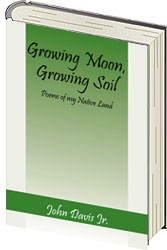
coverBlog followers and fans, THANK YOU. Because of your loyal support and great word-of-mouth promoting poetjohndavisjr.com, I am proud to announce that this weekend, my 2005 collection, Growing Moon, Growing Soil, will be available FREE on Kindle to those who would like a copy. The promotion begins on Friday and ends on Sunday, so grab a copy while you can! The site, at last count, has 257 followers, well above my initial hopes of 200. With your continued support and avid readership, my hope is to make this site into something that every artist, writer, and creative can enjoy. Plans for the future include video clips of readings, audio files of certain pieces, poetry prompts, and lots more.  Thank you again for your confidence; please see below for a link to the Kindle version of my book for your complimentary use:

Also, if any technical issues arise with the promotion, please provide feedback here. Happy reading!

poetry, Uncategorized

An honest offer

cover

This is just a quick post to say that poetjohndavisjr.com has almost reached 200 followers! If I can pass the 200 follower mark by Friday, I will offer all of my blog followers free Kindle copies of my first book. The second collection is currently under consideration and should find a home soon. For now, spread the word about my site, and you can get a free Kindle copy of Growing Moon, Growing Soil!

poetry, Uncategorized

Hometown Fellowship — A guide to being inspired where you are

downtown1
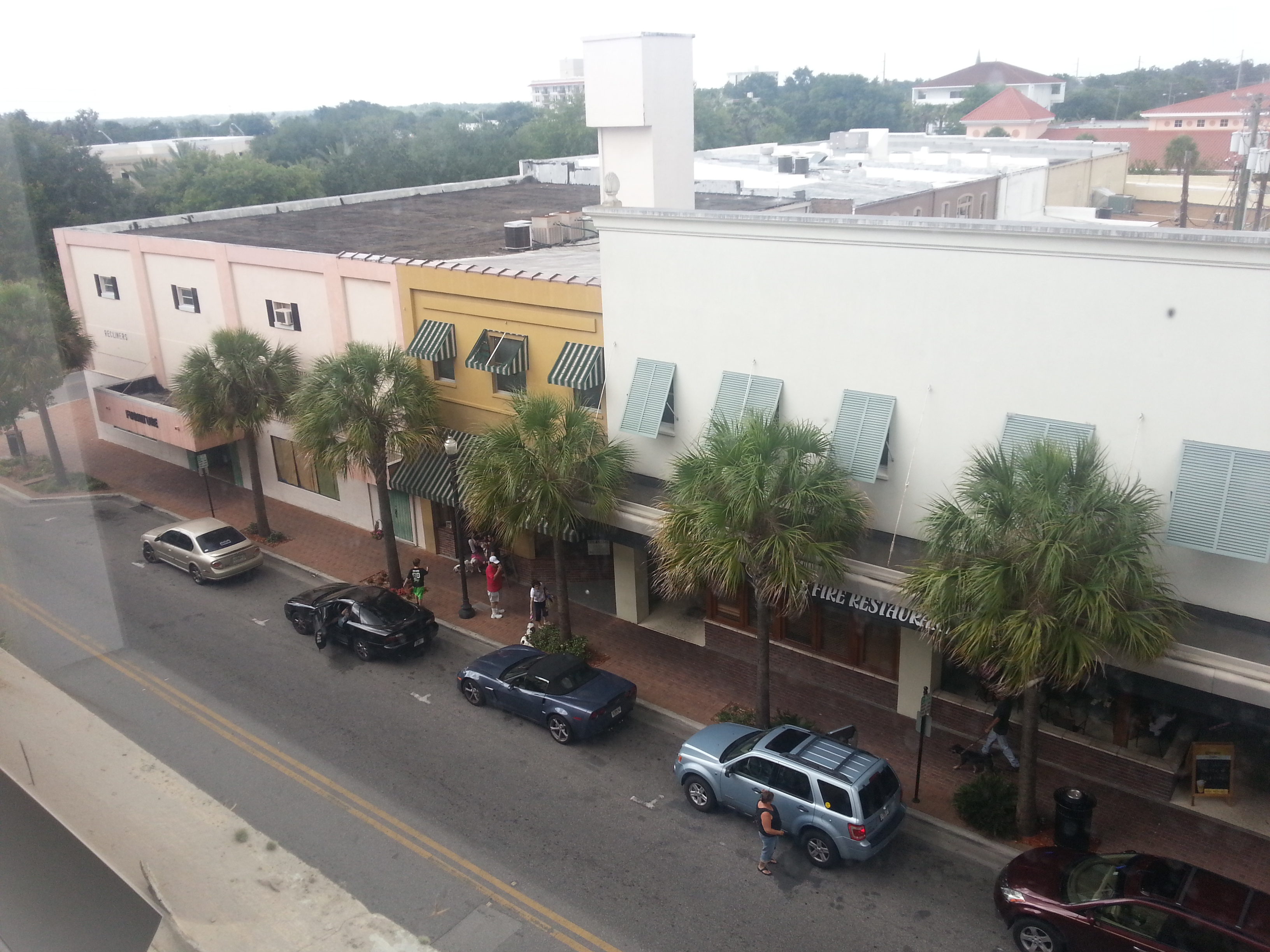
A view of Central Avenue from my new short-term writing space.

Recently, I decided to invest in my writing using a different method. Plenty of my writer friends pay some high-priced writing retreat or conference a handsome sum for the sake of privacy and different surroundings. Still others win residencies at noted creative spaces like Yaddo or The Studios of Key West. My objective was to experience this same “getaway” mentality without the hassle of airlines, rental cars, or questionable bathrooms.

I decided, simply, to invest recent prize winnings of mine in a “loft.” Here in my city, we have lots of historic buildings downtown with inexpensive space for rent. My thought was, by providing myself with a different perspective on a usual place, my writing would be renewed. So far, the new view has generated one piece, and I’m hoping, of course, for more.

I also gave myself a deadline and a project: for three months, I will use this office space as a creative venue outside my usual lake-view “writing room.” During that time, my plan is to produce a chapbook-size accumulation of work inspired by this new locale. Notice, I did not say “at least 20 poems,” or “at least 30 pages,” or any other precise measurement. By leaving the project somewhat open-ended, I have allowed myself the luxury of defining my own parameters as time proceeds. After all, I’ve only paid for three months here, and using the space judiciously is imperative.

By giving ourselves, writers and artists, permission to invest in our passions, we are assuring at least some level of productivity. There is also a tradition to be observed here: plenty of poets, novelists, and creatives have similarly allowed themselves the liberty of “lofts” or “studios” over the centuries. The views from these spaces have produced some of our greatest masterpieces. If I can achieve even some small slice of that same motivation, my objective will be achieved.

In the meantime, I would ask my fellow right-brainers to consider something similar if they’re in a funk or need a breath of fresh air.  A small getaway can result in the greatest returns, I’ve found. Hopefully, my little experiment will pay several creative dividends as the months pass. Updates, as usual, will follow.

downtown2
A second view of Central Avenue from the new writing space.
poetry, Uncategorized

Epiphany #5: The Emersonian Epiphany

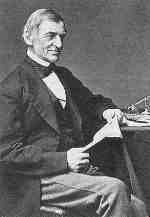
emerson You knew it had to show up sooner or later, reader. What better way to conclude a series on epiphanies than with the one thing that has inspired countless poets over centuries? Nature, when all else fails, returns us to our basest and most earnest humanity. In nature, we find a little of what has motivated all those poets who have come before us. Moreover, who can resist the mesmerizing wonder of a spider repairing a dew-dropped web, or a leaf reflecting with the orange of seasonal light? Nature, for certain, holds both scientific mysteries and spiritual inspiration, even for the most adamant cynic.

Why else would so many poets “go for a walk” when words fail them? Why is it that, when we wish to “escape” our civilized routines, we inevitably turn to remote greener locales as our getaway? Yes, the view in wilderness is different from our common existence, but there’s also a matter of instinct at work here: As living, breathing organisms, we have an inchoate desire to connect with the raw and unmodified elements of a more primal, unspoiled world. I know. Some of you are shaking your heads, yelling “Just give me my Ritz-Carlton, my Starbucks, my iPhone and my Land Rover!” That’s okay. Deny it all you want, metropolitan, but deep within you, beyond that glossy, technology-loving veneer, you too have a drive to connect with nature. We all do.

Poets, of course, have historically been more susceptible to this drive than others less sensitive. Every crackle of a branch, every rustle of a leaf, every soft flit in the brush is amplified to the artist, and so, nature becomes a sense-heightening experience. This fact drives the plethora of residencies, fellowships, and conferences held in splendorous locations amid mountains, forests, lakes, and canyons. Knowing full well that artists, and especially poets, cannot resist the draw of God’s inimitable creation, organizers and program developers often choose serene vistas for optimum imagination engagement. It just makes sense.

The writer’s versions of Daniel Boone and Davy Crockett, Ralph Waldo Emerson and Henry David Thoreau embodied the Naturalist aesthetic, and in so doing, fathered a movement followed even today. We can look at formalists, modernists, post-modernists, Language poets, or the broad spectrum of other “schools” that exist out there, but within each one, there is influence that stems from the natural world, no matter how slight. Some may justify this influence by stating the obvious: The world is all around us; of course it’s going to drive artistic work! True, but in a world dominated by steel, circuits, satellites, and fiber optics, why would we continue to devote our attentions to things less shiny, less electronic, or less progressive? You, reader, know why. Whether you believe evolution and adaptation are to credit, or whether you believe in a more supernatural cause, the truth is undeniable — nature is as much a part of us as our flesh, our blood, our very DNA. To get outside our limited perspective, we must literally and figuratively get outdoors.

As I draw this series to a close, I would ask my followers and readers to respond to one simple question: What is it that gives you revelation? How do you generate or receive epiphanies of your own? Your thoughts and comments, as always, are appreciated. And until next time, get outside!


poetry, Uncategorized

Epiphanies, part 4: The Epiphany While Reading

booksA while back, I decided I hadn’t read enough Marcel Proust. To better equip myself with his viewpoints and his genius, I began reading his work with serious, scholarly depth. My intent was not to generate my own writing, but to better understand his so that I would be able to utilize his philosophies in academic endeavors.

The pleasant surprise of this “new” reading material came when I stumbled across the phrase “…kaleidoscope of darkness.” Immediately my mind began to whirl and hum with the possibilities that this contradiction provided. I turned the phrase into a first line, and wrote an entire poem inspired by it. Then, I deleted the first line. I still owe a pretty debt to Proust for his inspiration, despite his words’ disappearance from my work.

Lots of poets have moments like these — they’re reading a happy piece of summertime fiction or an article unrelated to anything literary when one certain phrase or circumstance elicits the poetic response. Maybe a memory is stirred, or perhaps an idea is initiated because a unique turn of phrase strikes the creative core just so. Whatever it is that lights our imaginative fire, those epiphanies had while reading can prove to be some of the strongest, and produce work that is often the most rewarding. No doubt this effect is why generations of poets have told younger ones to read, read, read. The more exposure one has to others’ original diction, the greater the likelihood for inspiration becomes.

Hmmmm…I suddenly feel like I could know a little more about John Stuart Mill — signing off for a while, friends. Until next time, READ.

poetry, Uncategorized

Epiphanies, part 3: The Reflection Epiphany

1990, Central Park. Chorus class trip with Mr. Barlow.

Every decent writer has some key memories that, when recalled much later, prove to be fertile ground for literature. Whether it’s a childhood recollection, a happy vacation from adolescence, or even a school-related flashback (see photo), every memory holds the potent possibility for springing to life in new writing.

In this case, I never really considered the smaller details of that New York trip from decades ago. While there, we had to ride buses to various venues. Being the small-town boy that I was, I had no familiarity with tokens and procedures related to mass public transit. As a result, I held onto my bus token instead of depositing it rightfully.

While digging through my sock drawer recently, I found that old token, and a million memories of that trip came flooding back: Broadway musicals, FAO Schwarz, the Statue of Liberty, the Empire State Building, and so many other sights and sounds were generated by this one tiny piece of metal.

When I sat down to write about it all, however, I dismissed the tourist traps, the typical big-city experiences, and all the fluff of a trite “cultural shift” poem. Instead, I began to focus on the minutiae of that one moment, getting onto the bus without paying all those years ago:

NYC Apologia

Mr. Bus Driver, I didn’t know
where this metal disc was supposed to go
in 1990. I faked the deposit:
no token, just motion before taking
an inconspicuous seat beside classmates.

I know you don’t believe me.
Neither do I.

A bronze and silver guilt memento:
City of New York Transit System raised letters
round as a steaming manhole cover. This passage
pressed around an accusing bull’s eye – target
of my crime: petty theft by a small-town minor.


The piece in all its particulars, I believe, is far stronger than a “big picture” poem that tries to capture all the landmarks and sensations of a city too large to do justice in a single piece. Many years ago, Richard Hugo wrote a nice little guide to poetry entitled The Triggering Town. He encouraged poets to “adopt” a town they knew nothing about, approaching it as though they were someone who’d lived there for years rather than an outsider. This practice, he wrote, would allow a writer to generate new ideas and material. Indeed, it has worked for countless poets throughout history. New York was not my “triggering town.” But, its sensations, its differences, and its expectations from more than 20 years ago certainly gave rise to a piece that is unique. Only through artistic distance are we able to see some things for their truest significance. Like old farmhouse windows, the warps and waves in the lens of time give rise to pictures, that, while not totally accurate, make our human experiences more meaningful. The lesson for poets and writers everywhere? Look back to look forward.

poetry, Uncategorized

A Chat with Mildred Greear

Mildred Greear
Mildred Greear

Once in a great while, a poet has the chance to meet with someone who has “been there, done that” many times over. Such was the case over my recent spring break. My family and I had gone to north Georgia to visit my dad’s sheep farm and do the tourist routine. While there, my father suggested we visit with local writing legend Mildred Greear. I must admit, I was hesitant about the engagement. Stopping by the home of an 87-year-old woman wasn’t really on my itinerary amid mini-golfing, mountain climbing, and snowball fights, but I figured, what the heck — vacation means no real schedule, and who knew? It might turn out a piece of writing or two.

As it turned out, Mildred’s home wasn’t too far away from where we were staying; just “up the hill,” to be exact. My father and I arrived and were greeted at the door. Mildred offered to put on some coffee for us, but we had just gone by the Sweetwater Coffeehouse and were good to go, we replied. So we sat down at her big dining table and began to talk literature. Mildred was especially interested in my literary endeavors, and asked if I’d ever submitted to the Atlanta Review, in particular. I told her I’d sent them a few pieces many years ago (pre-undergrad, let alone MFA), and she encouraged me to submit again.

“The editor there,” she said, “always sends back the most personal responses. Even if he rejects your work, you can expect to get something from it.”

Then she began to speak of her work in the local schools: “I get the boys and girls to think about Emily Dickinson,” she explained. “We look at poems and ask three questions — What, so what, and then what. Every poem has to answer those three questions, and the boys and girls really like it.”

So far, I’d gotten pieces of valuable advice for both of my fields of expertise: writing and teaching. But she wasn’t done yet. The next lessons were the best of all, as they dealt with literary life in general. Like me, Mildred self-published some years ago, and was disconcerted by the work’s treatment by others in the poetry and book community.

“They’ll say, ‘it’s not a real book,'” she recalled, “but you and I know different. Our books are better than a lot of that stuff (traditional publishers) publish.” She looked over a poem of mine from my first volume, Growing Moon, Growing Soil: Poems of my Native Land, and gave it both praise and refinement. “These words — isolation and anticipation — they throw me off a little,” she stated candidly. “Everything else is so peaceful and beautiful, and these words are jarring, kind of out-of-place.” She made me wish I’d met her before I went to press with that first volume back in 2005. Even at 87, her editorial eye hadn’t faded a bit.

She spent a little time recalling her science professor husband Phillip, bragging on his groundbreaking work regarding walnuts and other topics. Her pride shone behind a great smile as she thought of walnut trees returning all over the nation, largely because of Phillip’s influence and experiments. Modern scientists use much of his research even today in modern laboratories, she bragged. Yellowed articles about Prof. Greear’s work were pinned to her wall nearby, lasting reminders of an academic life well-lived.

My father spoke with her a little about local politics and old friends, and Mildred had opinions on all, of course. Asked about legendary north Georgia poet Byron Herbert Reese, she recalled the day of his death: “He was supposed to come by here for dinner,” she remembered. “I’d made fried chicken and we had several people over. … The time passed, and he hadn’t shown up. I just suddenly had this feeling that he wasn’t going to make it. … Somehow I just knew. I had set the table, and I told (someone in the family), ‘you can take that plate off. He’s not coming tonight.’ A moment later, the phone rang, and we found out that (Byron Herbert Reese) had shot himself.”

The memory of that night still haunts Mildred Greear. A pair of boys, Reese’s pupils, had stopped by minutes before his death, and Byron was playing a sad song on the Victrola in his office, the story goes. He seemed very depressed, and the students attempted to cheer him up before heading out. As they proceeded down the hallway, they allegedly heard Reese’s fatal gunshot. The boys ran back to find their good professor dead. Mildred said she encountered one of the young men years later and asked him if he was one of the students who visited Reese that infamous evening. The gentleman she inquired of, now a full-fledged adult, said he was indeed. They consoled one another all over again, remembering Reese’s spirit and work.

Mildred, my dad and I talked a little longer, mostly small, innocuous chit-chat, and then she completed our visit with a hearty thank-you to both of us for stopping by. She wished me well, and implored me to keep in touch. She also asked for a copy of my book, which I’ll be sending soon. Mildred, like so many other elder writers, offered me a keen sense of what value can be added to a life by simply “sticking around.” Her history, her perspectives, and her sound sense of good writing made our visit not only an unexpected pleasure, but a real privilege as well. Thank you, Mildred.


poetry, Uncategorized

The First Line Epiphany

shakes

Scholars might argue with me, but I would be willing to bet that an awful lot of William Shakespeare’s writing began when he had a sudden realization of a great first line.

We poets know how it is: You’re mowing your yard, taking out the trash, or doing some other mundane chore when suddenly WHAM-O — a great first line just sort of strikes like lightning. You write it down in your pocket notebook, and when you come back to it later, that first line serves as a catalyst for some much bigger piece.

Sometimes these first lines survive in the final draft, sometimes they don’t. No matter why those primary words strike us as they do, they almost always reap great rewards. Even if those initial ideas get culled, the work they produce tends to be refreshing, inspired, and original.

Sometimes the first lines occur because of weird word combinations; things like “nuclear neurology” or “concrete coffee” tickle our fancy. Other times, it may be a random statement from a stranger that rings with a certain poetic something.

One time, a student of mine informed me that “The ice cream trucks in our neighborhood only play Christmas carols.” While the exact iteration of his words didn’t survive in my later poem’s final draft, the concept of a summertime ice cream truck tooling about playing “Jingle Bells” was too irresistible to refuse. It became “Merry Summer,” a sonnet-like piece written from the perspective of a boy waiting to hear the warbled yuletide tunes of the dirty, somewhat questionable ice cream truck.

First line epiphanies are some of my favorites. There’s always such a bright hope and a brilliant promise that comes with an entire line coming into consciousness. When we have a start, we’re obliged to build toward an end. Think I’ll go mow the lawn and see what strikes…

poetry, Uncategorized

Epiphanies: A new blog entry series

brick All of us have them: Those ingenious revelations that visit us in a state of reverie, near-sleep, or near-awake. The problem comes for many of us when we decide to leverage our big revolutionary ideas in an approachable way for others. Epiphanies, elusive and sometimes seemingly divine, can be a source of pleasure or torture, depending on how we use them.

For the next several blog posts, I plan to highlight different types of epiphanies, and then present one way of leveraging them into applicable plans or products, especially from a writing standpoint. To begin, let’s look at one type of epiphany that regularly strikes the poetic mind: the analogy epiphany.

In this revelation, the poet or thinker is suddenly and shockingly aware of a similarity or relationship between two previously alien things. Usually, the two items in question are comprised of one concrete, tangible thing and one abstraction. For instance, when Robert Burns realized his love was a red, red rose, his writing documented that epiphany. Many may say that this thought lacked originality, as poets had been symbolizing love with roses for centuries. Often though, our own epiphanies are far from original as well. When we begin speaking in similes and metaphors about two previously disparate ideas, you can bet that an analogy epiphany is hard at work forming itself. Our “aha” moments need not escape us, however.

When the analogy epiphany strikes me, my first choice is to dissect the relationship between the two things using a plain, ordinary T-chart. You know the kind: Two columns created by one vertical line intersecting a shorter horizontal line toward the top. One topic goes on the left at the top, one topic goes on the right. From there, I’m able to list qualities, characteristics, and descriptors of the two things and see their similarities and differences with parallel acuity. Sure, this may seem elementary — a Venn Diagram or another instrument may work just as well for visual organization. But by having the two ideas side by side, I’m able to begin a larger process. About five or ten minutes into listing qualities, first lines begin to form inside my mind. I write these down. Maybe I’ll use them, maybe not. More often than not, refined versions of these first lines work their way into my poetry somehow.The two items often create a central metaphor around which the larger piece is built.

By examining relationships between tangentially connected things, the wheels and cogs of the mind begin to naturally create points of commonality that were previously unexplored. These connections are the creators of poetry, as well as products and plans in the business world. The more receptive we become to our analogy epiphanies, the better our world will be. Creators and connectors, keep your minds wide open. More epiphanies to follow.