poetry, publishing, Uncategorized, writing

Big News for Followers!

My new book, Hard Inheritance, was just submitted to the publisher! I’m pleased to announce that this latest collection, 60 poems strong, will be available in 2017. Launches are being scheduled, and news of times and places will come soon. Also, I’ll be posting sales links and sites in the future for those who like to patronize both electronic and brick-and-mortar vendors.

For now, please take a look at my publisher’s other wares to get an idea the company my book will be among: http://www.five-oaks-press.com/our-titles/

I’m especially pleased to share Five Oaks Press publication with the likes of Julie Hensley (another Disquiet International Literary Program alum), and the inimitable Peter Murphy. I am also pleased to announce that this latest collection has blurbs from some of the best-known and most respected voices in poetry today. See below for a free preview:

The poems in Hard Inheritance are set firmly in the poet’s “ancestral terrain” of small-town Florida.  The landscape is lovingly but unsentimentally brought to the page, and it is peopled by the poet’s family, friends, neighbors, and fellow parishioners, with “the calm assurance of traveled/trails with familiar footholds.”  These truly are “songs sculpted by home’s hard structures.” 

~Andrew Hudgins, National Book Award Finalist and author of The Joker: A Memoir, American Rendering: New and Selected Poems and other critically acclaimed works


What is architecture, without its inhabitants? “In our heart pine handmade farm house, / my grandparents were window weights: // cast iron bars tethered in country wood, / plumb and place-holding pendulums.” What is a field, without the hands that tend it? In Hard Inheritance, John Davis Jr. recognizes the potent ecosystems of everyday life, as in “What the Grove Knows”: “Stirred soil lifts its secrets to the sky. / Revealed and overturned crickets / invite snowy egrets who eat them.” Readers will enjoy taking a joy ride on an untethered dock, hunting down poisonous white frogs, harvesting worms before a father and son’s angling expedition, and hand-nestling one newspaper section into another before the morning’s delivery. Yet these poems resist mere nostalgia; the author’s voice is attentive, conversational, and wise to how class shapes the landscape at hand. Given graceful and balanced stanzas, consonance of word choice, and the unexpected glimmer of a pantoum, I admire both Davis’s rigors of craft and vitality of spirit. 

~Sandra Beasley, author of I Was the Jukebox and Count the Waves


John Davis Jr.’s Hard Inheritance offers us a fine collection of well-built poems. Vivid images drawn from Florida’s flora and fauna, the pressures and rewards of family life, and work ranging from the orange grove to the printing press balance Davis Jr.’s heart-breaking restraint and precise diction. Heir in part to Seamus Heaney and to Claudia Emerson, Davis Jr. has made of his literary and literal ancestry a singular twenty-first century voice.

~John Hennessy, author of Coney Island Pilgrims, poetry editor of The Common

I’m eager to post a cover image here, so keep your eye peeled! Thank you all for your support of my continued work. Your readership makes it all possible!
 

life, poetry, publishing, teaching, Uncategorized

On starting small

Earlier this year, brilliant mathematician and Nobel Prize winner John Nash and his wife Alicia were killed in a car wreck. Nash’s work and life were the subject of the film A Beautiful Mind, directed by Ron Howard in the early 2000s. Like many moviegoers, I too was touched and inspired by Nash’s biography (even if it was “adapted” for film). His humble West Virginia origins, his battle with personal demons, and his eventual rise to academic and economic prominence spoke to audiences everywhere.

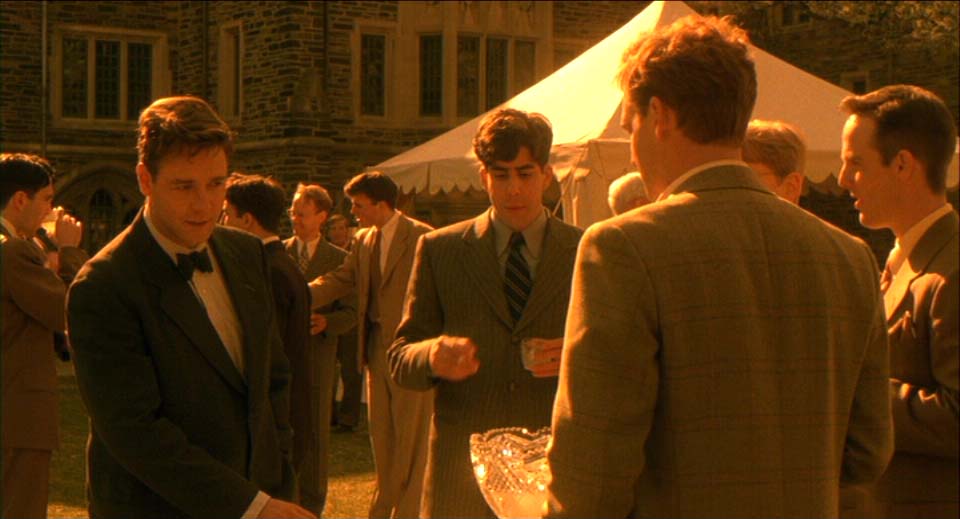
A Beautiful Mind scene, courtesy of Universal Pictures
Martin Hansen, played by Josh Lucas in the foreground, engages in some party snobbery toward John Nash (Russell Crowe), at left.

Recently, one scene from Howard’s movie replayed in my head as I encountered a situation similar to one faced by Nash early on in the film: Upon his arrival at Princeton after receiving a substantial scholarship, Nash is confronted by Martin Hansen during a reception. Hansen indicates that he “simply assumed [Nash was] the waiter,” due to his appearance. This barbed condescension is a hallmark of the early Nash-Hansen competitive relationship as portrayed in the film.

People from small towns or rural upbringings often face this kind of slight, even today. I grew up in a town of 3,500 people. Everyone knew everyone else, and the main vocation was agriculture. So, when I eventually moved to a city of 35,000 people (and growing), I felt as though I’d made my home in a more metropolitan area. Even though the culture here is still one of welcoming and warmth (see prior posts), my city has many markers of being a larger, slightly more urban place than many of Florida’s smaller map dots.

While I was serving as a guest lecturer at an area university some months ago, a student I met had the audacity to insinuate that small to mid-sized cities are undeserving of artists in residence or poets laureate. His contention was that only large cities and crowded urban areas should pay attention to literary and arts-related matters, because, after all, creative gifts can only thrive in such a vast and populous setting. There was more “talent” to choose from, he indicated, and more educated people inhabiting the big cities.

So, let me set the record straight, if only to repudiate this student’s erroneous assumptions. Many highly educated and erudite individuals choose to be country-dwellers, suburbanites, and big city expatriates (I’d supply a list, but it would be far too long). Their decision is made not because they desire to be “bigger fish in smaller ponds,” but because they desire a truer sense of community, a safe and clean place to raise a family, or maybe because they hold dear the virtues that modestly populated areas often embrace. In the end, there are several reasons to eschew the hustle and bustle of the sky-scraped city, especially if one is an artist. Certainly, there are benefits to larger metropolises, just as there are drawbacks. And yes, arts and culture do thrive there in most cases.

However, assuming ignorance or lack of refinement exists solely in smaller towns or mid-sized cities is the height of arrogant urban imperialism. I believe that Annie Dillard, Mark Twain, and John Nash would agree, for starters. And for me, smaller places yield bigger ideas. It is not by accident that Richard Hugo encouraged poets to seek out “triggering towns” that seemed to be more tight-knit communities.

I’m not attempting to prescribe small-town living to those accustomed to bigger cities, nor am I advocating one particular mode of residency. But I do know that, for my creative purposes, small and medium places work. Those who denigrate them, somewhat ironically, need only a broader mind.

life, poetry, writers, writing

In Praise of Being “Mainstream”

The Cast of


As a kid growing up in the 80s, my television family was the Seavers, not the Cleavers. Every boy my age wanted to be Kirk Cameron (Mike Seaver of Growing Pains), or maybe Michael J. Fox, who played Alex P. Keaton in Family Ties. Shows like these made it seem cool to be like those families and their kids, for certain.

In today’s literary community, aspiring toward a more traditional type of success has been replaced by a phobia about being “too mainstream.” I was reading an article just the other day by a respected author who lamented that her life was “becoming too mainstream,” which she defined by tasks like going to the grocery store, washing dishes, and tending to the relationships beneath her roof.

Sadly, being responsible and attempting to live a reasonable, self-sufficient life are both ideas that have been denigrated by various media in recent years. The notions that we should work ethically, raise a family, seek advancement in a single field, and aspire toward something greater than self-satisfaction are frowned upon by a vocal minority. There are those, after all, who believe such ideas to be too old-fashioned, too whitebread, or too puritanical for the twenty-first century.

But this isn’t a political post. I’m here to defend the value of the mainstream in our literature, specifically. There is beauty in the common, after all, and while socio-cultural activists may be trying their hardest to redefine what constitutes “the norm,” Joe and Jane Average still know that their lives — complete with light bills, plumbing repairs, and runny noses — have wonder, merit, and poetry in their seemingly mundane routines. Eschewing the everyday limits the scope and reach of our literature.

What’s more, by omitting mainstream details, artists portray a fallacious picture of what our world is really like: Rather than giving readers honest visions of life, many are seeking shock value, or perhaps some abstract, inauthentic version of their environment. In the end, both of these motives generate lies — creative, occasionally beautiful lies, perhaps, but lies nonetheless. While I’m no Realist (artistically speaking), I also don’t believe that writers should fear the mainstream. Give us the sidewalk cracks, the wasps and overdue notices in the mailbox, the wiffle ball stuck in the backyard oak tree. There is poetry in all these things, and there is life.

Being mainstream, by the way, isn’t all that bad, you’ll find. Parenthood and the obligations of marriage, career, and family life remain sources of great inspiration, just as they did in prior generations. Maybe it’s not new, it’s not avant-garde, and it’s not the “artist thing to do.” But I’ll take it any day over the exotic or the crazy. To be clear, I’m not saying “mainstreaming” is for everyone. However, I am saying that in going about the business of writing, we as authors should not be scared of that which seems standard. For it is the run-of-the-mill that yields the exceptional, the original, and the special. And that, writers, is what we’re after — the diamond in the rough, the pearl inside the oyster, and the rainbow out of the gray. Without the ordinary, there can be no extraordinary.

poetry, publishing, writers, writing

On the Color of Names

Asian-sounding Pen Name Gets White Guy in Trouble

So, I read the story linked to above from the Washington Post. Here’s my two cents, for what it’s worth:

As a plainly named, semi-average white guy, I too have considered using a name that sounds “less Caucasian.” In today’s literary marketplace, it sometimes feels like people with humdrum, plain-Jane names get overshadowed by those without them, no matter what the ethnicity, gender, or background in question may be.

“Oh, to be a Li-Young Lee, a Marina Tsvetaeva, or a Yusef Komunyakaa!” say the Joe Smiths of the writing world. Of course, poets’ names are not their strength (although the aforementioned ones, especially, are impressive and beautiful sounding). It is the authors’ fine work that has earned them their spot in the literary marketplace. Their awards are many, and rightfully so. It is not a matter of name alliteration, length, or origin that has raised them to prominence; it is the quality of their writing, and a strong history of artistic contribution.

Statistics from a number of sources show us that writers from historically underrepresented communities still struggle to get their work in front of readers, and the good folks at Vida: Women in Literary Arts have demonstrated the imbalance between published male writers and their female counterparts. Nonetheless, when one opens a copy of Poets and Writers, AWP Chronicle, and other trade pubs that scribblers like me regularly receive, the most highly publicized writers can seem to be comprised of those with extraordinary and uniquely identifiable names, no matter what their color or creed.

Consider if you will the glossy back cover of the September 2015 issue of The Writer’s Chronicle: There, in a full-color ad for Grand Valley State University’s Poetry Night 2015, are Kwame Dawes and Aimee Nezhukumatathil. I wish I could be at the advertised event, not because I want an excuse to form such lovely names more often, but because these are exceptional writers. Inside the back cover, a full-page ad for the Sanibel Island Writers Conference (another event I wish I could attend this year) proclaims the presence of Edwidge Danticat, another brand-name poet whose work is as striking as her name, if not moreso. A quick flip through the magazine reveals Nikki Giovanni, Ravi Shankar, Minal Hajratwala, Luisa Igloria, and Natasha Trethewey, among other names like poems.

Admittedly, my name has sometimes raised an editor’s eyebrow or two because “John Davis Jr.” could belong to someone of any number of races. Sure, it’s a white guy’s name, but it could belong to someone of African-American descent, Native American descent, or any one of many other races, I’ve found. A quick run of my name through Google reveals a rainbow of people from all walks of life. Some are realtors, some are doctors, and one even ran for president in 2012. I’ve had editors presume I was African-American because my name reminded them of another famous “Davis Jr.” — Sammy Davis Jr. No joke. I didn’t mind the confusion, nor did I take offense. But then, I’m a member of this country’s majority. My people are not disenfranchised, nor have they faced excessive hurdles in society. And maybe that’s why Michael Derrick Hudson’s decision irks me.

It irks me for the same reasons that dialect-discrimination irks me, actually. I’ve had plenty of people assume over the years (based upon my size, appearance, and Floridian accent) that I am ignorant. “Dumb Southerner” is the label some have attached without knowing my full story. They hear my use of the colloquial “y’all” and jump to their conclusions, which are, ultimately, dead wrong. Yes, my family has farmed for three generations (at least). But we’ve also been educators, doctors, lawyers, professors, and Air Force pilots, just to name a few other roles. I don’t appreciate others assuming we’re hillbillies any more than writers of Asian descent appreciate “Yi-Fen Chou.”

So what’ll it be, Mr. Hudson? You think your name sounds too Anglo-Saxon? Oh, gosh. Better fix that right up. You’ll never get published now. It’s not like Billy Collins, Ted Kooser, C.K. Williams, or — let’s go back a ways — Edgar Allan Poe, Robert Frost, or W.B. Yeats have had any luck. I can see your quandary, what with all the illogical repression of white male names and voices, It’s clearly a wonder that your work has managed to see the light of day.

But I get it. I really do. All those delicious-sounding syllables from diverse cultures are out there, just waiting to be exhaled. And they’re tempting. I know they are. That, however, doesn’t make them yours to appropriate. Might I be so bold as to suggest Mr. Hudson read an excellent essay by Henry Louis Gates Jr. entitled “What’s In a Name?” I assign it to my students regularly. When you read it, consider yourself Mr. Wilson, Michael. For in essence, you have called Asian and Asian-American writers everywhere “George.” And that’s not okay.

poetry, publishing, writers, writing

When should you blacklist a publisher?

magazinesI’m not usually one to post one negative thing after another, but recently, circumstances in my literary life have been causing me to offer a few “no-nos” to the general public. In today’s edition: How to know when you should never submit to a magazine/journal/publisher again.

Without naming names, I’ll tell you that I’ve recently scrawled a list of literary venues that I will never offer my work to again, and posted them to my bulletin board as a reminder. As a younger writer, I did this after a single rejection (or even two or three), which was hot-headed and foolish on my part. However, the places that I’ve listed and “sworn off” recently have committed editorial faux pas that I consider frankly unforgivable in the 21st century. And so, without further adieu (punny, yes?), here’s why I said goodbye and good riddance to a few literary outlets lately:

1. No response unless accepted. One journal is on my list because the editors cling to a policy that states, “We will communicate with you only in case of acceptance.” Hogwash. There is absolutely no reason that a magazine of any size should refuse sending a simple “no” to a waiting and hopeful writer. Their exclusive practice is rude, and rudeness doesn’t fly, even today.

2. Hostile, condescending, or insulting rejections. Another place is on my list because the editor could have sent a simple form rejection letter or a polite “This doesn’t fit our current needs,” but decided instead to engage in blatant snobbery and offer a few ad hominem cutting remarks. Where “no thanks” will suffice, subtle or obvious condescension has no place. Farewell, editorial ugliness. You have no home here.

3. Rampant inefficiency or gross incompetence. My third blacklisted venue accepted my work more than two years ago, and published it about a week ago. No, I haven’t mentioned them by name here or on social media. I thought the place had gone belly-up, honestly, as my attempts at communication were never returned, and I had already submitted the pieces they accepted to other venues. This could have created a major legal snafu, among other issues. Also, my author’s bio was grossly outdated in this publication due to lax oversight and poor management. Never again, (name withheld) Review. Yes, I know publishing is tough and time-consuming, but not to the extent that it should cause literary malpractice.

4. Emotional/personal affairs affecting editorial discernment. The final place to which I will no longer submit is operated by a novice publisher who sees every “no thank you” as a personal attack, or as an affront to the integrity of her/his operation. This same publisher overshares his/her personal problems when deadlines are missed or when quality is questionable. When the boss has problems, everybody has problems, much like the old adage “When momma ain’t happy, ain’t nobody happy.” I’ll steer clear, thanks.

So there you have them: my reasons for “blacklisting” certain publishers. Some of these may seem hasty or even unfair, but in every case, my personal experience has been such that I felt compelled to write them off. I would be interested to know why you, the reader, have stopped submitting to various places, as well. Feel free to posit your experiences in the comments section (please keep it clean and non-libelous). We’ve all been there. Keep writing!

poetry

Against Obviation of the Abstract

colorful-abstract-face-chris-bradleyIn just a few short weeks, I’ll be speaking to the graduating class of my alma mater’s MFA program. I’m supposed to be addressing “Life after the MFA,” a subject that I’ve become intimately familiar with over the last year and a half. In preparation for this talk, I’ve been looking over some of the notes I once took in MFA workshops, seminars, and synthesis sessions, and I’ve found that, while apart from the academic structure of the program, I’ve developed a discerning sensibility about some of the issues presented by professors in grad school.

One subject is that of using the abstract vs. using the concrete. Not one, not two, but three different professors in the MFA program at different times encouraged students to eschew abstraction in favor of concrete images. This is a good idea for beginning writers like the ones I teach, as their poetry is often littered with pathos in the form of notions like love, jealousy, rage, and abandonment.

But to lay down as a rule the idea that anything abstract or intangible must be omitted is incorrect, or at the very least, in need of refinement. The truth that I’ve found is this — using the abstract in poetry is much like using anything else in art: too much, and the work will become imbalanced; too little, and the work will lack relatability. This is especially true in the use of one of my favorite literary devices, the zeugma. For the unfamiliar, a zeugma is a combination of something concrete with something abstract in a line of poetry (or literature): “She spoiled her honor and her Sunday dress,” for example. Using too many zeugmas cheapens a poem and casts the image that the author must prevail upon parlor tricks to wow the audience rather than solid content.

But the right zeugma in the right place can make a piece sing. Just like similes, metaphors, oxymorons, and the whole array of other literary devices, the zeugma too carries its weight. And without abstraction, the zeugma is relegated to the status of a single image, a single item. Abstraction is necessary for this device and so many others to work.

“Everything in moderation,” the old saying goes, and in poetry as in life, this cliche actually holds true. Plenty of concrete imagery mixed with the right amount of abstract language can produce beauty, truth. Will I, like my former professors, prescribe my advice to near-graduates?  Probably not. I’ll probably discuss the pragmatics of literary life — the necessity of staying in touch with fellow writers and readers, the merits of continuing to submit work, and possibly the necessity of overcoming rejections.

As for using the abstract, my students and I will continue to ply the often-holistic, qualitative language in our everyday writings. Rather than removing a tool from the writer’s toolbox, we will use it as a carpenter uses a plane — the write tool for the right job at the right time.

poetry, Uncategorized

The Awards Game

Award_imageIt’s that time of year again: Editors and publishers are nominating works from their magazines and bookshelves for a broad range of laurels. Most notably at this time of year, writers receive word of Pushcart Prize nominations. As a younger writer, I used to get all tingly when those nominations arrived by email — kindly journal editors who liked my work sent it on to that mystical committee that views thousands of submissions every year from literary journals all over. I am still honored to have my work nominated for the Pushcart (as it was again this year), but in speaking with mentors and writer-friends of mine, I’ve come to understand something: Poets “worth their salt” are nominated for the Pushcart almost annually. Venerated veterans of poetry take such nominations for granted, apparently, even though those of us who are still “emerging” think them a big deal. So, I’ve learned to cool my jets a little. Once my work is actually included in the honorable Pushcart anthology, I’ll certainly add that detail to my author’s bio. But for now, I suppose I should join the ranks of my fellow authors who see nominations as a nice thought, a kind gesture, but ultimately, little more than a tip of the hat toward one’s work.

I’ve learned also that the awards one reads about in other writers’ portfolios aren’t always as glamorous as they seem (take note, young writers). Certain awards may open some doors, they may add something to one’s CV, but outside the literary community, they don’t amount to a hill of beans. Robert Frost was a fan of the old saw “Fine words butter no parsnips,” and I suppose in the world of literary awards, a similar thought exists — shiny trophies, parchment certificates, and faux-wood plaques don’t make you a writer any more than a fancy hat does.

Recently a publisher friend of mine let me know that my book has been nominated for a couple of other awards, as well. If I win, it will be a wonderful experience, and I’m trying hard not to get my hopes up too much prior to the announcements. These awards are entered by many of my most respected fellow writers and their publishers, as well. To even enter the field is an honor unto itself. The danger, of course, in winning awards is the temptation toward stasis — many a great writer, after earning the Pulitzer or the National Book Award, has lain down his pen. The award was an end rather than a milepost on the journey. Writers, as awards season enters full swing, the temptation is great to see pinnacles where only plateaus exist. Gilded honors are stations on the path, not summits to be conquered. Let us be grateful and humbled, but let’s not be complacent. There’s writing yet to do. Stick that award on the shelf or on your book cover, and let’s keep going.


poetry, Uncategorized

When did you become a “real” writer?

220px-Stipula_fountain_pen The question above isn’t new. Literary magazines and writing guides have been debating it forever, it seems, and the general consensus among writers groups, workshop participants, and seminar-givers is this: people gets to call themselves writers when each individual decides it’s time. What a horribly unspecific and wishy-washy answer. That being said, all I can provide is my own experience in an attempt to help elucidate some sort of solution to this continuing conundrum.

For some people, becoming a full-time writer gives them the license to wear the title. For others, attaining a degree in writing allows them to introduce themselves with the phrase “I’m a writer.” Many novices don’t consider bringing up their writing unless they’ve published extensively. So, let’s be clear — going full-time, earning educational laurels and publishing are all nice components to a writer’s personal history. Yet none of those (by itself or in concert with the other factors) will magically bestow the name of “writer” upon anyone. What, then, does it?

An oversimplified answer would be to say, “Well, writers write.” That unfortunate phrase has become a cliche (if not a trope) that writing magazines and workshop providers have been uttering like a forged instrument for too many years. We know writers write; hence the name. But if writing is our only criteria for calling someone a “writer,” we’re losing something along the way.

Allow me to provide an example: Last night, my six-year-old son received a new art table from the store. He drew pictures of rockets and dragons and all sorts of things, and then put some words under them. Some of the words were correctly spelled, others were more phonetic. Does he then qualify for what we would call a “writer?” I’d like to say yes, but by societal and cultural standards, I’m afraid that the answer is a resounding negative.

Stephen King is a writer. Billy Collins is a writer. Even Danielle Steele (yeesh) is a writer. Why? Because they have been advertised, marketed, promoted and published as writers, and therefore the public has dubbed them “authors.” Does that mean that our names must be up in lights or on the front of Barnes and Noble before we can lay claim to such a noteworthy nomination? Not exactly.

Here’s what did it for me: Yes, I earned an MFA. Yes, I’ve published three books now. And yes, I’ve seen my name in a pretty good number of literary magazines over the years (gratefully). But honestly, it wasn’t until I finished this most recent book that other people began calling me a writer, and I suppose the reality sank in at last. You see, my first book was self-published (fodder for another post entirely), and my second was a shorter volume (chapbook). This third book was published by a respected and professional publisher, and it has been better received than either of my previous two. It has been advertised in newspapers, online, and in magazines, and friends of mine from various lit journals have promoted it fiercely. I have not one but two different launch events planned. Many of these efforts were self-initiated, and mostly because I have greater respect for this book than I’ve had for my others. That’s not to say the others were bad; it’s just that this volume kicks their cumulative butts.

So I suppose you could say that this most recent book, Middle Class American Proverb, was the magic ingredient that finally allowed me to admit to myself that I’m more than a schoolteacher. Because I’ve given it the respect, the time, and the investment that it truly deserves, it has allowed me to finally say to others, “Yes, I’m a writer.”

The lesson here: When we give our endeavors serious treatment, we will then be treated seriously by others, and more importantly, by our selves.

poetry, Uncategorized

The Book Trailer: Just Say Yes

In contrast to my recent post about the triviality of “cover reveals,” this post deals with a technique that I and other authors find effective: The Book Trailer. Simple to produce, short enough to keep interest, and crazy affordable (you can’t beat FREE), the book trailer has a vast reach. Within the first hour of uploading the book trailer below, I had more than 100 views. I haven’t checked the stats today, but the trailer is probably one of the more popular marketing steps I’ve taken in preparing for the release of Middle Class American Proverb. The book has its own website, http://www.middleclassamericanproverb.com/, and its own Facebook page: https://www.facebook.com/middleclassamericanproverb?ref=bookmarks.

But none of these has received the attention that the book trailer did in such a short period. Maybe that’s my own fault — I could have pushed the website and the Facebook page harder, but at some point, marketing becomes annoyance. Anyway, without further ado, here’s the book trailer for my loyal blog followers:

poetry, Uncategorized

Launching the Chapbook

davis cover 1This Tuesday, I will launch my chapbook of poems entitled “The Boys of Men.” This volume, a collection of poems dealing with the topics of fatherhood and mentorship, is near and dear to me, as it was originally developed as a gift for my two sons. As the poems developed, though, I began to understand how this little assembly of verses might be useful to others beyond my family. The messages, after all, cross the boundaries of bloodlines.

Ideals of trust, loyalty, persistence, and courage are universal, after all, and these poems speak of all those and more. As a bigger book of poems waits for its release just around the corner, I want to take the time to celebrate this smaller milestone; this little get-together of poems that future generations can look to for fond reflection, family connection, and perhaps even a moment or two of guidance. My purpose in publishing this book was never to get rich — rather, I wanted those close to me to have a keepsake, something intimate and direct. In this volume, I feel that’s accomplished.

For those wishing to buy a copy, here’s the Amazon address: http://www.amazon.com/Boys-Men-John-Davis-Jr/dp/0692276874/ref=sr_1_1?s=books&ie=UTF8&qid=1411822481&sr=1-1&keywords=The+Boys+of+Men+by+John+Davis+Jr.

I hope that you gain as much from reading this as I gained from writing it. Your purchase is appreciated, and your attention to my work is always, always valued. Thank you.