poetry, Uncategorized

The Culture of Complaint: Image Killer

oldpersoncomplainingIf you read this blog with regularity, you know I recently returned from Amherst, Massachusetts, where I attended a writing conference and explored literary landmarks around New England. I am also a student of municipalities that encourage and invite tourism, however, and Amherst, despite being small and comparatively out of the way, was doing a number of things to make their town tourist-friendly to folks like me:

1.) The public library celebrates renowned local authors and artists. In fact, the whole third floor of Jones Library is devoted to historical artifacts and volumes regarding Emily Dickinson and Robert Frost. Also, local landmarks have significance to the artistic and literary history of Amherst.

2.) The area’s history is celebrated with events, as well, and there appears to be good community involvement which has been stimulated through the use of various media.

3.) Churches and civic groups are partners in the arts.

4.) Colleges in Amherst offer their space as venues for arts-related and literary events, even if the organizers are unrelated to the colleges.

I was favorably impressed by all these details, and thought I would bring them back to my city as suggestions for implementation. After all, Winter Haven is a city on the grow, and with a renewed focus on the arts and tourism, all of these Amherst traits seemed worthy of emulation.

Why, then, don’t I plan to return to Amherst anytime soon? The answer lies in people. Everywhere I went, from the Stop N Shop and Big Y grocery stores to the corner diner, people were complaining. Conversation in the diner was dominated by older men bemoaning a new red light that had been installed. Younger women in the grocery store aisles were whining about their toddlers’ behaviors. Cashiers never smiled, and transacted business without pleasantries. It seemed to me, an outsider, like Amherst was a miserable place to be a local. I stopped in at Friendly’s, New England’s version of Steak N Shake, and nobody, not even the servers, made the restaurant live up to its name. Maybe the city was just having a bad week, but it was enough to sour my perception as a visitor.

Granted, I’m a little spoiled on hospitality. Here in my part of the country, “service with a smile” isn’t just a catchphrase, it’s an overall attitude. Some days, that smile might be forced, but there never seems to be a time when merchants aren’t glad to see you. Publix serves as a national example of what grocery stores should emulate, mostly because of their kind and responsive customer service. Likewise, local chatter at our diners and coffee shops usually consists of a healthy mixture of politics, business, family life, and current events — and most of the time, those conversations, even contentious ones, are cordial.

There are those who would accuse my people of being disingenuous. They might claim that we hide our anger, frustration, or dismay behind stereotypical southern “sunnyness.” But the truth is, no matter how bad the world might be, whether a new red light, an unruly child, or a hard day at work has flustered us, most of us can still muster up kindness for others. It’s what people here do, and it’s one reason why I stay.

The great irony of this post, perhaps, is that it falls into the category of “complaining about complaining.” I get that. But perhaps this post is also demonstrative of attitude infectiousness: pessimism yields more pessimism, yes, but the opposite is also true. Come to Winter Haven sometime and find out for yourself. I’m off to Richard’s Fine Coffees.

poetry, Uncategorized

Of Robert, Emily, and Thoughts of Legacy

Emily1
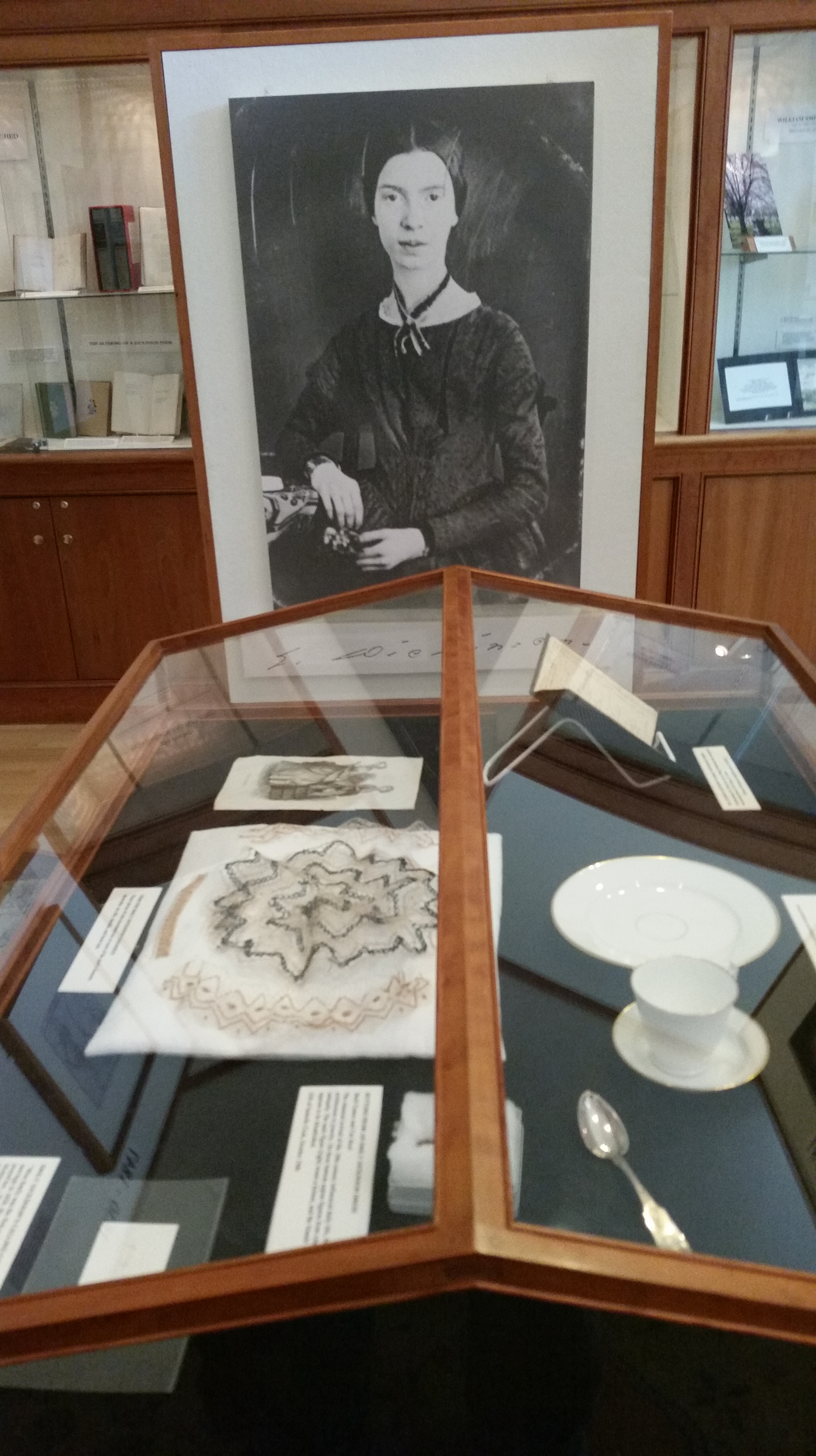
Emily Dickinson’s portrait in the Dickinson/Frost collection of Jones Library, Amherst, Mass.

Recently, I attended the Juniper Writing Institute at University of Massachusetts in Amherst. For the unaware, Amherst is the hometown of one of the canon’s most memorable and memorized poets, Emily Dickinson. Also nearby, one can find the farm of another great American poet, Robert Frost, considered by many to be the landmark poet of the 20th century. Both of these poets have meant a great deal to me as a writer throughout my career, and being in their part of the world was an unforgettable experience.

But my own independent studies of both Frost and Dickinson raised a new question for me — one that awoke me at 3:30 a.m. the first night of the conference. So distracted was I from this recurring question that I arose from my semi-peaceful travel slumber to write by hand in my journal. Here, in its unedited version, is the transcript of my late-night, early-morning writing:


6/21/15, 3:30 a.m.

I am awake because Emily Dickinson will not leave my mind. Having visited her house yesterday, I keep seeing her small corner bedroom over and over: its little sleigh bed, its dresser, its white-knobbed doors.

The Dickinson House in downtown Amherst.

Most of all, though, I think of all its windows. The tour guide kept using phrases like “extraordinary fenestration,” and she did not exaggerate. The natural light in Emily’s room was almost church-like. White and spiritual, it seemed to give life to the broad, thick beams of hardwood flooring there. As old as everything was, the light carried no dust. The air in her quarters was as pristine as the white housecoat she sewed for herself. On that air was the scent of history, a rare mixture of old wood, natural fibers, and unstirred earth.

I glimpsed the Amherst world from her window. Her tiny desk was positioned before it, and for a second, I could visualize her sitting, penning lines of legacy. Some of these lines also awoke me today, mostly her first lines:

Hope is the thing with feathers

I dwell in possibility

My teacher-mind sets to work on these, and I envision exercises for my students:

(Abstraction) is the thing with (concrete object)

What idea or notion do you “dwell in,” and why?

EmilyCollection
A collection of Emily’s things at the Jones Library in Amherst.

 The second of these questions applies to me as well, for once again I find myself too fixated on the idea of leaving my mark as an artist. I dream of a time when others tour my family’s farm or my smaller lake-view house in the city to see where and why and how I worked. Even at this mature age, my boyish whims of literary celebrity return, thanks in part to Emily Dickinson. My pragmatism intervenes, though, and tells me I need to sleep before daylight arrives. [End Journal Entry]

So, I was at my most honest in the middle of the night. But my thoughts of leaving a literary trail for others to follow would not stop with Emily. No, not when the home and writing space of one of my all-time literary heroes was nearby.

Upon my visit to the Frost Farm in Derry, New Hampshire, I was privileged to see his barn, his house (both floors!) and the land surrounding. I stood where the great man stood, walked where he walked, and even trod the staircase his wife descended, prompting the poem “Home Burial.” All these experiences once again raised the concern of posthumous impact.

Would people want to similarly experience the spaces where I have created? Will my own work ever merit that kind of attention, before or after my death? The literary marketplace is full of Frost-wannabes and Dickinson-aspirants, and who am I to even ponder such weighty matters? How does proving oneself a “fanboy” of literature make one any more likely to succeed at literary and scholarly endeavors? And thusly, I tortured myself further.

I visited the Robert Frost Library. I spent hours perusing the Frost-Dickinson collection in the Jones Library of Amherst. I allowed my imagination to run wild with scenarios concocted only from the notion of greatnesses recognized. And once again, I found myself twisting my brain into the same enigma that it has puzzled over like a Rubik’s Cube countless times before: Will I matter? Will my work matter? How do I ensure both? What steps must I next take to be certain that I’m not forgotten, like so many writers of the past?

EmilySign
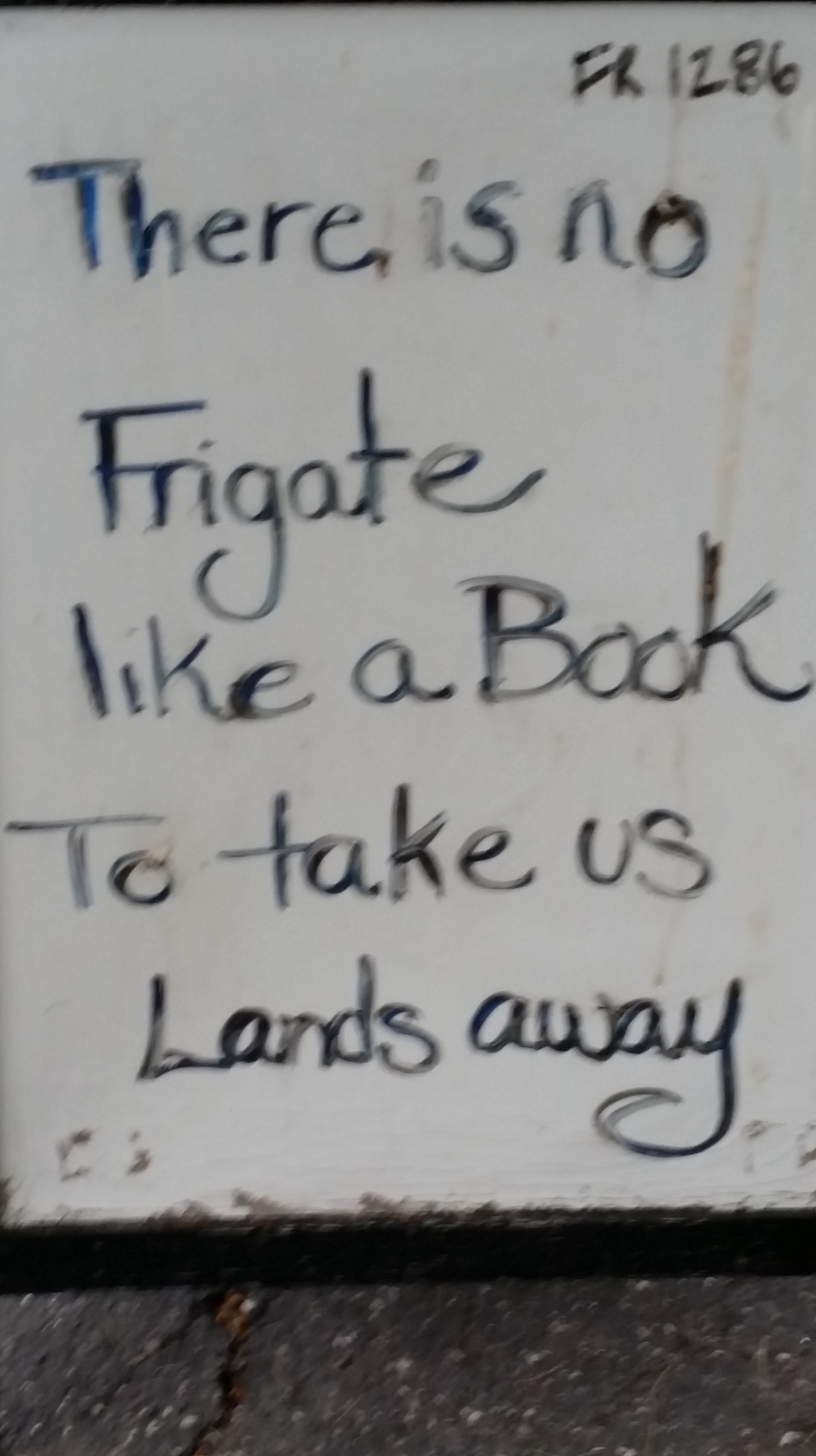
A sign on the grounds of the Dickinson House in Amherst. This passage is directly from Emily’s poetry.
FrostBust
A bust of the great man himself inside the Dickinson/Frost collection at Jones Library.

I had hoped by now, at my nearly 40 years of age, that such concerns would really be a thing of the past. After all, I continue to write, and I’m sure that one day I’ll see some wider recognition than my meager efforts have so far produced. Like all writers, I’d like a Pulitzer and maybe some other big awards (see prior posts), but honestly, at the end of the day, what I’m really aiming to do is preserve people, times, and places that have mattered to me the most. If my poetry results in just a few people gaining a broader appreciation of the heritage, values, and experiences I’ve received in this life, then I’ve won. And I don’t mean that all of my poems are totally autobiographical — certainly many are not. But all of them lend themselves toward ideas, visions, and perspectives that, however universal, have arisen somehow from the life I’ve lived.

Will people care about that life? Why should they? Will students sit through laborious documentaries about the different periods in my writing timeline? Will my work be anthologized in textbooks of the future? Such inquiries can drive one mad, if left unchecked. Spending countless hours in the homes of the greats might not make me a better writer, but it did accomplish one thing — it allowed me to see a shared humanity, a common thread of inspiration, motivation, and dedication.

Persistence, diligence, and  enormous creativity are shared traits among those we celebrate today, so long after their earthly departures. And perhaps it is these traits that we should take away from memorials and museums commemorating their contributions. More than the vanity of asking, “How can I attain their level of distinction?”, perhaps we (I) should be asking, “What can I do continuously and creatively well to positively affect my world?” Such a question surpasses the superficial desire for remembrance, and enters us into a more philosophical, even theological, realm. May our answers lead us not to fame, not to fortune, and not to solipsism. Rather, may they lead us to be better human beings, produce finer work, and seize the opportunities of the everyday.

Frost's Desk
Robert Frost’s writing space at Frost Farm in Derry, N.H.
FrostStatue
A statue of Frost just outside the Robert Frost Library at Amherst College.


poetry, Uncategorized

Upon Returning to Caffeine

This morning, for the first time in a year, I had my first cup of real, honest-to-God coffee. You see, last summer I had an encounter with caffeine that totally reformed my whole perception of it: While on a writing binge, I consumed three large cups of coffee one after the other after the other. Something then happened that had never happened before — my heart rate shot through the roof (like say, 130 bpm), my blood pressure spiked to a dangerously high number, and I thought I was going to die. Yes, really. I even wound up going to the hospital to get checked out, having never encountered anything like that before. Once the effects of the caffeine subsided about an hour or so later, I was fine. In the twenty-some-odd years I’d been drinking coffee, it had never turned against me with such hostility. After this bright red warning sign, when I consumed even a little caffeine, I noticed that some of my previous symptoms began to return. Maybe it was psychosomatic, maybe not. Either way, I didn’t like the feeling.

So, I was turned off of caffeine for a good long while. For the past year, I’ve been a devotee of caffeine-free everything, from sodas to foods (bummer: chocolate has caffeine), and it has been a purification by fire. Admittedly, my mind has been clearer, my body has been more responsive, and my teeth have been noticeably whiter. This fast of sorts has had its advantages. Still, though, something was missing.

At family events, I declined the southern house wine (Sweet Tea) in favor of water. At writing events, I opted for beverages clear and flat while others around me were delighting in the carefree enjoyment of lattes and mochas. Yes, I missed it. But I didn’t miss the near-death sensation from my prior encounter. Better safe than sorry, I told myself.

So this morning, when I found I was totally out of decaf (which, by the way, still has trace amounts of caffeine), I took a risk and made a cup of the hard stuff. I prepared it as I would have pre-fast, two sugars no cream, and partook slowly and cautiously. Thus far, as I’m writing this, I’m feeling no ill effects. A little physiological charge, perhaps, but nothing devastating.

World religions of all sorts preach moderation, and perhaps this account is one that reinforces that idea. “Sucking the marrow out of life doesn’t mean choking on the bone,” teacher John Keating advises his charges in the classic movie Dead Poets Society. Sometimes we have to nearly choke on the bone to appreciate the marrow, however. I don’t plan to caffeinate myself like I used to, but I am hopeful that I can have an occasional indulgence without frightening repercussions. I’ve missed being a coffeehouse regular, I’ve missed the ritual of preparing a single cup before writing, and I’ve missed being a part of the rich history that “real” coffee embodies.

Today, as ten ounces of Nantucket Blend wind their way through my system, I’m reminded of a Simon and Garfunkel tune: Hello darkness my old friend/ I’ve come to talk to you again. The trick is not to be consumed by the darkness. As sunrise peeps over the lake beyond my writing window, I’m grateful that a new day has begun.

My dealer of choice -- a fine little coffeehouse here in Winter Haven.
My dealer of choice — a fine little coffeehouse here in Winter Haven.
Uncategorized

Prewriting for Failure

Sometimes we begin the act of writing just to find out how bad some ideas truly are. This has happened to me frequently in recent weeks. I have some notion that is disguised as epiphany, but when I sit down to explore it, the revelation occurs: This is rubbish.

An educator-mentor of mine used to say, “We can do anything, but we don’t necessarily want to do everything.” Lately, I’ve been hitting upon a whole bunch of inappropriate everythings. Some poems simply weren’t meant to be written. This is not to say that we shouldn’t persevere in the face of difficult subjects or poems, but it is to reaffirm what poet Peter Meinke once told me: “At my age, it’s easier to figure out when you’re heading the wrong way.” By that, he meant sometimes in the beginning of things, you can tell when you are working against yourself. Poems forged in the fire of forced diction never read well, and the audience can read the disingenuousness from a mile away.

So what if we wind up throwing out the scribblings of initial efforts? At least when the paper pings the trash can, we’ll know that our standards were high enough to prevent sloppy or mundane work from escaping. And after all, isn’t that part of the reason we prewrite? To find out what’s good and what isn’t? For me and my practice, I’d rather toss a forest of legal pad pages than produce writing I’m uncertain about.

IMG_0484

poetry, Uncategorized

The Belligerent Merry Christmas

Ho-ho-hold your horses there, buster. 


Allow me to begin this semi-controversial post with two disclaimers, or what my logic and rhetoric professors would have called “assumptions:” For the remainder of this reading, please assume that I am a Christian (as I am), and that I am both a poet and language arts educator (which I also am). This means two things — 1. I have no problem saying Merry Christmas to anyone, and often do so both publicly and privately, and 2. I spend a lot of time thinking about the way words are constructed, their connotations, and their overall impression upon audience.

All these assumptions lead us to the real meat of this post: People who angrily insist upon “Merry Christmas” when shopping, on the phone, or in the public forum at large. Yes, I’d like to see everyone wishing everyone else a Merry Christmas, but here’s the thing — God-fearing Christian folks, when you’re in line at the grocery store/Wal-Mart/Target, and the already overburdened clerk says “Happy Holidays,” then and there is not the time to launch into a political and dogmatic soapbox about the use of Merry Christmas. People have families to get home to, dinners to prepare, cards or invitations to send out, and frankly, your high-minded and heavy-handed semantics are only making the season slower and worse for everyone in line behind you.

If you’re that concerned about conveying Jesus to the world, perhaps a better tactic would be to show grace, love, and a touch of holiday empathy to that already overworked person in the store uniform who’s helping you. Look around — everyone knows it’s not just “the holidays” — manger scenes, stars of Bethlehem, advent calendars, and a whole host of heavenly hosts can be found all around you. Yes, there are also snowmen and Santas and all the gaudy lights that Charlie Brown abhorred, but there, in the midst of all that commercialism, is Luke Two, also.

From a strictly academic standpoint, the phrase “Happy Holidays” is more vague and, although alliterative, bland to the point of being trite. Maybe it is this linguistic homogeneity that is the source of conflict — it’s not the lack of Merry Christmas, it’s that the alternative sounds so generic and impersonal. We like people that are regularly in contact with us to know our names, and a little of our likes and dislikes. When we’re confronted with the ho-hum Happy Holidays, we feel like we’ve been shortchanged in some way. That much is understandable.

But to turn a well-wish into an open wound of ill-perceived malice and religious persecution is to defeat the spirit of the season entirely. What makes you so special that you MUST receive a Merry Christmas over any other type of parting exchange? Would you be so offended by the nonseasonal “Have a Nice Day?” How about “Take care now?”

Listen: I make my living from words and their direct and indirect meanings. If anyone should have a beef about what language is used when and how, it should be me. But I’m not going to lambaste the poor soul who wishes me a happy holiday, a good evening, or even a (gasp) Happy Hanukkah. I may return their good tidings with a Merry Christmas of my own, or I might simply say thank you. But to use my faith as a weapon of ridicule? No thanks.

Lighten up, ye merry gentlemen. Let nothing you dismay, including what the tattooed kid at the cash register says. May your days be merry and bright. Enjoy this Christmas season and all its glorious traditions with family, friends, and others. Let us keep the good cheer through civility, respectful discourse, and that most universal of all greetings: an honest smile. Merry Christmas to all, and to all, a good night.


Uncategorized

Beggars and Choosers

pencilsSure, you’ve heard that old expression, too — “Beggars can’t be choosers.” Today, I come to you as the former hoping that you will be the latter. Let me explain:

After the recent publication of my book, I began almost immediately writing more poems and getting them published. At current count, I’m up to 24 new pieces, many of which have been published in respected literary journals. However, to continue this streak, I need some assistance.

I don’t often use this blog to solicit funds, as a general rule. I don’t plaster it up with ads for bookstores or Big Macs. And the reason I don’t monetize this site more (aside from a page where you can buy my books) is because I like for it to be a clean slate of expression. That is, I don’t read other people’s thoughts because I sense they might sell me something on their site, and I don’t expect you to read mine with that expectation, either. It isn’t a morality-based decision, just a personal one.

So today, when I ask for a hand-up, I’d like to think that some of you loyal readers out there in the blogosphere or the literary community will take me up on the offer. Here’s the thing — I’ve started a fundraising page at Patreon.com, where you can donate a small or large amount to help keep my poetry thriving. Monies collected will allow me to attend writing conferences and retreats, pay submission and reading fees, and generally assist in the everyday operations of poetry writing (ink cartridges are awfully expensive, you know).

Here’s the link: http://www.patreon.com/user?u=410644

In return for your donation, I will produce new poems for the collection. Also, big donors receive gifts and perks — see the patreon page for specifics. I hope you’ll donate and keep my poetry flowing. Your donations appreciated!


poetry, Uncategorized

The Awards Game

Award_imageIt’s that time of year again: Editors and publishers are nominating works from their magazines and bookshelves for a broad range of laurels. Most notably at this time of year, writers receive word of Pushcart Prize nominations. As a younger writer, I used to get all tingly when those nominations arrived by email — kindly journal editors who liked my work sent it on to that mystical committee that views thousands of submissions every year from literary journals all over. I am still honored to have my work nominated for the Pushcart (as it was again this year), but in speaking with mentors and writer-friends of mine, I’ve come to understand something: Poets “worth their salt” are nominated for the Pushcart almost annually. Venerated veterans of poetry take such nominations for granted, apparently, even though those of us who are still “emerging” think them a big deal. So, I’ve learned to cool my jets a little. Once my work is actually included in the honorable Pushcart anthology, I’ll certainly add that detail to my author’s bio. But for now, I suppose I should join the ranks of my fellow authors who see nominations as a nice thought, a kind gesture, but ultimately, little more than a tip of the hat toward one’s work.

I’ve learned also that the awards one reads about in other writers’ portfolios aren’t always as glamorous as they seem (take note, young writers). Certain awards may open some doors, they may add something to one’s CV, but outside the literary community, they don’t amount to a hill of beans. Robert Frost was a fan of the old saw “Fine words butter no parsnips,” and I suppose in the world of literary awards, a similar thought exists — shiny trophies, parchment certificates, and faux-wood plaques don’t make you a writer any more than a fancy hat does.

Recently a publisher friend of mine let me know that my book has been nominated for a couple of other awards, as well. If I win, it will be a wonderful experience, and I’m trying hard not to get my hopes up too much prior to the announcements. These awards are entered by many of my most respected fellow writers and their publishers, as well. To even enter the field is an honor unto itself. The danger, of course, in winning awards is the temptation toward stasis — many a great writer, after earning the Pulitzer or the National Book Award, has lain down his pen. The award was an end rather than a milepost on the journey. Writers, as awards season enters full swing, the temptation is great to see pinnacles where only plateaus exist. Gilded honors are stations on the path, not summits to be conquered. Let us be grateful and humbled, but let’s not be complacent. There’s writing yet to do. Stick that award on the shelf or on your book cover, and let’s keep going.


poetry, Uncategorized

When did you become a “real” writer?

220px-Stipula_fountain_pen The question above isn’t new. Literary magazines and writing guides have been debating it forever, it seems, and the general consensus among writers groups, workshop participants, and seminar-givers is this: people gets to call themselves writers when each individual decides it’s time. What a horribly unspecific and wishy-washy answer. That being said, all I can provide is my own experience in an attempt to help elucidate some sort of solution to this continuing conundrum.

For some people, becoming a full-time writer gives them the license to wear the title. For others, attaining a degree in writing allows them to introduce themselves with the phrase “I’m a writer.” Many novices don’t consider bringing up their writing unless they’ve published extensively. So, let’s be clear — going full-time, earning educational laurels and publishing are all nice components to a writer’s personal history. Yet none of those (by itself or in concert with the other factors) will magically bestow the name of “writer” upon anyone. What, then, does it?

An oversimplified answer would be to say, “Well, writers write.” That unfortunate phrase has become a cliche (if not a trope) that writing magazines and workshop providers have been uttering like a forged instrument for too many years. We know writers write; hence the name. But if writing is our only criteria for calling someone a “writer,” we’re losing something along the way.

Allow me to provide an example: Last night, my six-year-old son received a new art table from the store. He drew pictures of rockets and dragons and all sorts of things, and then put some words under them. Some of the words were correctly spelled, others were more phonetic. Does he then qualify for what we would call a “writer?” I’d like to say yes, but by societal and cultural standards, I’m afraid that the answer is a resounding negative.

Stephen King is a writer. Billy Collins is a writer. Even Danielle Steele (yeesh) is a writer. Why? Because they have been advertised, marketed, promoted and published as writers, and therefore the public has dubbed them “authors.” Does that mean that our names must be up in lights or on the front of Barnes and Noble before we can lay claim to such a noteworthy nomination? Not exactly.

Here’s what did it for me: Yes, I earned an MFA. Yes, I’ve published three books now. And yes, I’ve seen my name in a pretty good number of literary magazines over the years (gratefully). But honestly, it wasn’t until I finished this most recent book that other people began calling me a writer, and I suppose the reality sank in at last. You see, my first book was self-published (fodder for another post entirely), and my second was a shorter volume (chapbook). This third book was published by a respected and professional publisher, and it has been better received than either of my previous two. It has been advertised in newspapers, online, and in magazines, and friends of mine from various lit journals have promoted it fiercely. I have not one but two different launch events planned. Many of these efforts were self-initiated, and mostly because I have greater respect for this book than I’ve had for my others. That’s not to say the others were bad; it’s just that this volume kicks their cumulative butts.

So I suppose you could say that this most recent book, Middle Class American Proverb, was the magic ingredient that finally allowed me to admit to myself that I’m more than a schoolteacher. Because I’ve given it the respect, the time, and the investment that it truly deserves, it has allowed me to finally say to others, “Yes, I’m a writer.”

The lesson here: When we give our endeavors serious treatment, we will then be treated seriously by others, and more importantly, by our selves.

poetry, Uncategorized

Shhh….Don’t tell anyone

Loyal blog subscribers, I have a secret for you: Today you can order your pre-release copy of my newest book, Middle Class American Proverb. Here’s the link:

This is the definitive Florida poetry collection I’ve been writing about. Get your copy today!

johndaviscover (3)

poetry, Uncategorized

The Book Trailer: Just Say Yes

In contrast to my recent post about the triviality of “cover reveals,” this post deals with a technique that I and other authors find effective: The Book Trailer. Simple to produce, short enough to keep interest, and crazy affordable (you can’t beat FREE), the book trailer has a vast reach. Within the first hour of uploading the book trailer below, I had more than 100 views. I haven’t checked the stats today, but the trailer is probably one of the more popular marketing steps I’ve taken in preparing for the release of Middle Class American Proverb. The book has its own website, http://www.middleclassamericanproverb.com/, and its own Facebook page: https://www.facebook.com/middleclassamericanproverb?ref=bookmarks.

But none of these has received the attention that the book trailer did in such a short period. Maybe that’s my own fault — I could have pushed the website and the Facebook page harder, but at some point, marketing becomes annoyance. Anyway, without further ado, here’s the book trailer for my loyal blog followers: